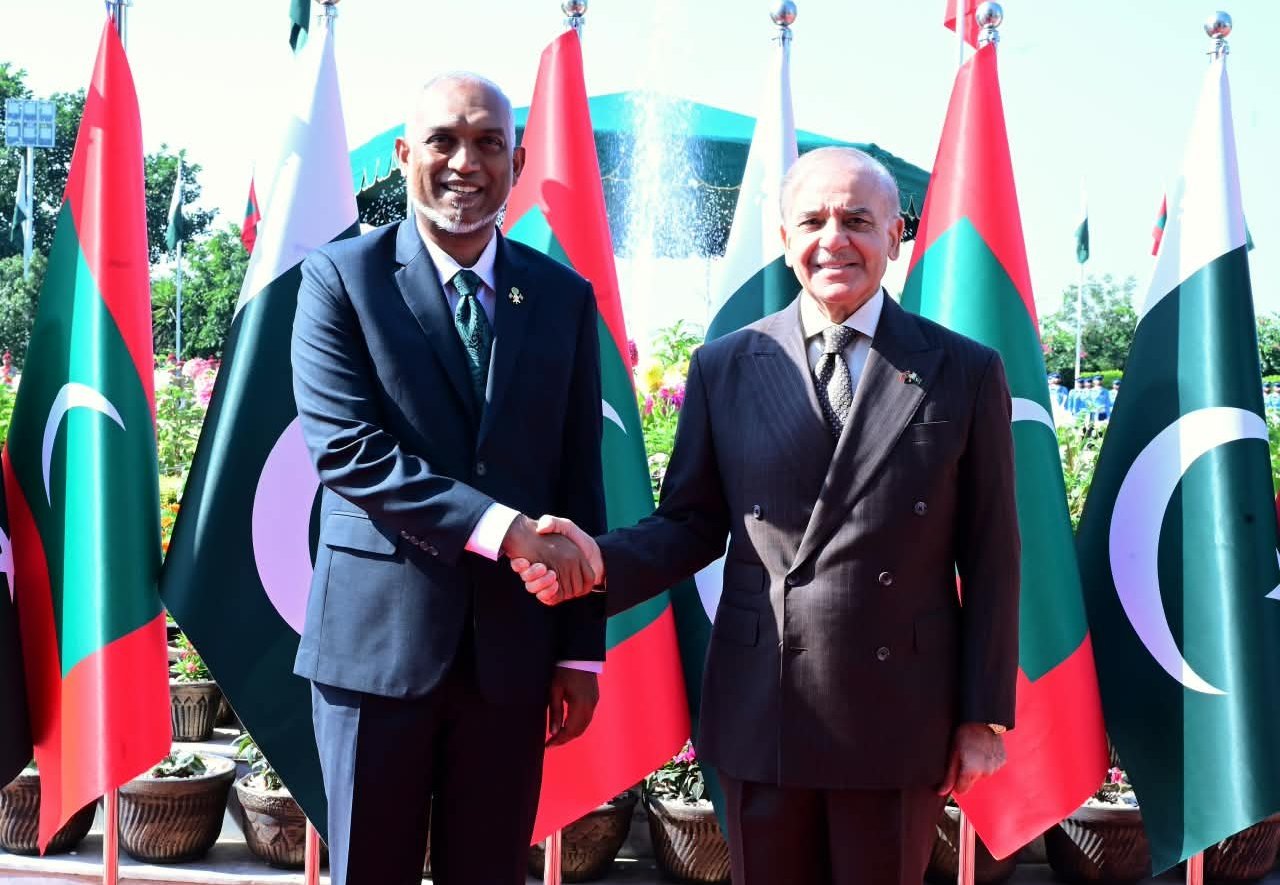
For decades, the standard assumption in New Delhi was that geography provided an inherent strategic buffer. The Indian subcontinent is bounded by towering mountain ranges to the north and vast oceanic expanses to the south, creating a natural fortress. Yet geopolitics is rarely static. Recent diplomatic realignments across South Asia and the Indian Ocean are testing the limits of this traditional security paradigm. When Mohamed Muizzu, the president of the Maldives, landed in Islamabad to sign a sweeping package of bilateral agreements, it was more than a routine diplomatic exchange. It was another data point in a broader regional trend that finds India facing a tightening diplomatic and strategic ring around its borders.
The immediate catalyst for New Delhi anxiety is the rapid deepening of ties between Islamabad and Male. The Maldivian leader visit yielded roughly twenty agreements spanning defense and commerce. For an archipelago nation straddling critical international shipping lanes in the Indian Ocean, these shifts carry outsized weight. The Maldives holds immense strategic importance for regional trade routes and maritime security. When a government that swept to power on an explicit anti India platform begins aligning more closely with Pakistan, strategists in New Delhi take notice.
This Maldivian pivot does not happen in a vacuum. It forms part of a wider recalibration across South Asia that has steadily gained momentum. Consider the transformation in Bangladesh following the fall of Sheikh Hasina. Under the Awami League, Dhaka maintained a firm distance from Islamabad, keeping historical animosities subdued. With the shifting of political tides and the rise of opposing domestic factions, relations with Pakistan have warmed visibly. Pakistani naval vessels have made port calls in Bangladesh for the first time in years, and diplomatic channels have expanded.
At the same time, the enduring axis between Beijing and Islamabad continues to cast a long shadow over the region. China remains the primary supplier of military hardware to Pakistan, accounting for the vast majority of its arms imports. Through infrastructure projects like the China Pakistan Economic Corridor, Beijing has cemented its footprint near India western frontier. When this deep bilateral alignment is coupled with growing Chinese influence in Nepal and now visible diplomatic drift in the Maldives and Bangladesh, the cumulative effect is unmistakable. India neighborhood diplomacy is confronting its most complex environment in years.
Compounding these regional pressures is a notable shift in Pakistan wider diplomatic standing. While Western capitals once viewed Islamabad primarily through the lens of regional security or economic instability, recent months have revealed a more active diplomatic footprint. Pakistan has leveraged its relationships across West Asia, participating in broader multilateral frameworks alongside regional heavyweights like Saudi Arabia and Turkey. By positioning itself as a diplomatic interlocutor in various regional dialogues, Islamabad has worked to rehabilitate its international stature while steadily expanding its diplomatic capital.
In Male, the political narrative often emphasizes a policy of multi-alignment and putting national interests first. Officials in the Maldives insist that expanding relations with Pakistan and other external partners does not mean hostility toward India. During the recent summit in Islamabad, while the host leadership raised contentious bilateral issues concerning Kashmir and regional water treaties, the Maldivian delegation maintained a measured public silence on those specific disputes. Instead, Muizzu focused his public remarks on reviving regional cooperative frameworks like the South Asian Association for Regional Cooperation, a body that has remained largely defunct for roughly a decade due to deep seated political friction between India and Pakistan.
Yet the subtle shifts in tone matter immensely in diplomacy. Even without explicit anti India proclamations from Male, the trajectory of defense cooperation and strategic coordination points toward a warming orbit around Islamabad. For New Delhi, the challenge lies in managing a neighborhood where traditional diplomatic levers are losing traction. As smaller neighbors seek alternative patrons to balance regional heavyweights, India must navigate a more crowded and competitive strategic landscape. The wall of geography remains, but in an era of shifting alliances, walls alone are no longer enough to guarantee security.