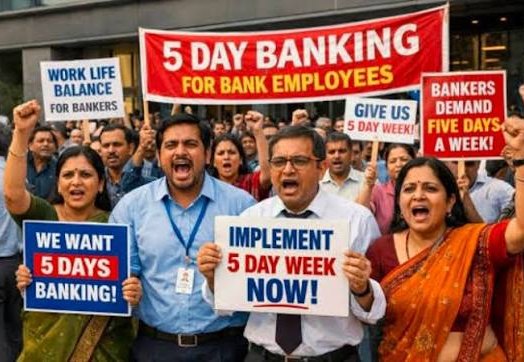
The persistence of traditional work schedules in an automated era reflects a structural disconnect between institutional practice and operational reality.
To the casual observer, the Indian banking hall remains a site of perpetual activity. Paper slips pass across wooden counters, queues form before tellers, and administrative ledgers accumulate in neat stacks behind manager desks. Yet this scene increasingly masks an underlying transformation in how financial capital actually moves through the economy. Over eight in ten retail banking actions in India now occur entirely through digital pipelines. Peer-to-peer transfers, merchant clearing, and routine balances move instantaneously across networks without human intervention. Even localized informal economies, long reliant on physical currency, now display digital quick-response codes on traditional transport carts to collect micro-payments via the Unified Payments Interface (UPI).
Despite this technological shift, the institutional cadence of Indian banking remains anchored in an earlier operational era. Bank employees demand a uniform five-day work week. Public commentary has largely framed this dispute in predictable terms, pitting worker convenience against consumer access. Social media platforms frequently criticize bank staff for seeking fewer operational days while already enjoying alternate Saturday closures alongside standard public holidays.
This conventional narrative misapprehends both the nature of modern financial operations and the mechanical details of the workers’ proposal. The demand for a five-day work structure is not a sudden reaction, nor does it represent a request to reduce total operational hours. The proposal originated during the tenth bipartite negotiations between the Indian Banks’ Association and the United Forum of Bank Unions in 2015. Although the industry association agreed in principle years ago, and the Department of Financial Services acknowledged active consideration of the shift, implementation has stalled within administrative processes.
Crucially, the proposed model does not diminish total working time across the week. To offset the closure of remaining operational Saturdays, daily work schedules would lengthen by 40 minutes across the five operational days. Total labor capacity delivered to the institution would remain identical. The adjustment represents a structural redistribution of working hours rather than a quantitative contraction in labor supply.
The rationale for this operational realignment rests on two principal developments: the rapid digitization of customer transactions and the systematic automation of credit underwriting.
The migration of routine consumer activity away from physical branches has altered branch footfall patterns. Daily account management, bill clearing, and small-balance transfers no longer require a physical presence. The Reserve Bank of India has actively encouraged this transition, directing that credit facilities below ten lakh rupees move toward automated, application-based processing.
Underwriting itself has split into two distinct operational modes. Schematic lending, which covers standard retail consumer credit, relies on algorithmic evaluation. Where a borrower’s income profile, tax returns, and existing debt-service ratios fall within predetermined risk parameters, approval occurs automatically without discretionary manager intervention. Discretionary human judgment is preserved primarily for customized corporate lending or non-standard credit structures that fall outside algorithmic templates. Furthermore, loan processing has centralized into dedicated regional units, removing credit administration from individual branch locations.
While technological integration has reduced physical branch visits, the administrative burden on existing bank personnel has expanded. Modern banking institutions have managed rising transaction volumes and expanding balance sheets without proportional increases in frontline staff. As a consequence, individual employees now manage significantly higher business volume per capita than in previous decades. This ongoing expansion in volume alongside static staffing levels creates chronic operational strain, even as external observers view the workplace through the lens of branch transaction numbers.
The institutional framework of Indian finance already contains numerous precedents for a five-day operating cycle. The Reserve Bank of India operates on a five-day weekly schedule, as do major state-backed insurers like the Life Insurance Corporation and General Insurance Corporation. Domestic money markets, foreign exchange clearing houses, and national stock exchanges operate entirely within a five-day structure. Broader public sector entities, including central government ministries and specialized research institutions, similarly function on five-day weeks without compromising regulatory governance or administrative output.
From a balance-sheet perspective, consolidating physical branch activity into five continuous days offers measurable operational savings. Continuous facility management across six days incurs overhead expenses in utilities, physical security, transport infrastructure, and building maintenance. Shifting to a five-day on-site schedule lowers institutional operating expenditures while yielding ancillary economic benefits, including reduced urban traffic congestion around key financial districts.
Should policy authorities conclude that continuous six-day or seven-day physical access remains vital for specific public segments, alternative staffing models exist. Industrial sectors requiring unbroken operations, such as power grids, emergency medical facilities, and mining enterprises, maintain continuous service availability through rotational shift scheduling. In these environments, individual workers maintain standard five-day schedules while the institution itself operates continuously. Public sector financial institutions could adopt a similar structure, providing continuous customer access while honoring standardized staff hours through rotational coverage.
The debate surrounding the banking schedule highlights a fundamental administrative choice. Indian financial institutions can adapt their workforce structures to align with digital processing capabilities, or they can maintain outdated scheduling frameworks out of institutional habit. The transition toward a five-day work week reflects an effort to reconcile organizational policy with modern operational reality.