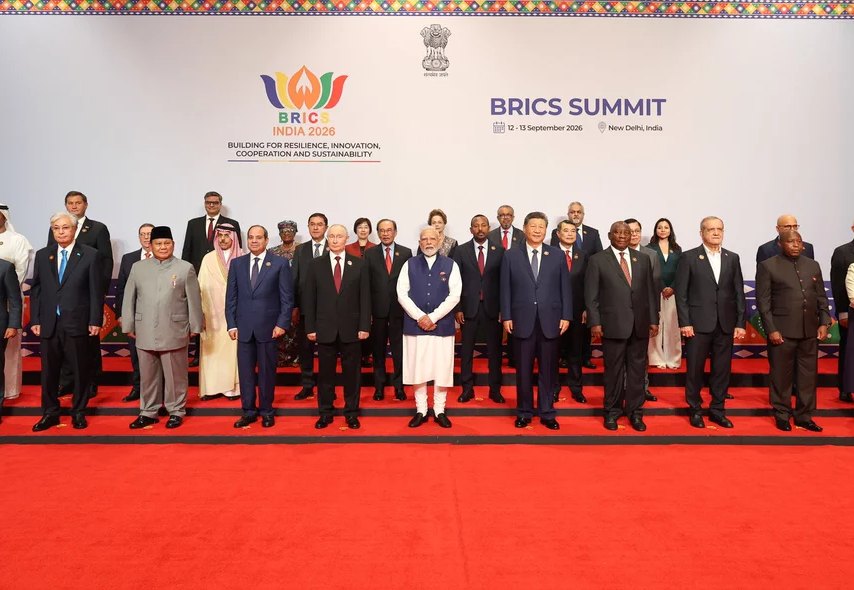
The New Delhi Declaration is the longest text BRICS has ever produced. Its verbs, more than its paragraphs, show how far the Global South's agency still sits from delivery.
Paragraph 16 of the New Delhi Declaration does something BRICS documents almost never do. It names its own ancestor. The leaders of eleven countries recall the 1955 Asian-African Conference at Bandung, list its principles of equality, independence, non-intervention and mutual benefit, and then state that the Bandung Spirit remains a reference point for building a fairer and more representative multilateral system.
They adopted that paragraph at Bharat Mandapam on 12 September 2026, closing a circle that took seventy-one years to draw. Twenty-nine Asian and African delegations gathered at Bandung as newly sovereign states with almost no material leverage. Their successors gathered in New Delhi commanding roughly 41 per cent of world output. The distance between the two rooms is not merely geographical. It measures the passage of the Global South from defensive solidarity to institutional agency. Read closely, the same document measures how much of that agency remains unbuilt.
The Material Case, Not a Nostalgic Revival
The re-emergence of the Global South answers to arithmetic rather than sentiment. The IMF's April 2026 World Economic Outlook puts BRICS at about 41 per cent of global GDP against the G7's 28 per cent. The grouping held 20.4 per cent when it began coordinating in 2006 and overtook the G7 in 2020. Its eleven members contain roughly 3.9 billion people, or 49.5 per cent of humanity, and conduct about 26 per cent of world trade. India's Commerce Ministry puts intra-BRICS merchandise trade at $1.17 trillion in 2024, against $84 billion in 2003.
Weight of that order has not bought matching influence, and the mismatch drives everything else. Those numbers explain why BRICS expands rather than dissolves, and why the declaration spends its opening third on institutional plumbing rather than ideology. The leaders demand that the quota increases agreed under the IMF's 16th General Review take effect without further delay, press for realignment under the 17th, and insist that the World Bank's 2025 shareholding review correct what they call the historic underrepresentation of developing countries. They also note that no woman has ever been chosen as UN Secretary-General, and that only two Africans and two Asians have held the post. That is the language of shareholders who believe they have been shortchanged, not of revolutionaries.
From Moral Appeal to Transactional Realism
The logic of alignment has been rewritten since Bandung. Where the early post-colonial generation prized principled distance from great-power blocs, today's Global South operates transactionally, and the shift shows up in three ways. Emerging powers reject binary alliances in favour of issue-based partnerships. They entrench themselves inside global markets rather than retreating from them, holding positions in critical mineral chains, technology hubs and maritime corridors. And they cultivate several diplomatic options at once instead of seeking insulation from great-power competition.
BRICS has also built something the Non-Aligned Movement never possessed, which is financial machinery of its own. The New Development Bank had approved 141 projects worth $44 billion by the end of June 2026, of which roughly $25 billion has been disbursed. The declaration encourages the bank to expand local-currency financing and to mobilise private capital through a multilateral guarantees initiative.
The honest reading, though, lies in the verbs. The text encourages the BRICS Payment Task Force to continue discussions on cross-border settlement, and concedes that no single approach suits every member. The proposed New Investment Platform receives a study group whose terms of reference still need refining. The grain exchange gets continued elaboration. The submarine cable network gets a feasibility study. A common currency appears nowhere at all. Forty-four billion dollars of approved lending is real money, and it is also a rounding error beside the institutions this bloc wants to rebalance.
India's Bridge Diplomacy
India's own arc tracks the larger story. Nehru's delegation spoke at Bandung with moral authority and very little leverage. Modi's India hosted this summit seven months after concluding a trade agreement with Washington that cut American tariffs on Indian goods from 50 per cent to 18 per cent and rescinded the punitive duty tied to Russian oil purchases. Delhi then welcomed Vladimir Putin and Xi Jinping to Bharat Mandapam, the same hall where it secured the African Union's accession to the G20 in 2023, a step the declaration explicitly salutes.
That sequence carries the whole argument for bridge diplomacy. Writing in the Indian Express, C. Raja Mohan observed that Delhi had resisted efforts to turn BRICS into a confrontational geopolitical bloc. The text bears him out. Unilateral tariffs occupy a single paragraph out of 140, and the declaration criticises them without once naming the United States. India wants a reformed order rather than a rival one, and it has calculated that it can court Washington and Beijing in the same season.
The China Problem
The bloc's central contradiction is also arithmetic. China accounts for 48.5 per cent of BRICS GDP. India contributes 20.7 per cent, Russia 8.2 per cent and Brazil 5.7 per cent. Almost half the coalition's economic weight sits in one capital, which makes the promise of a polycentric alternative harder to sustain than the communiqués suggest.
The declaration's language on Security Council reform gives the game away. China and Russia reiterate their support for the aspirations of Brazil and India to play a greater role in the UN, including its Security Council. They do not endorse permanent seats. They do not mention South Africa, which the 2023 Johannesburg declaration had named. After two decades of summitry, that carefully weighed formula marks the limit of what Beijing will concede, and Beijing takes the chair in 2027 and hosts the next summit.
Other fractures sit in the record. BRICS foreign ministers met in New Delhi in May 2026 and failed to agree a joint communiqué over the war involving Iran, leaving India to issue a chair's statement instead. Saudi Arabia, which Indian officials list among the eleven members, sent its foreign minister to the September summit as an invitee and has still never confirmed that it joined. This is not an ideological bloc. It is a coalition of convenience, bound less by shared belief than by shared exposure to the same systemic deficits.
Reform, Not Rupture
Nothing in the New Delhi Declaration sets out to dismantle the existing order. It asks for the WTO's dispute settlement mechanism to be restored and its appellate body staffed. It calls the G20 the premier forum for international economic cooperation and defends South Africa's standing as a founding member of it. A bloc bent on rupture would not spend its energy repairing the referee. Members whose universities, security partnerships and export markets run through North America and Europe show no appetite for tearing the building down.
The grievances they press are the ones Bandung raised and nobody settled. The Security Council still reflects 1945. Developing economies still borrow at a premium under rules written without them. On climate, the declaration states that developed countries shall provide adequate and predictable adaptation finance, opposes carbon border adjustment mechanisms as discriminatory, and concedes in the same breath that fossil fuels will keep playing an important part in emerging economies' energy mix. That contradiction is not hidden. It has been negotiated.
The Test Ahead
Bandung's limitation was that its delegates could proclaim principles they had no means to finance. New Delhi inverts the problem. The money exists now, the institutions are being sketched, and the language still hedges. Welcome, note, encourage, acknowledge: these are the operative verbs of a document protecting the cohesion of eleven governments that agree on grievance far more readily than on remedy.
The test arrives next year, when China takes the chair. Should the study groups harden into institutions, should the payment task force produce settlement rails that members actually use, and should the bank's lending scale towards the need, the Global South will have converted weight into governance. Should they not, the 140 paragraphs adopted at Bharat Mandapam will read in time exactly as Bandung's did. Eloquent, correct, and unenforced.
*(NOTE): The author is a research scholar at the University of Lucknow, specializing in Indian Foreign Policy and International Relations. (Email: sonisinghbhu14@gmail.com) ↑