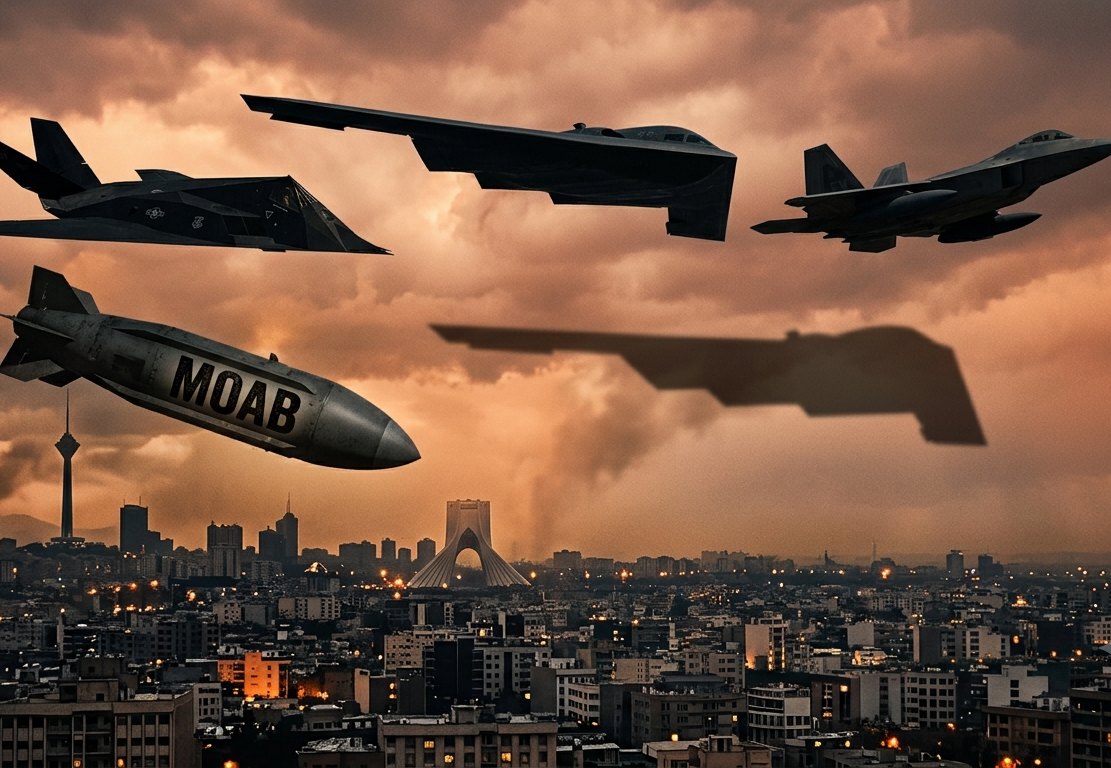
Washington is once again staring into the abyss of Middle Eastern escalation. Reports from intelligence and defense analysts indicate that American military planners have readied a strategic roadmap for potential strikes against Iran. The final decision rests entirely in the Oval Office. If the president gives the order, the United States could deploy the most powerful non-nuclear weapon in its inventory, a colossal device colloquially known to military strategists as the Mother of All Bombs.
This looming prospect raises urgent questions about the nature of modern warfare, the limits of conventional military supremacy, and the dangerous calculus of deterrence. Understanding what this weapon actually is, and what its deployment would mean, requires looking past the rhetorical thunder and examining the hard realities of modern ordnance.
Anatomy of a Conventional Titan
Formally designated as the GBU-43/B Massive Ordnance Air Blast, the weapon was developed in the early years of this century. It earned its infamous moniker from a linguistic evolution that began during the nineteen-ninety-one Gulf War, when analysts described the conflict as the mother of all battles. Defense engineers designed the weapon to shatter massive underground fortifications, tunnel complexes, and cave systems that conventional artillery could not penetrate.
The statistics associated with the weapon are staggering. Weighing nearly ten metric tons, the device carries roughly eight thousand five hundred kilograms of high explosives within a nine-meter casing. Despite its immense destructive capacity, it remains a conventional weapon rather than a nuclear one. It produces no radioactive fallout and carries none of the apocalyptic environmental contamination associated with atomic warheads.
Delivery is uniquely cumbersome. Because of its sheer size and weight, the weapon cannot be loaded onto standard fighter jets. It must be rolled out from the rear cargo ramp of large transport aircraft such as the C-130. It relies on a global positioning system guidance kit to guide it toward a target zone, detonating slightly above the surface rather than on direct impact.
The resulting blast generates a devastating overpressure wave capable of leveling installations, infrastructure, and geographical features across a wide radius. Yet its actual destructive footprint depends heavily on local topography, soil composition, and the presence of natural barriers.
The Strategic Dilemma
Washington’s deliberations center on two primary categories of targets within Iran: vital energy infrastructure and heavily fortified underground nuclear facilities. Hitting surface-level economic and industrial assets would inflict severe economic trauma on the Iranian state, crippling vital supply lines and energy grids. However, targeting deeply buried nuclear installations presents an entirely different engineering hurdle.
Iranian nuclear research and enrichment facilities are often buried deep beneath mountainous terrain and shielded by multiple layers of reinforced concrete. While the GBU-43/B is devastating against surface and shallow underground targets, penetrating the deepest subterranean redoubts often requires specialized earth-penetrating munitions like the GBU-57. Even then, military experts debate whether conventional ordnance can completely neutralize deeply buried and hardened facilities without risking catastrophic regional fallout if secondary materials are breached.
Furthermore, military history suggests that massive destruction does not automatically translate into strategic victory. Decades of Western military interventions in the region demonstrate that inflicting severe physical damage on an adversary does not guarantee political capitulation or long-term stability.
The Asymmetric Threat
Tehran has made it abundantly clear that any such escalation will not go unanswered. Iranian leadership has issued stern warnings, noting that a renewed military campaign would invite severe retaliation. Rather than fighting conventionally against superior American air power, Iran would likely lean heavily on asymmetric warfare.
This approach involves activating regional proxy networks and targeting vital American allies and infrastructure across the wider region. Energy installations, maritime trade routes, and diplomatic outposts in neighboring countries could find themselves in the crosshairs. The danger extends beyond Iranian borders, threatening global economic stability and regional security architectures.
More importantly, the deployment of such a weapon carries profound political risks for the White House. With domestic political pressures mounting and foreign policy strategies facing intense scrutiny, trump administration might view a dramatic, high-profile military strike as a decisive break in a protracted stalemate. Yet entering a conflict without a clear, sustainable exit strategy risks trapping the world's premier military superpower in an intractable regional quagmire.
The Limits of Coercion
Ultimately, the threat of using the largest conventional bomb in the global arsenal serves dual purposes. It functions as a coercive signal designed to force Tehran back to the negotiating table, and it offers domestic audiences a dramatic demonstration of military might.
Whether this brinkmanship will achieve its desired diplomatic outcome remains profoundly uncertain. The threshold for major escalation has rarely been higher, and the margin for error is razor thin. As policymakers weigh the immense risks of striking underground facilities against the hazards of inaction, the shadow over Tehran grows longer, reminding the global community that the most formidable weapons often yield the most unpredictable consequences.