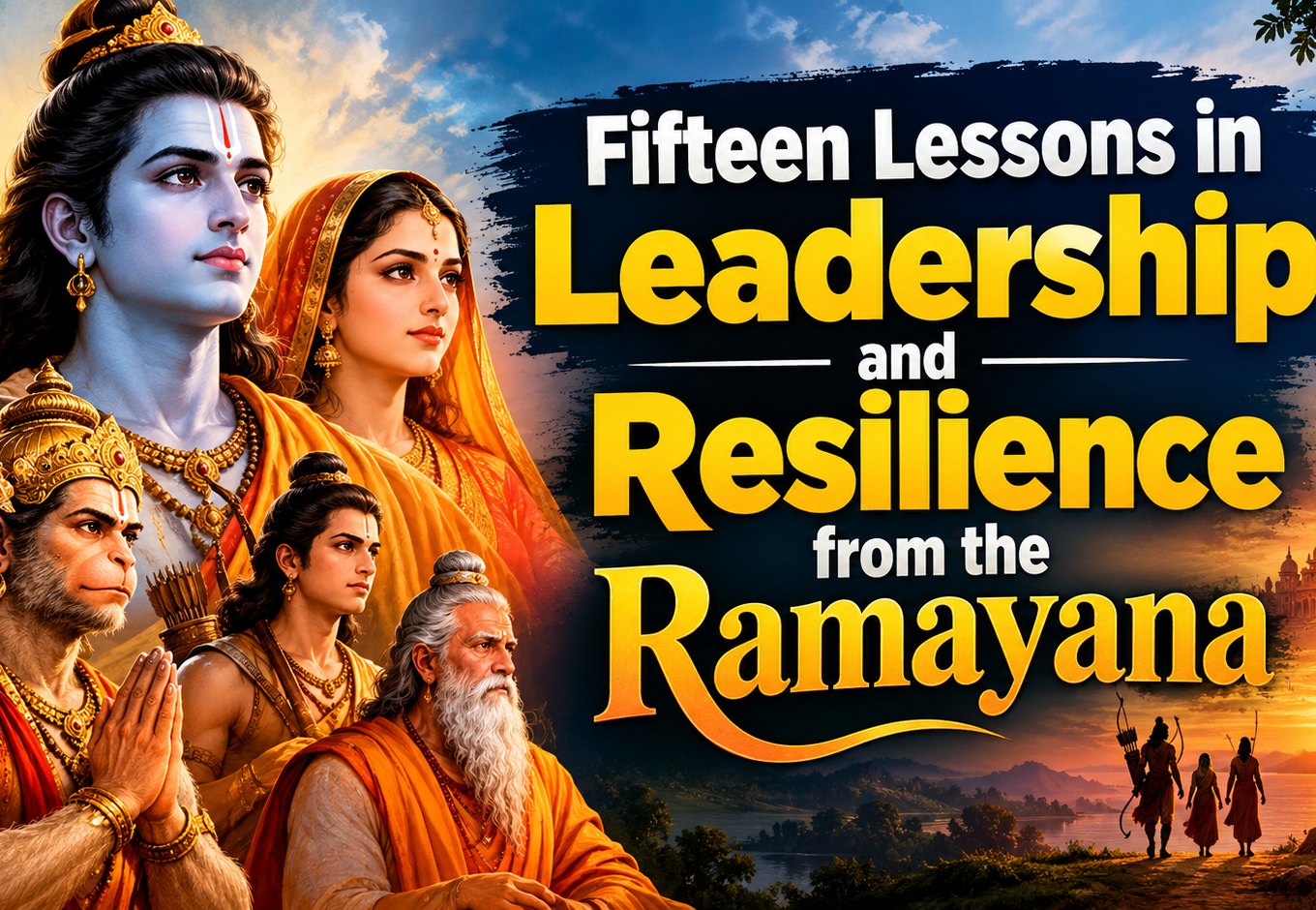
In an era dominated by superficial discourse and rapid technological change, societies often look to modern psychology or management literature for guidance on character and resilience. Yet, enduring wisdom frequently resides in ancient narratives. A compelling analysis of the Ramayana reveals that its foundational figures offer profound frameworks for human development, governance, and emotional regulation. Far from being mere mythological relics, these stories provide structured insights into the architecture of decision-making, interpersonal dynamics, and the psychological fortitude required to navigate systemic crises.
The foundational narrative begins with Valmiki, the author of the epic, whose own life serves as a primary lesson in personal transformation. Shifting from an existence outside conventional societal norms to creating a timeless epic, Valmiki demonstrates that individual capability is not fixed by initial circumstances. Sustained effort and a commitment to moral elevation can fundamentally alter a person's trajectory, establishing a precedent for continuous self-reinvention that persists as long as human civilization endures.
This theme of transformation extends to the epic's central protagonist, Sri Rama, whose life is a succession of severe systemic shocks, unprecedented obstacles, and structural dislocations. Rather than succumbing to despair, Rama confronts these challenges with disciplined equanimity. The text explicitly warns against the corrosive nature of grief, noting that sorrow paralyzes intellect, discernment, and courage, rendering it a person's most formidable internal adversary. In contemporary contexts, where minor academic or professional setbacks often trigger profound mental health crises, the Ramayana offers an alternative paradigm: true resilience lies not in the absence of adversity, but in the refusal to let grief compromise cognitive clarity.
A parallel danger is examined through the character of Kaikeyi, whose narrative illustrates the destructive mechanics of unbridled self-interest. While a degree of personal ambition is inherent to human nature, the epic demonstrates that limitless, unchecked selfishness inevitably generates systemic disaster, upending royal dynasties and fracturing communities. The underlying principle is clear: unmitigated individual greed carries catastrophic externalities that ultimately consume the perpetrator along with the collective.
Beyond individual psychology, the epic provides a rigorous examination of human relationships. In an increasingly transactional world where connections between family members, spouses, and colleagues are frequently commodified and treated as disposable consumer goods, the Ramayana posits that authentic relationships are enduring, enriching, and foundational to societal stability. Bonds of affection, filial duty, and loyalty are depicted not as negotiable utilities, but as permanent commitments that require active cultivation and protection.
Prudence and the avoidance of hasty reactions constitute another critical pillar of the epic's management philosophy. A striking illustration occurs when Bharata approaches Rama's forest encampment accompanied by a vast entourage. Lakshmana, misinterpreting the approach as a hostile military maneuver, prepares a retaliatory strike before pausing to assess the situation. Rama intervenes, counseling a single moment of deliberate reflection. That brief pause averts an irreversible catastrophe between brothers, highlighting the vital importance of exercising restraint and critical thought before reacting to ambiguous stimuli.
The exploits of Hanuman offer an extensive masterclass in diplomacy, strategic flexibility, and crisis management. When tasked with crossing the ocean to locate Sita, Hanuman encounters a series of distinct obstacles, each requiring a different tactical response. First, the mountain Mainaka offers hospitality, which Hanuman respectfully defers to prioritize his primary mission. Next, the serpent Surasa attempts to block his path; rather than engaging in brute force, Hanuman adopts a flexible, scaled approach to bypass the threat safely. Finally, the demoness Simhika, who captures targets by seizing their shadows, is neutralized directly through decisive action. This progression illustrates a sophisticated doctrine of conflict resolution: one must adapt strategy to the nature of the adversary, utilizing diplomacy, calculated concession, or direct force as circumstances dictate, while never losing sight of the ultimate objective.
Hanuman’s interactions also underscore rigorous standards of verification. Upon reaching Lanka, Hanuman identifies himself to Sita as an emissary, but she refuses to accept verbal assurances without verifiable evidence. In an age saturated with unverified digital information and widespread misinformation, this skepticism serves as an ancient warning against credulity. Sita demands proof before granting trust, establishing a precedent for intellectual rigor.
Furthermore, Sita's subsequent refusal to be carried back to safety on Hanuman's shoulders introduces a profound ethical principle regarding the relationship between ends and means. While Hanuman offers a swift shortcut to end her captivity, Sita insists that her liberation must be achieved properly by her husband, emphasizing that a righteous objective cannot justify compromised methods. The means employed to achieve a goal must possess the same moral integrity as the goal itself.
To prevent such vulnerabilities in the first place, the epic establishes the concept of structural boundaries, symbolized by the metaphorical Lakshmana rekha. Just as physical and operational limits are necessary in financial investment, governance, and personal conduct, exceeding established boundaries invariably leads to systemic failure. The golden deer episode further reinforces this warning, demonstrating how momentary infatuation can induce a lapse in discernment even among the wise, resulting in severe strategic consequences.
Intriguingly, the narrative also advocates for pragmatic learning from adversaries. Ravana, despite his moral failings and the catastrophic error of abducting Sita, is recognized as a master scholar and a profound political strategist. Rama directs Lakshmana to seek instruction from Ravana regarding statecraft, illustrating that intellectual capital and administrative wisdom should be acquired from any available source, even an opponent, without endorsing their character flaws.
The integrity of one's word forms the bedrock of the narrative's political and social structure. King Dasaratha's adherence to the promises made to Kaikeyi initiates the entire sequence of events, demonstrating that commitments must be honored regardless of the personal cost. Yet, this absolute commitment to duty is balanced by restraint in victory. Upon defeating Vali and Ravana, Rama does not annex their territories for imperial expansion; instead, he reinstates legitimate heirs such as Sugriva and Vibhishana, rejecting territorial aggrandizement in favor of lawful governance.
Character, however, remains paramount. The epic cautions that exceptional competence, valor, and talent can be entirely neutralized by a single fatal flaw in moral character, as exemplified by Ravana’s downfall. No amount of scholarly brilliance or administrative capability can insulate an individual from the destructive consequences of ethical collapse.
In the contemporary information ecosystem, the epic’s treatment of rumors is particularly prescient. Unsubstantiated gossip and anonymous claims are shown to inflict immense collateral damage, driving institutional and personal separations that alter the course of history. The narrative cautions against the uncritical consumption of unverified narratives, urging intellectual discipline in the face of widespread disinformation.
Finally, the arc of Hanuman's journey emphasizes the necessity of self-discovery. Possessing immense, unparalleled strength, Hanuman must nevertheless be reminded of his own capabilities before he can execute his mission. The ultimate lesson of the Ramayana is that individuals frequently harbor unrealized potential; until one undertakes the rigorous internal work of identifying, discovering, and activating those dormant strengths, capacity remains theoretical. Through these fifteen interconnected principles, the Ramayana endures not merely as a sacred text, but as a sophisticated manual for human agency and moral clarity in a complex world.