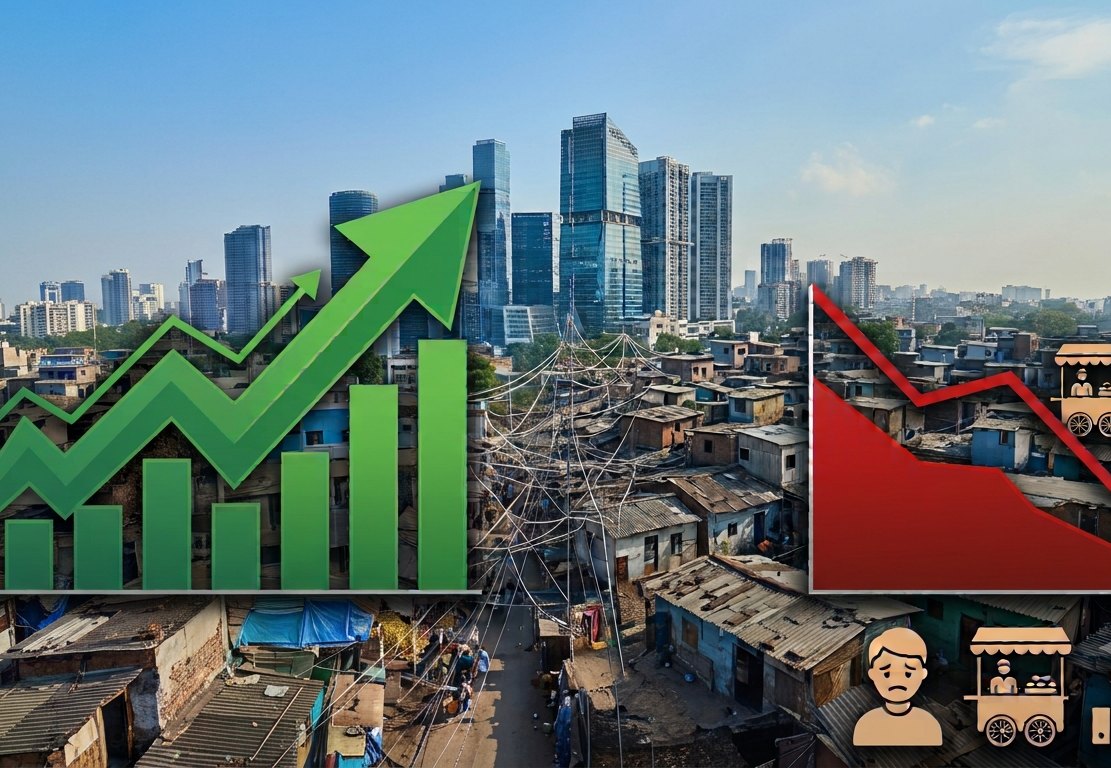
For months, official bulletins have echoed a singular refrain of triumph. India has posted a gross domestic product growth rate of 7.8 percent for the opening quarter of the fiscal year, comfortably placing itself among the frontrunners of major economies. In elite policy circles, this figure is hailed as proof of structural resilience, a vindication of market reforms, and a stepping stone toward the national ambition of attaining developed economy status by 2047. Yet, step away from the polished glass facades of financial districts and talk to a security guard or a roadside vendor, and a starkly different narrative emerges. The numbers speak of expansion, but the streets speak of strain.
Evaluating this economic moment requires looking past the aggregate headline and examining four distinct perspectives: global standing, historical trajectory, future aspirations, and everyday reality. Each angle yields a different truth, exposing a profound disconnect between the nation on paper and the nation on the ground.
The Global and Historical Mirage
When viewed through a global lens, the domestic growth rate appears remarkable. Major international financial institutions project figures that leave traditional powerhouses behind. While advanced economies crawl and China stabilizes around a moderate pace, India registers expansion that commands international attention. Proponents argue that comparing a four trillion dollar economy directly with a thirty trillion dollar giant like the United States is statistically flawed, much like comparing a student who improves from ten marks to twenty with one who moves from ninety to ninety-five. Even so, relative to the contemporary international landscape, the velocity of the economy is undeniable.
The historical view offers a similar sense of accomplishment. For decades following independence, the country trudged through the modest three to four percent growth corridor famously termed the Hindu rate of growth. The systemic reforms initiated in the 1980s and formalized in 1991 altered this trajectory, lifting the baseline. In the thirty-five years since liberalization, however, crossing the eight percent threshold has remained a rare milestone, achieved only a handful of times, with post-pandemic rebounds functioning largely as statistical illusions born from a previous economic standstill.
Aspirational targets demand an acceleration that stretches historical precedent. Government think tanks, official economic surveys, and multilateral lenders converge on a singular requirement: maintaining an eight percent growth rate for the next two or three decades if the country is to bridge the income divide and achieve advanced status. History suggests this will be exceptionally difficult, but policymakers insist that past performance need not dictate future capability.
The Disaggregated Reality
The friction begins when the analysis shifts from aggregates to disaggregates. Macroeconomic indicators are notoriously indifferent to distribution. In a landscape characterized by deep wealth polarization, average income metrics obscure more than they reveal. When the daily earnings of a prominent industrialist scale into thousands of crores while millions subsist on meager daily wages, the national average ceases to be a meaningful descriptor of human welfare.
Per capita income offers a slightly finer lens, yet it still speaks for an abstract average citizen rather than every citizen. While total output places the country among the top global economies, per capita income rankings languish much further down the international table. This dichotomy defines the core paradox of contemporary growth. The economy is expanding rapidly, but the fruits of that expansion remain concentrated at the top.
Inflation compounds this unequal distribution. Official retail inflation metrics often smooth over the harsher realities by averaging disparate commodities. For the median household, the cost of living tells a harsher story. Essential food items, educational fees, medical expenses, and rental housing in urban centers have climbed at rates that far outstrip nominal wage growth. When the price of basic food grains and vegetables surges, poorer households, who allocate a vast majority of their daily earnings to mere sustenance, bear the brunt of the shock. Real wages across key corporate sectors have stagnated or declined over nearly a decade, leaving ordinary families with dwindling purchasing power.
The Debt Trap and Structural Imbalances
This squeeze between rising costs and stagnant incomes has triggered a quiet crisis in household balance sheets. According to recent financial stability reports, household debt has climbed to unprecedented levels relative to the overall economy. More troubling than the mere volume of debt is its composition and direction. Unlike advanced nations where borrowing typically funds productive long-term assets like housing, nearly half of domestic household borrowing is now unsecured debt secured merely to fund daily consumption.
People are borrowing not to build wealth, but to bridge the gap between their income and their expenses. When liabilities outpace assets and debt servicing begins to consume fresh borrowings, households slip into a structural trap.
This domestic fragility exposes a deeper vulnerability. Unlike East Asian economies powered by robust export manufacturing, domestic private consumption drives the vast majority of local economic activity. When the purchasing power of the median citizen weakens, the foundation of the entire macroeconomic structure wobbles. Sales of high-end luxury goods and premium real estate may remain robust, sustained by the affluent minority, but budget vehicle sales, affordable housing inventories, and mass-market retail indicators reveal a sluggish underbelly.
Compounding these domestic strains, external pressures continue to mount. Foreign portfolio investments have seen substantial outflows as international markets adjust yields, and currency fluctuations cast long shadows over import-dependent energy costs. Meanwhile, the job market offers little solace. Educated youth face severe underemployment, and while official discourse encourages informal self-employment or manual trades, such avenues fail to absorb the millions of graduates entering the workforce with higher expectations.
Conclusion
The current economic debate is often framed as a binary choice between relentless optimism and unyielding pessimism. Obsessing entirely over aggregate achievements blinds policymakers to the structural decay beneath the surface, while dwelling solely on distress risks paralyzing reform.
The reality is neither a miracle nor a collapse. It is a profound imbalance. Until the architecture of growth is redesigned to generate quality employment, tame structural inflation, and distribute prosperity beyond a privileged tier, the headline figures will remain an abstraction. A nation cannot borrow its way to prosperity while the everyday life of its citizenry grows increasingly precarious. The true measure of an economy is not found in the height to which its top tier climbs, but in the stability of the foundation upon which everyone else stands.