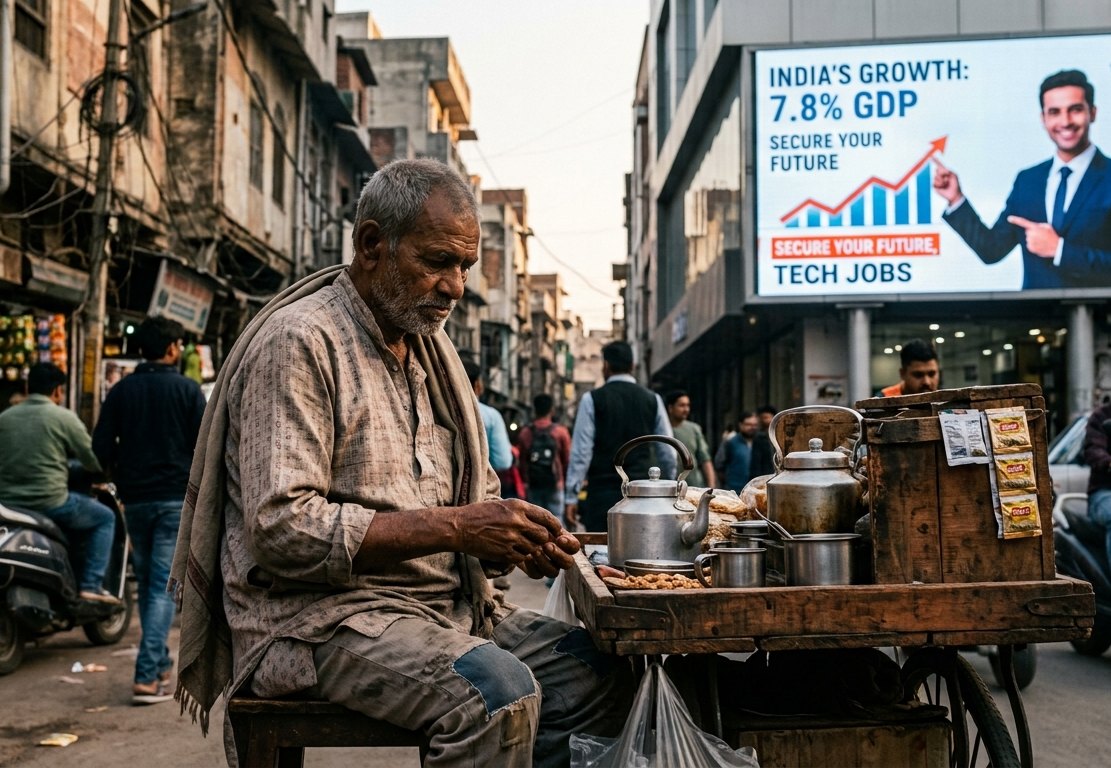
The International Monetary Fund recently projected that the Indian economy will expand by seven per cent this financial year. By global standards, such a headline figure commands attention. Across major industrial economies, growth is sluggish at best. China projects a more modest trajectory, while the United States, the United Kingdom, Germany, and Japan record significantly lower figures. Measured purely by macroeconomic statistics, India appears to occupy an enviable position near the front of the global pack, steadily marching toward becoming one of the world's largest economies.
Yet this impressive statistical expansion coexists with a profound sense of economic anxiety among ordinary citizens. Ask an auto-rickshaw driver waiting hours for a fare, a young engineering graduate cycling through fruitless job interviews, or a small vendor selling vegetables on a crowded street if they feel the benefits of a booming economy, and the response is rarely celebratory. A stark disconnect persists between national accounts and household realities.
The roots of this paradox lie in several structural fault lines that standard macroeconomic metrics routinely obscure.
First, economic growth is distributed unevenly. Gross domestic product aggregates diverse expenditures, including government defense outlays and public sector salaries, into a single national tally. While corporate balance sheets in certain sectors thrive, a vast segment of the population remains precariously positioned. Reports highlight that hundreds of millions of individuals subsist on meager daily earnings. For a household struggling to meet daily subsistence, a robust national growth rate offers little tangible relief.
Second, inflation exacts a heavy toll on the working population. While macroeconomic policymakers monitor aggregate price stability, everyday essentials register steep increases. Food inflation frequently outpaces headline figures, imposing severe pressure on lower-income families who allocate the majority of their monthly expenditure toward basic nutrition. Prices for essential staples, dairy, and provisions have risen significantly, eroding purchasing power faster than official indices suggest.
Third, secure livelihoods remain elusive for the majority of the workforce. Periodic labor surveys indicate that only a fraction of workers enjoy regular salaried employment. A large portion of the population relies on self-employment or daily wage labor, leaving them without assured monthly incomes. Concurrently, real wages in key sectors have stagnated or declined over extended periods, dampening consumer spending. Indicators such as fast-moving consumer goods consumption reflect subdued demand, pointing to constrained household budgets.
Fourth, household indebtedness is on the rise. As income growth fails to keep pace with the cost of living, families increasingly resort to borrowing not for discretionary luxuries, but to cover fundamental expenses such as healthcare, education, and transportation. Household liabilities have expanded faster than household assets, signaling growing financial vulnerability.
Finally, traditional avenues for household savings and wealth generation offer diminished returns. While retail participation in capital markets has surged, recent market corrections and modest returns across asset classes have disappointed everyday investors. Many mutual fund investments and speculative trading ventures have yielded returns below traditional bank deposits, leaving savers with fewer reliable options to protect their capital against inflation.
Ultimately, the debate over economic performance highlights the limits of headline numbers. Until expansion translates into secure employment, stable wages, and manageable living costs for the broader populace, the narrative of robust growth will remain detached from the daily experience of the common citizen.