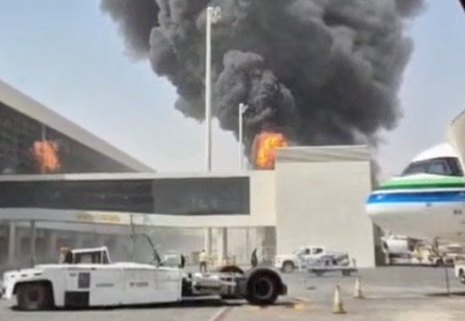
The geopolitical landscape of the Middle East is once again being violently redrawn. For years, the reigning security architecture of the Gulf rested on a foundational assumption that advanced Western missile defense systems would render core infrastructure impermeable to asymmetric threats. That illusion was violently punctured when ballistic missiles and drones launched by Yemen’s Houthi movement struck critical targets, including the international airport in Riyadh. The resultant casualties and panic have not only shaken the Kingdom of Saudi Arabia to its core, but they have also triggered an agonizing reappraisal of traditional alliances, prompting sharp questions regarding American reliability and strategic complicity.
To understand the gravity of the current escalation, one must look beyond the immediate shock of the tarmac explosions. The renewed hostilities mark a dramatic collapse of the fragile ceasefire that had held since 2022. The spark was struck earlier when Saudi jets targeted the runway at Sanaa’s airport to block an incoming Iranian-chartered flight. What followed was a tit-for-tat spiral that quickly escalated from a regional proxy standoff into a full-scale conflagration. The Houthis, emboldened by their strategic positioning along the Red Sea and vital maritime chokepoints like the Bab al-Mandab strait, initiated a comprehensive blockade and launched long-range projectiles deep into Saudi territory.
Yet, the most distressing element for Riyadh is not merely that the strikes occurred, but how easily they bypassed sophisticated interception grids. Saudi Arabia invests heavily in state-of-the-art defense technology, yet the recent barrage exposed glaring vulnerabilities in air defense coordination and early warning detection. Reports indicate that emergency services were stretched to their absolute limits as multiple explosions rocked the capital, forcing Western embassies to issue urgent travel warnings and compelling international carriers to rethink their routes. As military planners in Riyadh scramble to conduct internal probes into these defense failures, a deeper political anxiety has taken root among the kingdom's leadership.
This anxiety finds expression in a growing narrative of strategic betrayal. For decades, the security bargain between Washington and the Gulf monarchies was clear: absolute alignment and economic cooperation in exchange for ironclad security guarantees. However, as the regional order shifts and Western priorities recalibrate, Gulf capitals increasingly feel exposed. Critics point to perceived ambiguities in foreign policy, delayed intelligence sharing, and fluctuating diplomatic stances from Washington as evidence that traditional security partners are no longer reliable anchors in moments of existential peril. When a sovereign state’s primary international airport can be successfully targeted despite decades of military cooperation, the psychological shock reverberates far beyond the physical damage.
The economic implications are equally stark. Energy markets, highly sensitive to instability in the Arabian Peninsula, reacted nervously to the renewed hostilities. The threat to vital oil export routes and domestic refineries reminds traders that the global economy remains tethered to the whims of Middle Eastern security. This is setting the stage for an intensified military campaign by the Saudi-led coalition on multiple fronts inside Yemen.
Ultimately, the Houthi strikes on Riyadh represent a watershed moment for the region. They expose the limits of high-tech deterrence in asymmetric warfare and shatter the complacency that had settled over Gulf capitals during periods of diplomatic thaw. As the death toll rises and investigations into defense failures continue, Saudi Arabia finds itself standing at a dangerous crossroads. The imperative to re-evaluate its military readiness is matched only by the urgent need to reassess foreign partnerships in an era where historic guarantees look increasingly hollow.