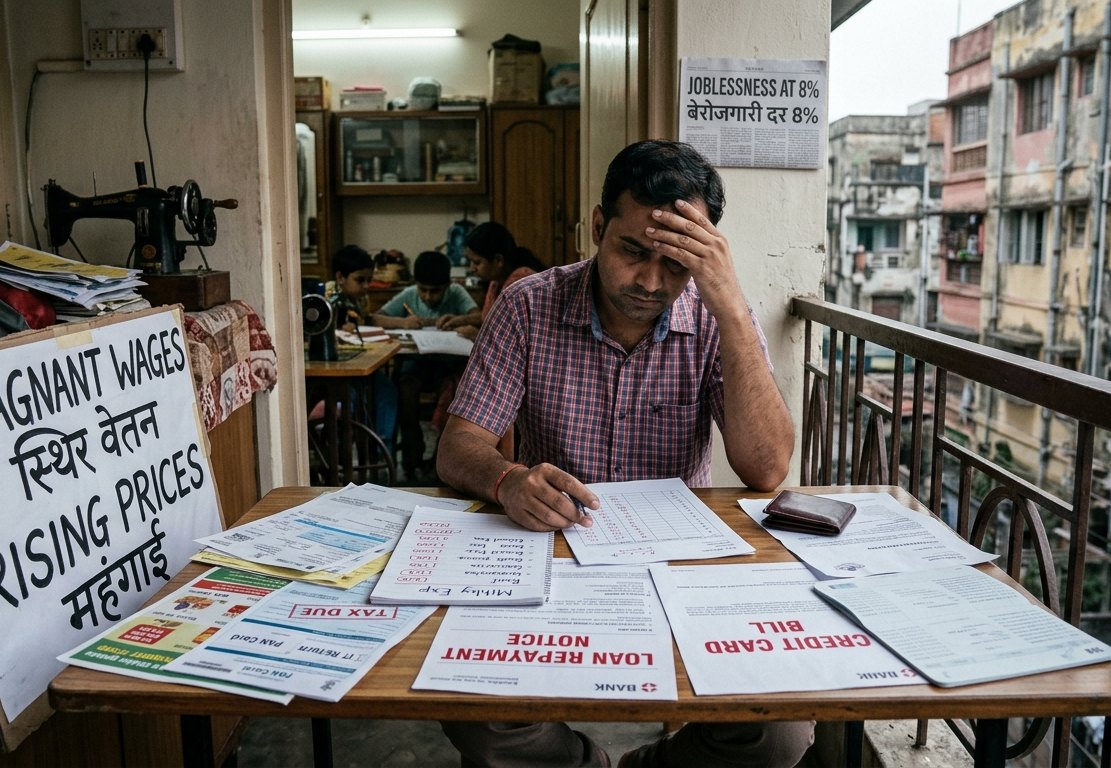
Headline figures can be delightfully deceiving. A macroeconomic overview of India presents a picture of robust strength, characterized by steady GDP growth rates that outpace most major economies, expanding equity markets, and glowing endorsements from international financial institutions. Yet beneath this impressive surface lies an uncomfortable structural paradox. The engine that traditionally powers sustainable domestic consumption, the urban middle class, is experiencing a prolonged squeeze that threatens the foundation of India’s economic momentum.
The disconnect between aggregate output and household financial health has become too pronounced to ignore. While corporate balance sheets and high-net-worth portfolios have surged in the post-pandemic era, broad-based consumer spending across India’s vast middle-income households has stagnated. This divergence is not merely a transient post-pandemic distortion; it represents a deeper realignment in how national income is generated, distributed, and absorbed.
The Mirage of Top-Line Growth
To understand the middle-class predicament, one must look closely at the composition of headline growth. GDP calculations capture aggregate domestic production, but they say relatively little about who receives the proceeds. In recent years, capital owners and financial asset holders have reaped disproportionate gains from high interest yields, equity market rallies, and corporate profit margin expansions. Conversely, wage growth across key employment sectors, including middle-management corporate roles, informal services, and manufacturing, has barely kept pace with real inflation.
This phenomenon creates a dual-track economic landscape. At the top end, premium consumption remains remarkably resilient. Sales of luxury vehicles, high-end real estate, and premium consumer electronics have set record highs. Yet mass-market consumption tells a completely different story. Major fast-moving consumer goods companies consistently report sluggish volume growth in middle-market segments. Sales of basic consumer durables, entry-level cars, and standard household appliances have experienced flat or declining trajectories when adjusted for inflation.
The inflation figures themselves often obscure the true magnitude of the pressure. Headline Consumer Price Index metrics heavily weight baseline items, yet the true cost of maintaining a middle-class standard of living has risen significantly faster than official inflation rates suggest. Expenditure on essential services such as private healthcare, education, fuel, and housing has outpaced broader index movements. Because public provision of quality healthcare and education remains severely constrained, middle-income families are forced to allocate an increasing share of their disposable income to private providers.
The Tax Asymmetry and Credit Trap
The fiscal architecture compounds these pressures. India’s tax structure relies heavily on direct income taxes from a relatively small pool of salaried professionals, alongside indirect taxes such as the Goods and Services Tax that fall disproportionately on general consumption. While corporate tax rates were lowered in recent years to spur investment, salaried taxpayers have seen little relief in real terms. With tax brackets failing to adjust adequately for lifestyle inflation, a larger share of middle-income earnings is drawn into higher tax slabs, diminishing net disposable income.
Concurrently, household savings have dropped to historically low levels. Historically, Indian households maintained robust financial reserves, primarily in bank deposits and safe assets, providing a resilient buffer against economic shocks. Over recent years, however, net financial savings among households have slipped dramatically.
To bridge the gap between stagnant real incomes and rising living expenses, many households have turned to retail credit. The rapid growth of personal loans, credit card debt, and buy-now-pay-later schemes has allowed consumer spending to appear stable on paper. Yet substituting credit for real income growth is inherently unsustainable. As debt service obligations consume a growing portion of monthly income, future discretionary spending is curtailed, leaving households vulnerable to sudden health or employment shocks.
The Corporate and Labor Disconnect
The underlying structural challenge lies within the labor market itself. India’s growth model in recent years has shifted toward capital-intensive sectors, technology services, and high-value manufacturing. While these industries generate substantial economic output, they create relatively few direct jobs relative to the population entering the workforce each year.
Furthermore, formal corporate employment has undergone significant restructuring. Cost-cutting measures, automation, and a rising reliance on contract or gig workers have suppressed real wage gains across traditional administrative and technical positions. As a result, the ladder of upward economic mobility, which previously enabled families to transition from lower-income brackets into stable middle-class security, has grown increasingly steep and narrow.
This labor dynamics shift creates a feedback loop that ultimately affects the broader economy. A broad-based domestic economy requires a vibrant consumer class with stable purchasing power to absorb goods and services. When growth is driven predominantly by capital investments and elite consumption, the domestic market for mid-tier goods contracts. Over time, private corporate investment outside of infrastructure and capital-intensive sectors slows down, as firms see limited incentive to expand capacity when mass consumer demand remains weak.
Rebalancing the Growth Formula
Addressing this imbalance requires a recognition that high aggregate GDP numbers alone do not guarantee economic stability. A resilient long-term economic path depends on restoring purchasing power and financial security to middle-income households.
Fiscal and economic policy must pivot toward strategies that enhance real household income. This requires structural reforms designed to broaden the direct tax base, relieve the fiscal burden on salaried employees, and reduce indirect taxes on essential goods. Simultaneously, targeted investments in public health and education services are critical to lower the non-discretionary costs borne by families.
In addition, fostering job-rich growth in labor-intensive industries remains essential. Encouraging small and medium-sized enterprises, which serve as the primary employers for the urban and semi-urban workforce, can help bridge the gap between national output and broad-based wage growth.
Until policy interventions directly target the structural pressures facing middle-income families, the core consumer base will continue to struggle under the weight of rising costs, stagnant wages, and expanding debt. For an economy striving for sustained high growth, ensuring that its primary economic driver remains financially robust is not just a social imperative, but an economic necessity.
(This Article Is Based On The Author’s Lecture To The Leadership Of School Teachers Federation of India [STFI])