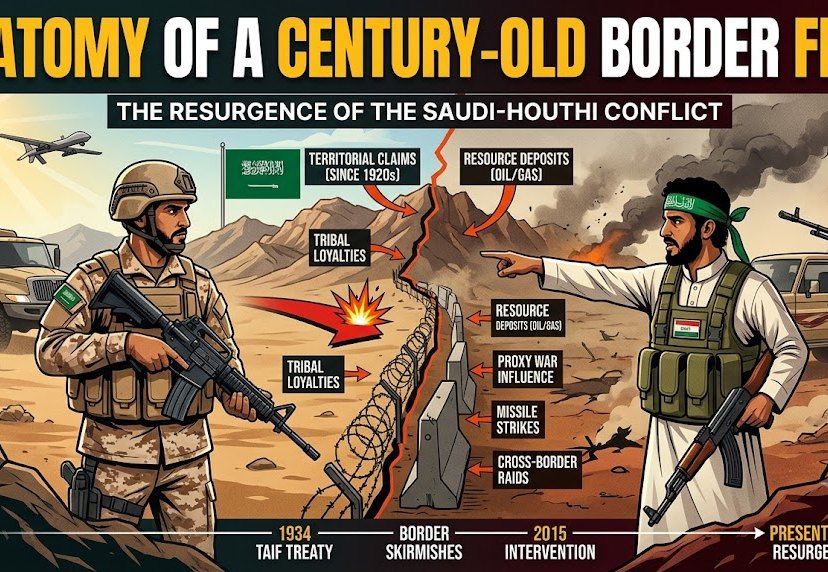
The friction between Riyadh and the Houthi movement in Yemen is reaching a dangerous new phase, threatening to destabilize the wider region once again. While contemporary headlines often focus on tactical skirmishes in the Red Sea and stalled diplomatic initiatives, the roots of this confrontation run deep. The animosity driving the current escalation is not a sudden rupture of modern geopolitics, but rather a century-old historical legacy that continues to haunt the Arabian Peninsula.
To understand why Saudi Arabia and the Houthis find themselves at loggerheads, one must look back to 1934. During this era, King Ibn Saud consolidated his expanding realm by defeating tribal fighters loyal to Imam Yahya of Yemen. The resulting Treaty of Taif formalised a territorial compromise, requiring Yemen to cede three provinces in the Asir region to the newly formed Saudi state. This transaction planted the seeds of a durable border dispute. Although a formal border agreement was signed in 2000 to delineate the frontier, generations of Yemeni nationalists have refused to accept the settlement, viewing the demarcation as a historical injustice imposed from a position of strength.
This territorial grievance mirrors other intractable regional fractures born from the pen of colonial and imperial mapmakers. Much like the Durand Line separating Pakistan and Afghanistan, where ethnic Pashtun communities straddle a contested border and fuel persistent friction between Islamabad and Kabul, the Saudi-Yemeni frontier cuts across deep historical realities. For decades prior to 1990, the border was porous, allowing millions of Yemenis to move freely into Saudi Arabia. Large numbers settled in the southern Saudi provinces of Asir and Jizan. While these populations became integrated into the local economy, many retained distinct Yemeni ancestral identities, creating an ethnic overlap that periodically complicates bilateral relations.
Beyond geography, the conflict is compounded by sectarian divisions. Saudi Arabia operates as a conservative Sunni monarchy anchored in Wahhabi traditions, whereas the Houthis belong to a distinct branch of Shia Islam. Within Yemen, the Houthis represent a significant minority that expanded its control during a protracted civil war, eventually capturing the capital of Sanaa in northern Yemen. Conversely, the internationally recognized Presidential Leadership Council holds power in the south, backed by Riyadh.
This internal Yemeni power struggle exposed deep fissures within the anti-Houthi coalition itself. Initially, Saudi Arabia and the United Arab Emirates coordinated their military campaigns against the Houthis. However, competing regional ambitions soon fractured their alliance. Riyadh threw its weight behind the central Presidential Leadership Council, which advocates for a unified Yemen, while Abu Dhabi lent its support to the separatist Southern Transitional Council, which seeks the restoration of a separate southern state. When suspicions arose regarding maritime shipments of arms to southern separatists, Saudi pressure led to a partial Emirati drawdown. This rift within the coalition weakened the anti-Houthi front and emboldened the movement, shattering hopes that a 2022 peace framework would hold permanently.
Compounding these grievances are severe economic and logistical pressures. Houthi leadership has long accused Riyadh of imposing a stringent sea and air blockade on northern Yemen, choking off vital supplies. A recent flashpoint occurred when Saudi authorities restricted an Iranian aircraft from landing in Sanaa to transport a Houthi delegation to the funeral rites of Ayatollah Ali Khamenei. Forced to reroute, the incident reignited Houthi anger over airspace restrictions and immediately preceded retaliatory drone and missile strikes targeting critical infrastructure inside the kingdom, including Abha International Airport.
Perhaps the most striking evolution in this enduring conflict is the shifting posture of international patrons. During previous escalations, Riyadh could rely on robust Western backing to secure its airspace and deter adversaries. Yet recent diplomatic realignments have left Saudi Arabia increasingly isolated. Reports indicate that backchannel negotiations between Washington and Houthi representatives in Oman have produced a tacit understanding: Houthi forces have reportedly agreed to refrain from targeting American and Israeli shipping assets in the Red Sea and the Bab el-Mandeb strait, in exchange for a reduction in direct US military retaliation against Houthi positions.
This tactical accommodation has effectively blunted the diplomatic and military support Riyadh might otherwise expect from its traditional security partners, complicating its defense strategy. Meanwhile, Iran continues to play a sophisticated long game. As a central pillar of Tehran's regional "Axis of Resistance"—alongside groups in Lebanon, Iraq, and Gaza—the Houthi movement operates with a high degree of operational autonomy. Iran has managed to pressure Saudi Arabia strategically without committing its own conventional forces directly to the battlefield, even positioning itself rhetorically as a potential mediator.
By combining historical grievances spanning a century with acute tactical maneuvers and shifting alliances, the Saudi-Houthi confrontation has evolved far beyond a localized civil conflict. It has transformed into a complex geopolitical puzzle where historical memory, border nationalism, and great power detachment intersect, ensuring that the Arabian Peninsula remains a volatile theater for the foreseeable future.