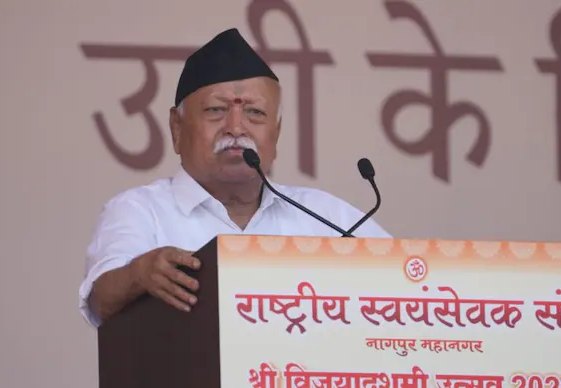
Every Dussehra, the annual address delivered by the Rashtriya Swayamsevak Sangh leadership attracts close national attention. Coming from a ideological family that shares deep links with the political establishment in New Delhi, these speeches carry substantial weight. In the latest address, the leadership issued a stern warning regarding malevolent forces attempting to weaken and destabilize the Indian nation from within and through external connivance. While official rhetoric frequently focuses on foreign instigation, genuine introspection requires examining the domestic structural pathologies that erode the foundations of the republic. True patriotism demands looking beyond convenient scapegoats to confront the systemic fractures damaging the social fabric, democratic institutions, and economic stability of the country.
Historical experience demonstrates that India requires no imported templates for social or political change. The anti colonial struggle spanning two centuries under British rule and the democratic resistance against the Emergency provide abundant indigenous inspiration. While foreign social movements may share superficial similarities in grievances, their tactical trajectories and ultimate consequences often diverge sharply from Indian realities. Transitions witnessed in neighboring societies offer no constructive roadmap for a complex, pluralistic constitutional democracy. India possesses robust constitutional mechanisms for governance and leadership transition, making any extra constitutional upheaval fundamentally subversive to national integrity. Treason and the disruption of national sovereignty do not constitute legitimate fundamental freedoms. Yet, acknowledging the need for constitutional order does not absolve society from recognizing the internal forces currently hollowing out the state from within.
The first major structural vulnerability stems from competitive political decay, specifically the erosion of foundational democratic norms through partisan engineering. Multi party competition forms the bedrock of the Indian political experiment, but this system faces severe distortion through political defections, engineered party splits, and wholesale acquisition of legislators by ruling apparatuses. Such practices reduce elections to procedural farces while trampling political morality. Healthy democracies rely on robust institutional checks rather than covert strategies designed to fracture opposition ranks. Furthermore, the deployment of gubernatorial offices to harass elected state governments creates a dangerous precedent that subverts federal balance. When political mobility is dictated purely by proximity to power rather than ideological conviction, the entire architecture of democratic accountability collapses, leaving the state structurally fragile.
Economic disparity constitutes the second critical fault line threatening national strength. While aggregate growth figures frequently dominate official discourse, prosperity remains profoundly skewed, failing to permeate the daily existence of ordinary citizens. Millions of Indians survive on minimal daily earnings while the fortunes of corporate conglomerates scale unprecedented heights. Such extreme polarization within the economic structure generates deep instability. True national development cannot be measured solely by the accumulation of wealth among a privileged elite while household debt burdens expand across the population. Reports from the central bank indicate that household liabilities have risen substantially relative to the gross domestic product, pushing millions into precarious financial distress as the cost of living surges. Persistent inflation in essential commodities such as food grains, edible oils, and pulses erodes purchasing power, while graduate unemployment hovers near alarming thresholds. An economic framework that produces joblessness and widening inequality weakens the nation far more effectively than any external adversary.
Cultural polarization represents the third major peril confronting the republic. Philosophical traditions within the India have historically championed universal human brotherhood, encapsulated in ancient ideals of a single global family. Yet contemporary political discourse increasingly weaponizes identity, reducing a rich, pluralistic heritage to narrow constructs of singular religion, language, or ethnicity. Systematic attempts to homogenize a diverse population undermine the constitutional ethos of unity in diversity. India derives its fundamental strength from the peaceful coexistence of varied traditions and cultural expressions. Imposing uniformity on a plural society disregards the historical reality that federalism and cultural diversity are structural shields rather than administrative inconveniences.
External economic pressures introduce the fourth dimension of vulnerability, often contradicting claims of absolute self reliance. Trade policies that expose domestic producers to uneven global competition can devastate crucial sectors of the domestic economy. Lowering import tariffs on foreign agricultural commodities directly undermines local cultivators, breaking the backbone of rural livelihoods. Opening agricultural and dairy markets to foreign imports under free trade frameworks compromises domestic producers who struggle against heavily subsidized foreign competitors. When local farmers producing cotton, oilseeds, and dairy face ruin due to unfettered external competition, the resulting rural distress constitutes a direct blow to national resilience. Protecting indigenous producers against destructive external trade terms remains an essential component of economic sovereignty.
Finally, the integrity of constitutional institutions provides the ultimate bulwark for the Indian state, and its erosion constitutes a severe internal threat. The foundational principles of secularism, federal autonomy, and the separation of powers face continuous pressure. Attempts to alter judicial independence, subordinate oversight bodies, or influence electoral administration undermine public trust in democratic governance. Free and fair elections serve as the ultimate safeguard of popular sovereignty, and any administrative misstep that disenfranchises voters or compromises electoral rolls damages the democratic mandate. Defending institutional autonomy, upholding the separation of powers, and resisting systemic decay are paramount duties for citizens concerned with the long term viability of the nation. True patriotism lies not in uncritical acceptance of prevailing policies, but in the courageous defense of constitutional integrity against every force that diminishes it.