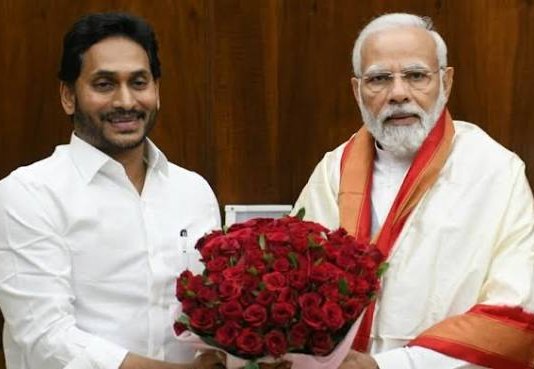
The political calculations of regional leaders often undergo sudden revisions when institutional capture strikes close to home. Yuvajana Sramika Rythu Congress Party chief Y.S. Jagan Mohan Reddy has publicly expressed profound regret over his party’s past parliamentary support for legislation governing the appointment of the Chief Election Commissioner. Standing before critics and the public to condemn what he terms deteriorating democratic norms in local body polls, the former chief minister admitted that backing New Delhi’s statutory overhaul of election oversight was a serious error.
The core grievance centers on the composition of the selection panel. Under the 2023 legislation pushed through parliament by Prime Minister Narendra Modi’s administration, the statutory panel comprises the prime minister, a cabinet minister nominated by the prime minister, and the leader of the opposition. This two-to-one numerical advantage ensures government dominance, effectively sidelining judicial neutrality. Previously, a Supreme Court ruling had mandated an independent panel including the Chief Justice of India, the prime minister, and the opposition leader to safeguard the integrity of the electoral referee.
Mr. Reddy now argues that an examiner cannot be appointed by the student, noting that even the most upright administrator inevitably faces criticism if the selection mechanism lacks a neutral arbiter. Yet this belated realization raises uncomfortable questions regarding political expediency. Observers point out that the ysr congress supported numerous central legislative initiatives over the past dozen years despite lacking formal membership in the National Democratic Alliance. Parliamentary voting records on high-stakes measures, presidential elections, and federal overreaches reflect near-total alignment between regional rivals in Andhra Pradesh when operating in New Delhi.
Critics argue that this strategic conformity stems from persistent legal pressures, noting that central investigative agencies have maintained a deliberate quietude regarding pending financial cases against y.s jagan . For over a decade, high-profile legal proceedings have progressed at a glacial pace, fueling public perception of an unspoken understanding between BJP and YSR congress. When national legislation curtailed local democratic autonomy in the national capital or undermined federal principles, both YSR congress and TDP repeatedly offered legislative backing, subordinating broader institutional health to immediate tactical survival.
The debate extends far beyond legislative regret into the mechanics of democratic accountability. Legal challenges to the 2023 election commissioner act remain active in the Supreme Court, with judicial panels recently expressing astonishment over controversial provisions granting sweeping lifetime immunities from civil and criminal proceedings to retired election chiefs—protections surpassing even those afforded to the prime minister or Supreme Court justices. Despite these grave constitutional concerns and nationwide mobilization ysr congress has largely refrained from mounting sustained street protests or leading mass demonstrations against central administrative overreach.
Whether this rhetorical shift signals a genuine strategic realignment or merely a tactical maneuver to pressure central authorities remains uncertain. As electoral landscapes shift and questions mount over the longevity of BJP-led NDA remaining in power, Y.S. Jagan find navigating the perilous intersection of central investigative leverage and public discontent. Ultimately, the admission of error highlights a sobering reality of contemporary governance, where foundational democratic safeguards are frequently compromised for short-term political shelter, only to be lamented when the consequences finally arrive at the doorstep.