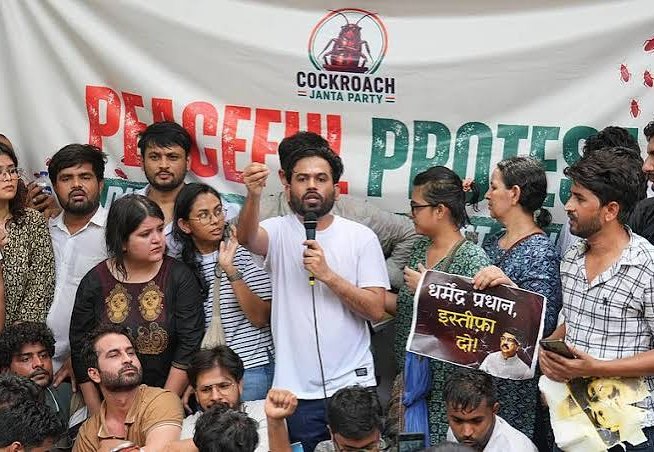
When a movement shifts its crosshairs from stolen exam papers to the institutional integrity of the Election Commission, standard political scripts suggest one of two explanations: either a necessary broadening of democratic grievances, or the calculated evolution of a burgeoning political force.
The Cockroach Janata Party (CJP) has embarked on precisely this journey. Having initially captured public attention through its agitation against paper leaks and employment scandals, which forced the resignation of Union Education Minister Dharmendra Pradhan, the group transitioned into its "School Theek Karo" campaign. Now, it has stepped directly into the political crucible with a high-decibel assault on the Election Commission of India. Targeting Chief Election Commissioner Gyanesh Kumar from Mumbai to Delhi, the movement’s abrupt pivot raises fundamentally uncomfortable questions about the life cycle of Indian civic agitations.
Two distinct interpretations explain this transition. The first posits that the move from education reform to electoral oversight is the natural progression of any serious public protest. Single-issue agitations rarely remain trapped within their original boundaries when the underlying systemic fractures are deep.
History provides notable precedents for this dynamic in Indian politics. In late 1973, student protests at an engineering college in Ahmedabad over a 20 percent hike in mess fees sparked the Navnirman Movement. Repression by local authorities drew in broader segments of society, transforming a dispute over dining costs into a statewide movement against government corruption that ultimately forced the resignation of Chief Minister Chimanbhai Patel. Narendra Modi was himself a young activist in that very upheaval.
A year later, Jayaprakash Narayan seized upon student protests in Bihar triggered by widespread unemployment and rising prices, forging them into the "Sampoorna Kranti" (Total Revolution) movement. That agitation reshaped the nation's political landscape, culminating in the dismantling of the Emergency regime and the rise of the original Janata Party experiment in 1977.
In both instances, localized economic frustrations morphed into demands for systemic overhaul because the institutional framework itself was seen as broken. Viewed through this historical lens, CJP’s escalation from school conditions to electoral fairness reflects the same structural logic: localized grievances over jobs and schools inevitably lead back to the integrity of the state apparatus that governs them.
The second, more critical interpretation views this shift as the clear manifestation of personal political ambitions among CJP’s leadership. By taking the protest to Mumbai, the home state of prominent figure Abhijat Deepke, and targeting national institutions in Delhi, the organization appears to be laying the groundwork for formal electoral participation.
While political ambition is neither unlawful nor inherently dishonorable in a democracy, converting a civil movement into a political party carries serious structural risks. The sharp turn toward the Election Commission inevitably distracts from the pressing realities of the "School Theek Karo" initiative and youth employment. Furthermore, civil society movements derive their primary strength from acting as empty vessels for public frustration. They attract individuals across party lines who feel alienated by the political establishment. Converting into a political party instantly splits this coalition, as voters aligned with existing opposition parties naturally pull back once a movement competes directly for parliamentary seats.
The CJP did not rise because it possessed deep financial resources, a formal party structure, or dedicated cadre. It expanded because citizens disillusioned with both the ruling Bharatiya Janata Party and the existing parliamentary opposition sought an outlet for their unaddressed grievances. No individual leader, whether Abhijat Deepke, Sonam Wangchuk, Saurabh Das, or Ashutosh Lanka, can claim sole credit for this momentum. They merely tapped into organic public dissatisfaction.
The structural danger of this political shift is well documented in modern Indian state politics. The trajectory of the Lok Satta movement, led by Jayaprakash Narayan in undivided Andhra Pradesh, serves as a clear historical warning. Lok Satta commanded immense respect as a non-partisan watchdog campaigning for electoral transparency, administrative accountability, and efficient public service delivery. Yet, when it formally converted into a political party to contest elections directly, it lost its non-partisan authority while simultaneously failing to contend with the realities of electoral politics. In the end, both the political entity and the original civic movement vanished.
While the Cockroach Janata Party continues to publicly deny any intention of converting into a formal political party, its tactical choices suggest otherwise. Demanding institutional resignations at the national level and launching protests across major metros are the actions of an entity preparing for an electoral debut. Political change may well be required to fix schools, stabilize employment, and protect electoral systems, but whether a civil movement can survive its own transformation into a political party remains an open question.