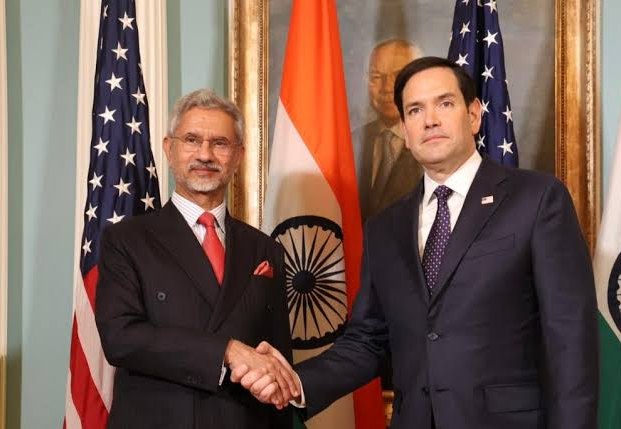
US Secretary of State Marco Rubio described protests as a sign of political discourse and differences of opinion, while asserting that he will not comment on India’s internal affairs. “This is a democracy. They have elections here, so I’m not going to opine on their domestic political matters,” he told reporters.
International diplomacy often resembles a theatrical performance where superpowers play the moral guardian of civil liberties until geopolitical convenience demands a quiet exit. Recently, Washington offered a remarkably hands-off assessment regarding domestic protests within India. For a nation accustomed to lecturing foreign capitals on governance, the commentary struck a notably deferential tone. Yet beneath the surface of diplomatic courtesy lies a calculated reality. Great powers do not alter their foundational foreign policy out of sudden philosophical respect for autonomy. They adapt to circumstance, maintaining selective silence where alignment serves their interests while intervening elsewhere when strategic imperatives dictate otherwise.
The remarks in question, delivered concerning civil unrest inside India, framed the turbulence as an internal political matter best left to local democratic processes. The comparison drawn to routine demonstrations within the United States attempted to normalize public dissent as an inevitable byproduct of pluralistic societies, provided it avoids wholesale destruction. From a purely nationalist standpoint, the initial impulse among observers in New Delhi is to welcome such restraint. Foreign capitals have no business dictating how a sovereign democracy manages internal dissent or legislative friction. When citizens contest government policy, external sermons from self-appointed global arbiters are neither requested nor required.
Yet viewing this stance through a lens of unalloyed diplomatic maturity risks a dangerous lapse in memory. Washington has rarely shown such constitutional shyness when strategic leverage beckons. Consider the persistent history of unsolicited American commentary regarding Kashmir, where successive presidential administrations routinely offered mediation despite explicit rejections from New Delhi. Human rights concerns involving religious minorities in India have similarly served as convenient diplomatic levers whenever Washington sought to exert pressure. If domestic political matters are strictly off-limits, the frequent preoccupation with disputed border territories and internal social friction reveals a glaring double standard.
The divergence between non-interference in one context and unsolicited mediation in another exposes the underlying architecture of foreign policy. Alignment with New Delhi currently serves broader strategic equations in the Indo-Pacific, rendering public censure of domestic protests counterproductive. The restrained posture is born of tactical necessity rather than principled consistency. When foreign capitals find it advantageous to accommodate a friendly government, sovereign autonomy is suddenly recognized and respected. When strategic alignment frays, the rhetoric swiftly pivots toward human rights and democratic guardianship.
A broader survey of global engagements confirms that selective sovereignty is a staple of imperial management. Washington has historically felt little hesitation in challenging the internal restructuring of land policies in South Africa or weighing in on civil unrest across European capitals, while occasionally endorsing separatist impulses within friendly neighboring jurisdiction like Canada. The doctrine of intervention is deployed wherever influence yields dividends and shelved wherever partnership proves more lucrative.
For observers in developing democracies, recognizing this transactional nature is essential. Accepting praise or avoiding censure from foreign superpowers without cynicism invites strategic vulnerability. India’s internal stability, legislative debates, and management of public dissent remain exclusively Indian responsibilities. True sovereignty requires neither the validation nor the instruction of external capitals, regardless of whether they arrive bearing lectures or diplomatic silence.