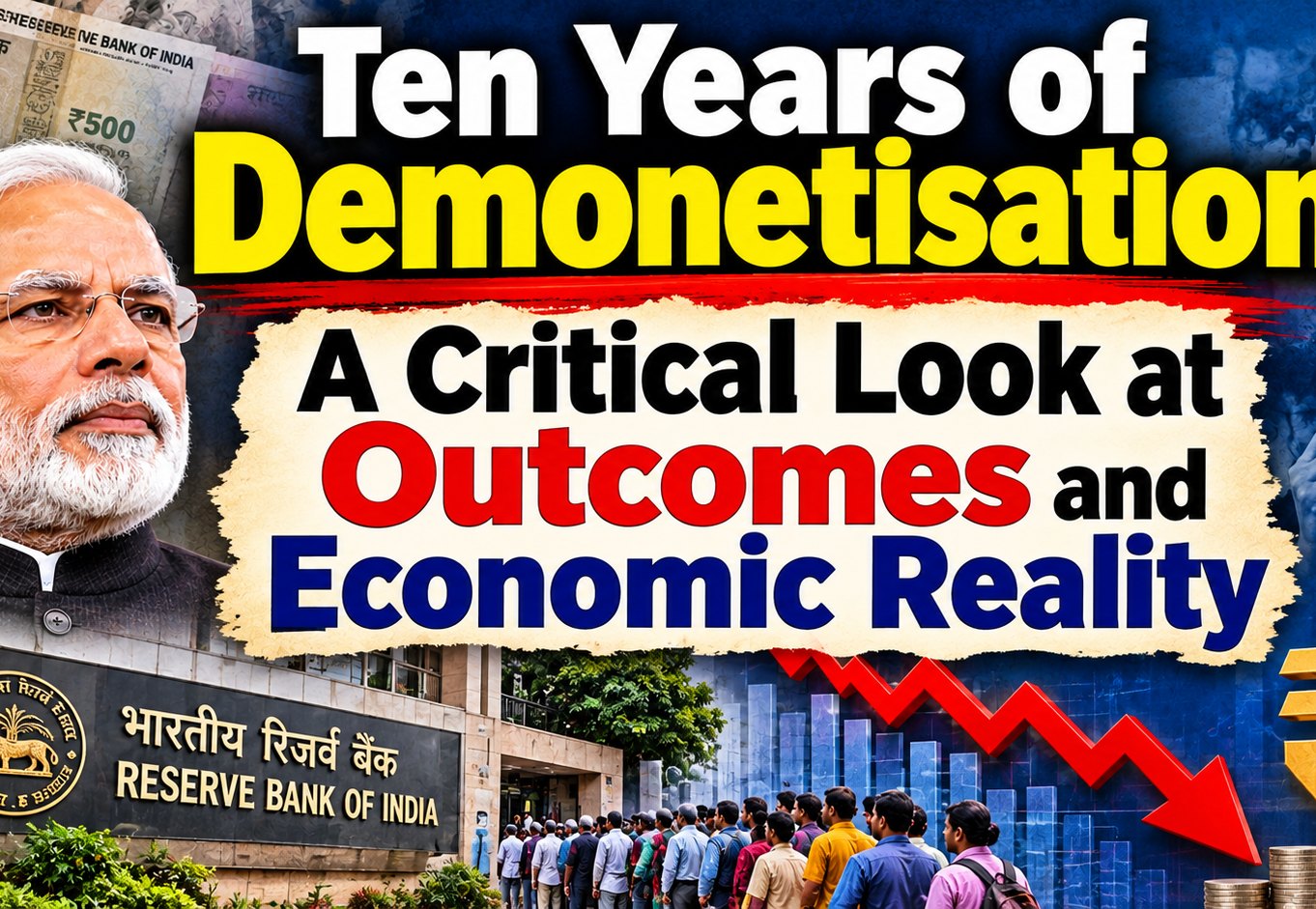
A decade has passed since the night of November 8, 2016, when Prime Minister Narendra Modi addressed the nation at 8:00 PM to announce the cancellation of higher-denomination currency notes. The policy invalidated five-hundred and one-thousand rupee notes overnight, stripping away eighty-six percent of the total cash value in circulation at the time. What followed was an immense economic crisis that hit cash-intensive sectors, agriculture, and informal trade hard. Citizens faced severe hardships, standing in long queues outside banks unable to withdraw their own money.
In the wake of that monumental disruption, the Indian economy has struggled to return to the pre-demonetisation economic growth rate. Although subsequent disruptions such as the implementation of the Goods and Services Tax, the pandemic, tax shifts, and global conflicts also played a role, demonetisation dealt a heavy blow to the foundational sectors of the economy. Yet, the policy was defended vigorously. The government successfully convinced large sections of the public, leading to political victories such as the 2017 election win in Uttar Pradesh.
The justification presented to the country centered on the idea that cash was the enemy. Modi argued that vast amounts of black money rested with the wealthy, that hawala networks thrived on physical currency, and that corruption, fake notes, and terrorist financing all depended on cash. Demonetisation was thus framed as a bold stroke to wipe out black money, eradicate counterfeit currency, suppress terrorism, and build a cashless economy. Ten years later, an examination of the specific stated goals reveals a stark reality.
The Question of Cash Circulation
One primary claim was that cash in circulation would shrink, paving the way for a cashless society. Today, looking at PhonePe and Unified Payments Interface transactions, many assume cash usage has vanished. Government promotion and technological progress certainly boosted online transactions, and the Unified Payments Interface remains a genuine success. Digital money use has undeniably grown.
However, looking at the broader economic proportion tells a different story. While absolute cash volume naturally rises as an economy grows, the true test is cash as a proportion of Gross Domestic Product. According to Reserve Bank of India data, in the 2015-16 financial year preceding demonetisation, cash held by the public stood at 11.9 percent of Gross Domestic Product. Today, that figure sits slightly higher at 12.1 percent. Despite technological leaps and online adoption, cash usage relative to the economy has not dropped. Instead, it has marginally increased.
Counterfeit Currency and New Notes
Another core argument for demonetisation was national security and the elimination of counterfeit notes that allegedly funded terrorism. When examining counterfeit statistics, the initial data appears promising at first glance. Before demonetisation, for every crore of currency notes, 70.1 fake notes were detected. Recent figures show that broader counterfeit detection dropped to 13.4 per crore.
Yet, Reserve Bank of India data demands a closer examination of the new currency series introduced after November 8, 2016, which promised advanced security features. While two-thousand rupee notes are no longer in circulation, newly introduced five-hundred rupee notes have seen a sharp surge in counterfeiting. In the financial year following the introduction of the new five-hundred rupee series, roughly 0.3 fake note was caught per crore. Today, that number has surged past twenty fake notes per crore. The proliferation of counterfeit versions of the new notes highlights that curbing fake currency remains an unresolved challenge.
The Fate of Black Money
The most critical promise concerned black money. In affidavits submitted to the Supreme Court, the Attorney General of the central government officially estimated that roughly three lakh crore rupees in black money existed in the system, theorizing that holders of illicit cash would be unable to deposit it into banks.
To the surprise of many, ninety-nine percent of the demonetised currency returned to the banking system, leaving only about ten thousand crore rupees unaccounted for. That remaining sum could be attributed to various factors, including funds held abroad or individuals failing to exchange them. But the central question remains: what happened to the three lakh crore rupees of anticipated black money? The outcome meant that virtually all the unaccounted funds successfully converted into white money through the banking channels created by demonetisation.
Furthermore, the government has not publicly named a single individual whose major stash of black money was successfully confiscated solely as a direct result of demonetisation, nor can such names be found in official documents or press records. Across all three stated objectives—eliminating black money, reducing cash circulation, and stopping counterfeit currency—demonetisation fell short of its promises.
The Ultimate Impact and Political Silence
Instead of achieving its stated economic cleanup, the policy severely damaged the agricultural sector, the informal economy, and cash-rich trades. Ten years later, the absence of official celebration speaks volumes. If demonetisation had been a resounding success, the anniversary would be marked by grand events, major celebrations, and prominent front-page advertisements detailing the triumphs of the policy. Yet, neither the central government nor the ruling Bharatiya Janata Party officially commemorates the anniversary of demonetisation. The quiet surrounding the milestone suggests that the administration recognizes the policy as a major structural failure, leaving little inclination to advertise its legacy.