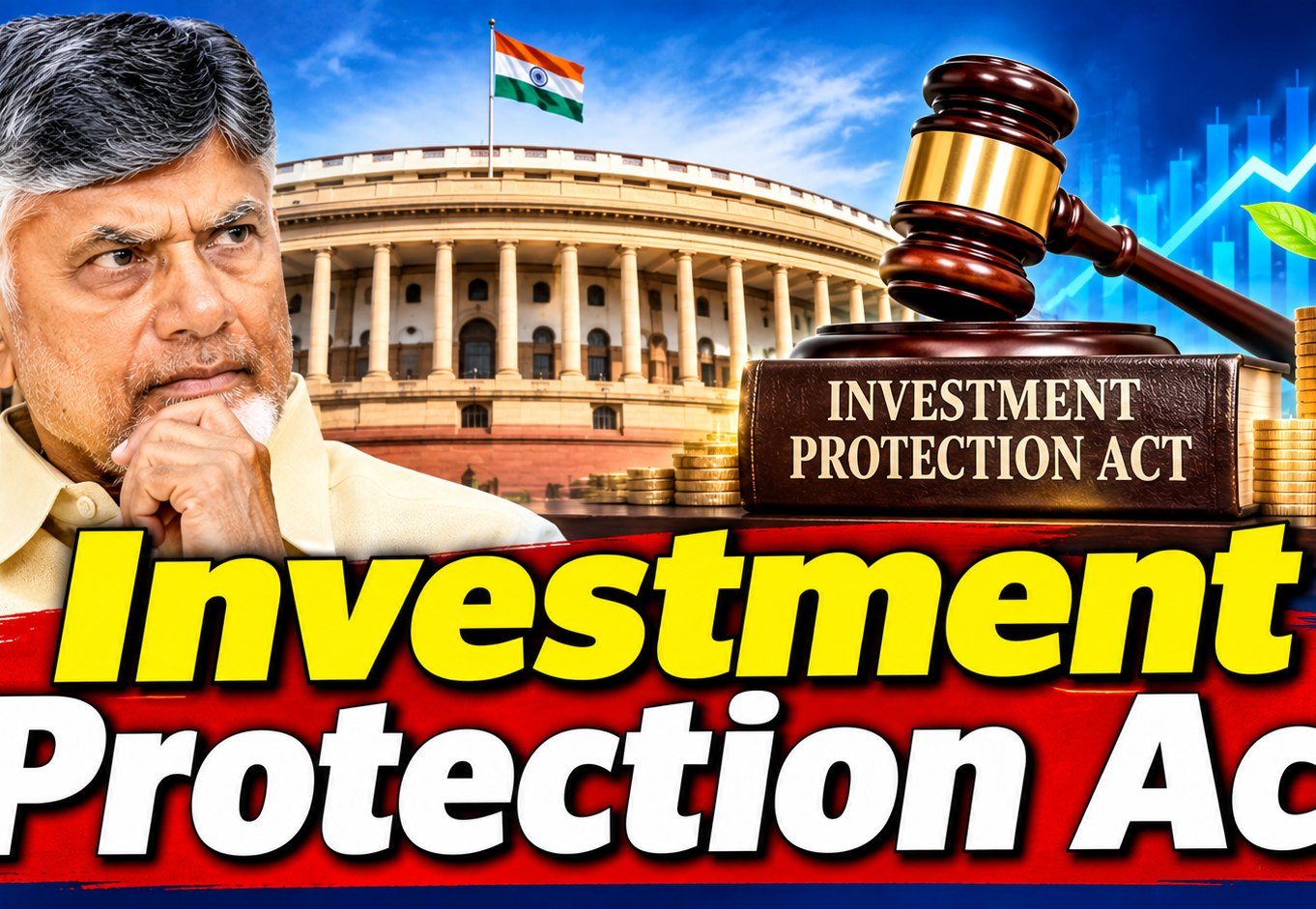
The political landscape of Andhra Pradesh has once again brought questions of industrial policy and capital security to the forefront. Chief Minister Chandrababu Naidu recently floated a notable proposal advocating for a national level Investment Protection Act. The core argument rests on insulating businesses from political friction when power transitions occur between competing parties. As governments change, enterprises that established operations under a previous administration often face anxieties regarding policy continuity and potential administrative backlash. Proponents argue that a centralized legal shield would assure global investors, streamline capital flow, and cement India as an unstoppable economic destination. Yet, this push for legislative protection has triggered a deeper debate regarding the intricate relationship between political power, corporate patronage, and public accountability.
To understand the weight of this proposal, one must examine the friction surrounding political transitions.
the underlying anxiety among industrialists is real. Vindictive politics can disrupt commercial operations, creating an unstable environment where business fortunes rise and fall with the electoral tide.
However, the intersection of business and politics reveals a more complex reality. Modern commercial entities rarely operate as entirely neutral economic actors. Over time, many business houses have evolved into political patrons, financial sponsors, and active stakeholders in electoral victories. When a corporate entity invests heavily in the success of a specific political party, it naturally becomes vulnerable when the political pendulum swings and the opposition takes office. This entanglement forms the crux of systemic concerns long highlighted by institutional panels like the Vora Committee, which mapped the nexus between politicians, businessmen, bureaucrats, and criminal elements. When investment is tied to political patronage, subsequent administrations inevitably view those projects through a critical lens.
The central question raised in policy analysis is what happens when state largesse meets legislative immunity. Consider a hypothetical scenario, where a company commits an investment of ten thousand crore rupees. In a bid to attract capital, a state government might offer twenty thousand crore rupees in concessions, land, priced at ninety-nine paisa subsidised water and electricity, alongside sweeping tax exemptions. In exchange, arrangements may involve substantial financial returns directed back to political stakeholders. When a new government takes charge, it confronts a massive fiscal imbalance. If an Investment Protection Act shields these historical agreements unconditionally, critics argue that the legislation ceases to protect investment and instead institutionalizes resource extraction. It risks becoming an exploitation protection act rather than a safeguard for genuine enterprise.
Long term agreements further compound these policy dilemmas. Infrastructure and energy projects often span decades. In sectors like solar power, technology costs decline rapidly over time, rendering older power purchase agreements financially burdensome for the state. Historical service contracts, such as multi-decade government agreements for telecom and digital services signed under past technological frameworks, demonstrate how rigid long term commitments can lock public treasuries into outdated cost structures. Similarly, when vast tracts of land or sensitive natural resources are committed under one administration, incoming governments face severe limitations in rectifying environmental damage or urban planning errors. Legislative shields that freeze these arrangements permanently strip democratic governments of their mandate to alter policy in the public interest.
Public policy must evaluate whether the primary objective of governance is safeguarding corporate profit margins or ensuring citizen welfare. Critics point out that current economic summits, memorandums of understanding, and letters of intent presented at global forums often showcase staggering monetary figures in official headlines. Yet, ground realities present a starkly different picture. Surveys across Andhra Pradesh indicate that a significant majority of youth, estimated around seventy percent, experience deep dissatisfaction over persistent unemployment. Alongside agricultural distress regarding fair minimum support prices, job creation remains the most pressing flashpoint.
A concrete examination of past industrial ventures illustrates the gap between capital attraction and public benefit. For instance, an undergarment manufacturing facility operated by Brandix, a Sri Lankan company located in Achutapuram near Visakhapatnam, received substantial land allocations under earlier governance at highly subsidized rates under a ninety-nine year lease. While the project generated employment primarily for women, wages were reported to be minimal, around six thousand rupees per month, under grueling working conditions. More critically, industrial waste discharge from the facility severely impacted the livelihoods of approximately ten thousand fishermen in the nearby coastal villages, destroying local marine ecosystems. Incidents like these raise fundamental questions about whether state support protects employment or merely shields corporate operations that externalize environmental and social costs.
Governance is fundamentally entrusted by the electorate to serve public welfare rather than act as an administrative wing for capital accumulation. While attracting investment is essential for generating economic activity and creating jobs, capital cannot be treated as an end in itself. Investments are required because citizens need employment and sustainable incomes, not merely to secure profit for private enterprises. Any legislative framework designed to protect investments must balance commercial stability with ecological preservation, fair wage structures, and accountability in resource management. Without addressing these foundational pillars, proposals for sweeping protective legislation risk prioritizing corporate balance sheets over the fundamental needs of the people.