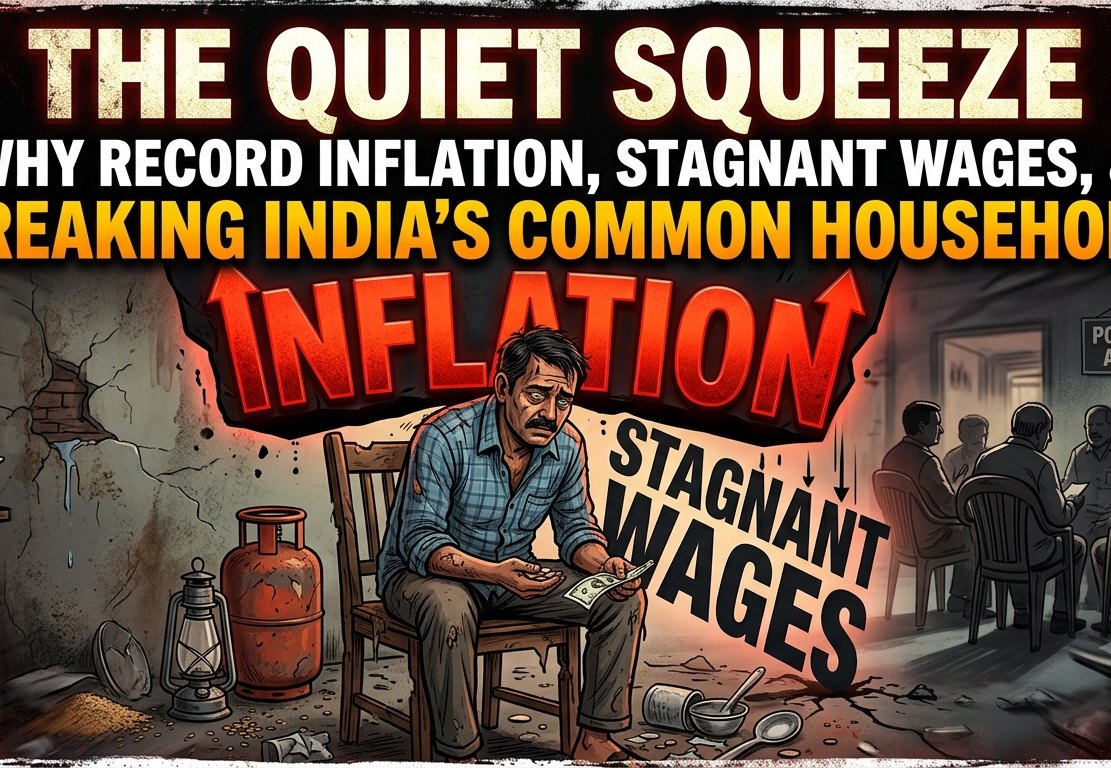
India is currently grappling with a severe cost of living crisis that touches every single facet of daily existence. Retail inflation has surged to a two-year high, touching 6.09 percent in October, while food inflation has climbed steeply to 8.94 percent. For an economy that prides itself on robust headline growth figures, these numbers represent a harsh reality check. More critically, this inflation spike has breached the Reserve Bank of India hard upper tolerance threshold of 6 percent. While the central bank considers 4 percent as its ideal target with a 2 percent comfort margin, crossing the 6 percent ceiling marks a dangerous territory that has not been witnessed in recent years.
What makes the current inflationary wave particularly punishing is its broad-based nature. In typical economic cycles, price rises remain compartmentalized, affecting certain sectors while leaving others stable or even declining. Today, however, every sector is recording upward price pressure. Food inflation at 8.94 percent directly translates into escalating restaurant and accommodation costs, which have risen by more than 10 percent. Basic household maintenance and cleaning agents, including detergents and home care products, remain stubbornly high at roughly 11 percent. Essential apparel, clothing, and footwear have seen increases of around 5 percent, while transport costs have climbed 5.8 percent. Even recreational activities, culture, and sports have become significantly costlier. From the food on the dining table to personal care items, education, and health care, nothing remains untouched.
This pervasive price rise inflicts the most devastating toll on the poorest segments of society and the working middle class. According to government data from the Consumer Expenditure Survey, the poorest households spend up to 60 percent of their monthly per capita expenditure purely on food. When food inflation spikes to nearly 9 percent, it eats directly into the survival margin of marginalized families. Middle class households, while spending a smaller proportion of their income on food, are severely squeezed by fuel and transportation costs. Because mobility is essential for daily livelihood, even families utilizing basic scooters or local transport are forced to absorb compounding daily expenses.
Compounding these immediate pressures is a frightening outlook for the near future. Agricultural production is bracing for a severe shock due to weather anomalies and El Nino impacts, which have triggered acute water shortages across the country. Cultivation acreage has shrunk across multiple staples. Rice production alone is projected to drop by a staggering one crore tons. Similar contractions in sowing area are evident across wheat, maize, pulses, oilseeds, and cotton. With the upcoming Rabi crop prospects similarly dimmed, India faces the grim prospect of even worse food inflation in the months ahead.
At the same time, the persistent high cost of fuel defies global market trends. While international crude oil prices have hovered around 90 dollars per barrel, down significantly from previous peaks of 120 dollars, domestic fuel prices at the pump remain exorbitant. For perspective, when Narendra Modi took office as Prime Minister in 2014, global crude oil traded at 108 dollars per barrel, yet petrol retailed at roughly 70 rupees. Today, with crude at 90 dollars, petrol and diesel prices in major centers remain above 100 rupees. This glaring discrepancy underscores that domestic retail prices are being heavily propped up by excessive government taxation rather than fluctuating global commodity markets, forcing ordinary citizens to carry an unnecessary fiscal burden.
The policy response from monetary authorities risks exacerbating the disease it seeks to cure. The Reserve Bank of India has already raised repo rates by 25 basis points, with strong indications of further hikes on the horizon. Raising interest rates restricts money supply, cools economic activity, and dampens growth. However, in an environment driven by structural supply deficits and input cost inflation, higher borrowing costs translate into higher costs of capital for businesses. This drives up production costs across the board, effectively turning the monetary remedy into a cure that is potentially worse than the disease itself.
Compounding the economic squeeze is the stagnation of real wages across the country. An analysis of corporate financial reports, such as the performance of Nifty 50 companies over the last five years, reveals a stark divergence: corporate profits have risen handsomely, while worker wages have stagnated or declined in real terms. When inflation soars while personal incomes remain flat, households experience severe stagflation at the micro level. Unlike discretionary consumer goods like computers or mobile phones, where purchases can be delayed or postponed during financial strain, essential commodities like cooking oil, pulses, onions, potatoes, and rice cannot be substituted or avoided. Families cannot simply decide to stop consuming staple grains or basic vegetables when prices skyrocket.
Despite this mounting socio-economic distress, the political establishment exhibits an alarming lack of urgency. Prime Minister Narendra Modi and his cabinet have held no high-profile review meetings dedicated specifically to addressing the inflation crisis, nor has Parliament convened special sessions to debate the rising cost of living. While political energy is frequently channeled toward ideological debates, legislative restructuring, or regional delimitation, everyday economic survival struggles fail to command top legislative priority.
This political apathy persists because of a distinct electoral calculus. The ruling Bharatiya Janata Party does not fear traditional anti-incumbency driven by economic performance. Extensive post-poll studies conducted by research organizations like CSDS Lokniti and media outlets like India Today consistently show that the Modi government receives relatively low public ratings when it comes to managing the economy and controlling prices. Yet, the party continues to secure sweeping electoral mandates because its political success is anchored in emotional, ideological, and national security issues rather than economic governance. Voters rally around issues such as the construction of the Ram Mandir, the Uniform Civil Code, nationalism, and strong postures toward Pakistan and China. In a democratic framework where political parties prioritize winning elections above all else, economic distress rarely translates into electoral punishment if emotional consolidation remains robust.
This systemic disconnect is mirrored by mainstream television and print media, which frequently abdicate their core journalistic duty. Rather than driving public interest debates on livelihoods, inflation, and economic policy, media channels routinely chase sensationalist political sparring and polarizing rhetoric. When questioned about this omission, media executives often defend themselves by claiming that viewers prefer sensationalism over substantive economic discourse. This circular argument ignores the fundamental definition of journalism. True journalism does not merely mirror what people passively watch; it directs public attention toward what citizens urgently need to know.
Ultimately, escaping this cycle requires a fundamental awakening in public consciousness. Unless voters begin to demand accountability on livelihood issues and everyday survival rather than surrendering entirely to polarizing emotional politics, governments will have little incentive to change course. Inflation is not an abstract statistical artifact. It is a daily erosion of human dignity and security. Until public pressure forces a realignment of national priorities, the Indian common man will continue to bear the silent, crushing weight of an unaddressed economic crisis.