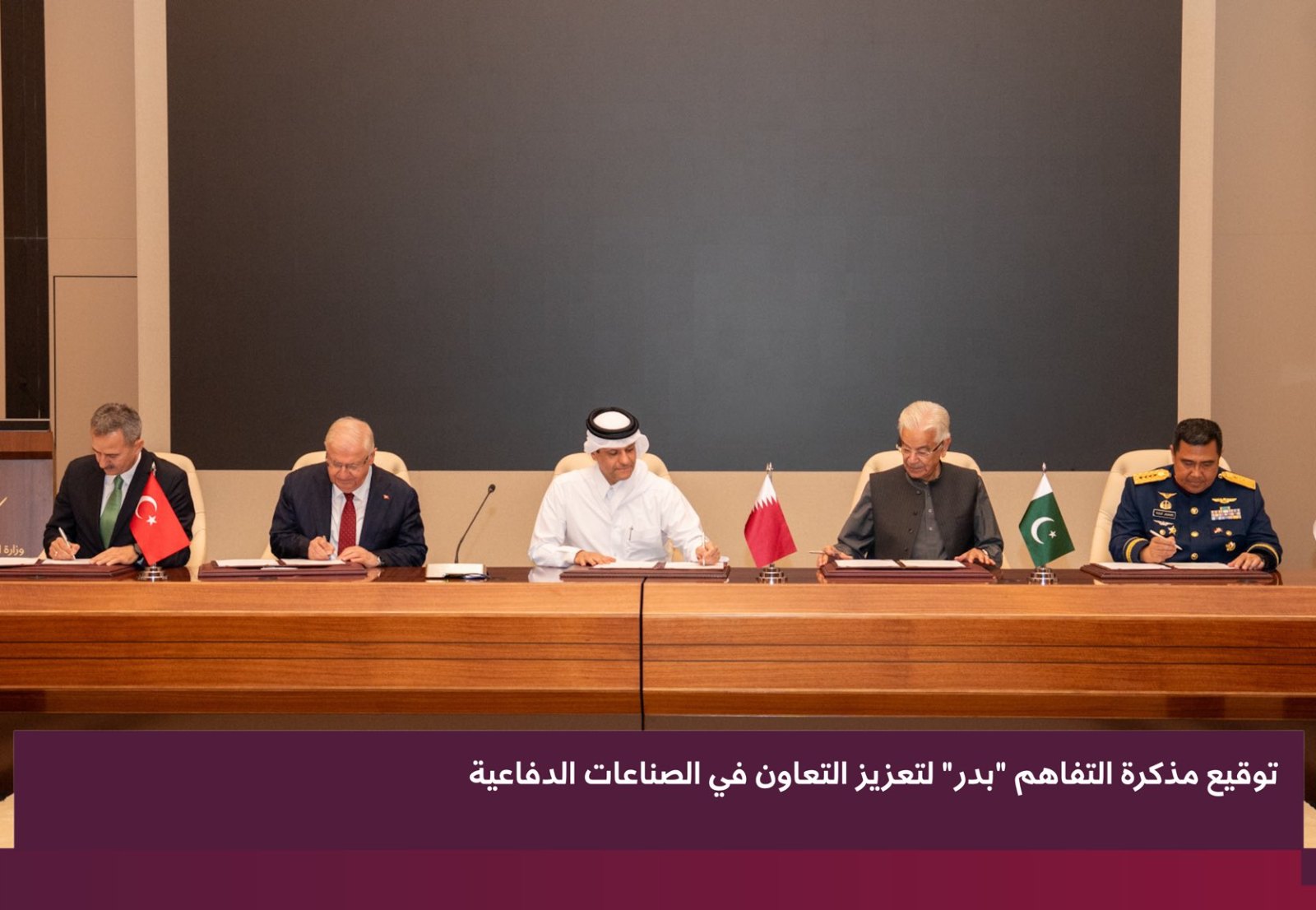
For decades, the security architecture of the wider Middle East and South Asia relied upon a predictable matrix of Western guarantees. Washington provided the security umbrella, anchoring regional client states through bilateral treaties, while Gulf monarchies and major Islamic nations integrated into a Western-led defense paradigm. That architecture is fracturing. In recent months, a series of geopolitical shocks has driven Islamic nations to question the reliability of external protectors. Against this backdrop, Pakistan, Qatar, Turkey, and Indonesia have forged a new defense framework known as the Badr Agreement.
Unlike previous security arrangements, the Badr Agreement represents a profound shift away from reliance on Washington. This grouping is not a collective defense pact modeled strictly after NATO's Article Five, where an attack on one member triggers a response from all. Instead, it is structured as a collective defense capacity building agreement. The participating nations intend to pool resources for joint military production, technological cooperation, research and development, and specialized training. By fostering an indigenous military industrial base, these countries aim to reduce their historic dependence on foreign arsenals.
The inclusion of Turkey brings immense industrial weight to the coalition. Ankara possesses one of the most advanced military manufacturing sectors within the NATO alliance outside of the United States. Pakistan, burdened by deep domestic economic struggles, nevertheless maintains a vast military apparatus and a long history of alignment with Western defense frameworks, dating back to the Cold War era of SEATO and CENTO. Qatar brings immense financial capital to the table, with discussions underway to establish local defense manufacturing facilities in Doha. Indonesia, as the world's most populous Muslim-majority nation, adds significant geopolitical heft.
The nomenclature chosen for these modern pacts is deeply revealing. They are steeped in historical religious symbolism rather than cold strategic calculations. Earlier, Saudi Arabia, Turkey, Pakistan pursued the Mecca Accord, a pact carrying explicit elements of Islamic solidarity and frequently described as a mini Islamic NATO. The choice of the Badr name for the new defense pact echoes the foundational battle in Islamic history, invoking unity and resilience. While the Mecca Accord leaned toward mutual defense commitments, the Badr Agreement focuses on industrial self-sufficiency and operational synergy.
The emergence of these independent security groupings was catalyzed by two major failures of deterrence in West Asia. The first occurred when Israel launched a unilateral strike targeting Hamas representatives on Qatari soil. Although the action drew diplomatic condemnation and subsequent apologies, the damage to regional confidence was permanent. In the aftermath of that breach, representatives from dozens of Arab and Islamic nations gathered in Cairo. The consensus was stark: reliance on the American security umbrella could no longer be taken for granted, and regional states must forge their own protective measures.
The second shock arrived with the direct military confrontations involving Iran and neighboring states. As hostilities escalated, Iranian strikes targeted several Gulf nations hosting American military installations. Gulf leaders discovered that the presence of foreign bases did not deter attacks, nor did external powers reliably intercept incoming threats on behalf of local allies. When Western military personnel reportedly sought shelter rather than actively engaging incoming threats, the illusion of absolute external protection evaporated. The realization that no outside power would automatically bleed for local security compelled these governments to look inward and laterally for partnership.
For New Delhi, the consolidation of the Badr Agreement introduces complex strategic calculations. Indian foreign policy makers must assess whether this alignment poses a direct threat to national security. Many of the nations involved maintain robust and friendly ties with India. Qatar and Saudi Arabia are crucial economic and diplomatic partners for New Delhi. Furthermore, Indonesia recently signed a high profile agreement to acquire BrahMos supersonic cruise missiles from India, weapons that demonstrated considerable precision during recent conflicts involving Pakistan.
Yet, the presence of Islamabad and Ankara within the coalition introduces undeniable friction. Turkey has repeatedly used international forums to raise the Kashmir dispute, despite India providing immediate humanitarian aid during major natural disasters in Turkish territory. Pakistan's diplomatic narrative relies heavily on religious solidarity to rally international support against India. Because Pakistan remains the sole nuclear-armed state within the Islamic world, its expanding network of alliances among wealthy Gulf monarchies and powerful Asian nations creates a new vector of geopolitical pressure.
Moreover, the transactional nature of regional diplomacy leaves open questions regarding the durability of the Badr pact. When Saudi Houthi conflict tested the Mecca Accord, signatories found reasons to withhold direct military intervention, citing domestic conflicts or regional entanglements. Whether a capacity-building framework can survive severe geopolitical stress remains to be seen, especially given that key members maintain simultaneous defense commerce with India.
Nevertheless, the symbolic and structural reality of the Badr Agreement cannot be dismissed. The pivot toward indigenous military industrialization and intra-Islamic security cooperation signals the twilight of uncritical reliance on traditional superpowers. For Indian diplomacy, the challenge lies in navigating a shifting landscape where regional solidarity networks are increasingly institutionalized, altering the balance of influence across South Asia and the broader Islamic world.