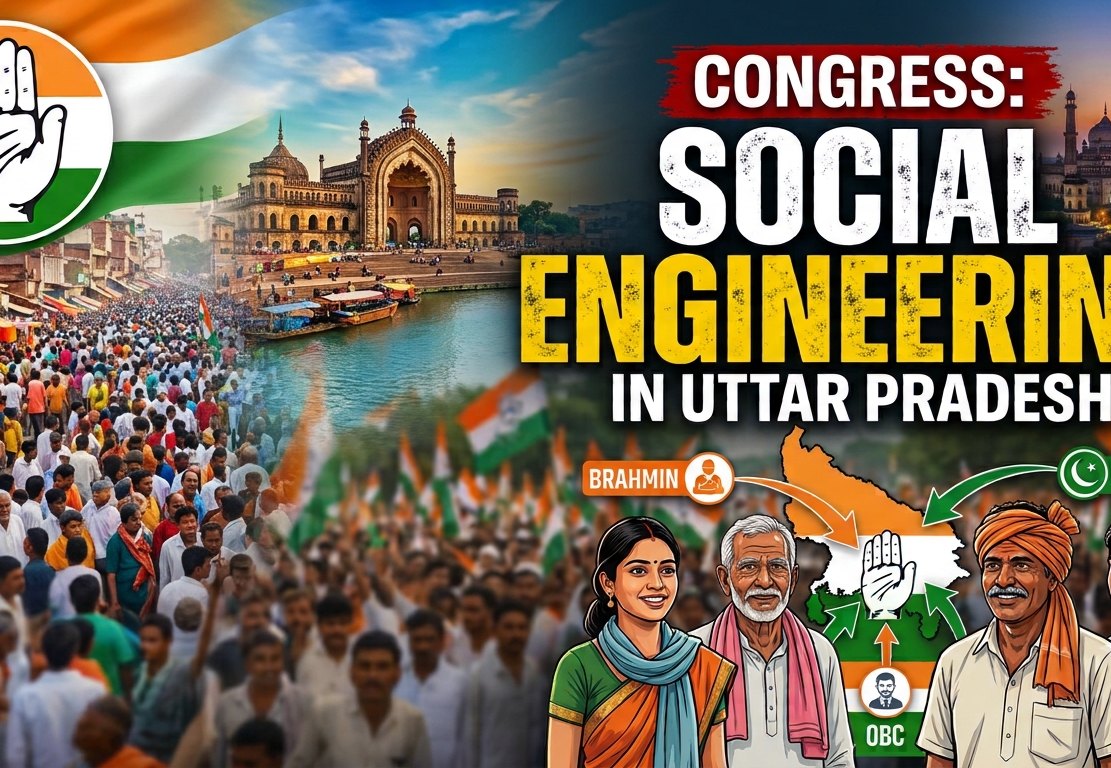
Political resurrection in India’s most populous state is an exercise in demographic geometry. For decades, the Congress party has wandered the political wilderness of Uttar Pradesh, reduced to a marginal player in a landscape it once dominated. As the state gears up for the upcoming electoral battles, the party has unveiled a fresh leadership lineup designed to reconstruct its historic social coalition. By leaning heavily on identity arithmetic, the grand old party hopes to claw its way back to relevance, yet history suggests that altering deeply entrenched voting patterns requires more than symbolic appointments.
At the center of this strategy is a deliberate restructuring of the state party apparatus. The leadership elevation of Aradhana Misra, a rare three-term legislator in a state where the Congress banner struggles to secure victory, serves as the anchor for an upper-caste outreach. Alongside her, the party has appointed prominent figures from other crucial social segments, including Muslim representation through Imran Masoud, alongside leaders from the Nishad and Dalit communities. This sweeping social umbrella attempts to recreate the diverse coalition that once formed the bedrock of the party in the Hindi heartland, bringing together Brahmins, Muslims, backward classes, and scheduled castes under a single banner.
The linchpin of this entire maneuver remains the Brahmin community. Historically, the upper-caste bloc formed the backbone of the Congress support system in Uttar Pradesh, propelling a succession of chief ministers to office. However, the seismic shifts of the Mandal and Mandir politics in the late twentieth century dismantled this alliance. As regional parties mobilized backward castes and the Bharatiya Janata Party consolidated the Hindu nationalist vote, upper-caste voters migrated en masse toward the saffron fold. Despite occasional internal friction between dominant upper-caste factions within the ruling establishment, this allegiance to the governing party has proven remarkably resilient.
Electoral data from past assembly elections illustrates the uphill battle facing the opposition. Comprehensive post-poll studies conducted by CSDS Lokniti reveal that the vast majority of Brahmin voters consistently cast their ballots for the governing party, while the grand old party’s share among this demographic languished in the single digits during previous assembly polls. Past attempts to reverse this trend, such as projecting high-profile Brahmin leaders or parachuting prominent campaigners into the state, failed to dent the ruling party’s dominance. The core dilemma lies in a fundamental deficit of political momentum. Voters rarely rally behind a faction unless they perceive a realistic pathway to victory and a viable organizational machinery on the ground. Superficial shifts at the top rarely translate into grassroots realignment without a compelling narrative of power.
Yet, contemporary political dynamics offer a different angle of utility for this strategy. Beyond attempting to pry away loyal voters from the governing camp, the current leadership changes serve a vital purpose in ongoing seat-sharing negotiations with regional allies like the Samajwadi Party. By positioning leaders with established legislative track records and strong local clout, the party strengthens its bargaining posture within the opposition alliance. Maintaining smooth coalition mechanics and securing a favorable share of constituencies remains critical for survival in a polarized arena.
Ultimately, social engineering functions as a mirror of aspiration rather than a guarantee of success. While demographic blueprints on paper look comprehensive, political legitimacy on the ground is earned through sustained organizational presence and a credible challenge to the status quo. Unless the opposition coalition can project an undeniable aura of victory capable of convincing cautious voters, the revival of the grand old party in Uttar Pradesh will remain an elusive ambition.