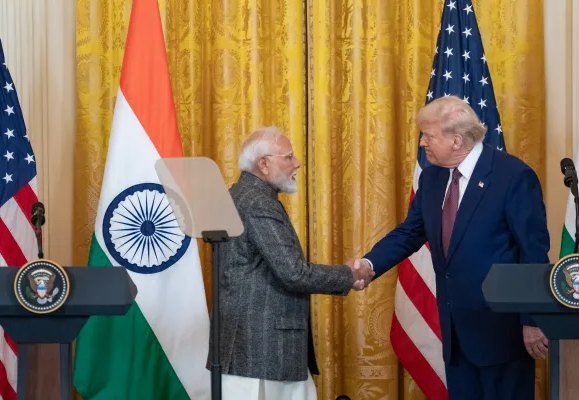
For years, the political trajectory of the Indian American diaspora appeared to be moving in a predictable direction. Long anchored firmly within the Democratic camp alongside other ethnic minorities, a segment of the community shifted rightward following the rise of Narendra Modi in India and the subsequent alignment between overseas nationalist networks and Donald Trump. Rallies featuring slogans like "Abki Baar Trump Sarkar" symbolized a newfound affinity for conservative American politics. Yet as the United States approaches the congressional midterms, recent data reveals a striking divergence. A notable fraction of those who backed Donald Trump in 2024 is having second thoughts, signaling a complex realignment within one of America's most affluent and influential immigrant groups.
Two recent studies illuminate this shifting landscape. Data compiled by Indian American Impact, which surveys South Asian political preferences, indicates that roughly twenty-five percent of Indian Americans who voted for Donald Trump in the last presidential election now intend to support Democratic candidates in the midterms. While a solid majority of former Trump supporters remain within the Republican fold, this defections rate carries substantial weight in closely contested electoral arenas. Conversely, voters who supported Kamala Harris in 2024 remain overwhelmingly steadfast in their Democratic allegiance, showing virtually no erosion of support.
Parallel findings from a collaborative study by the Carnegie Endowment for International Peace and YouGov highlight a sharp generational fissure. Older immigrants who spent their formative years abroad have often adapted pragmatically to changing political currents. In contrast, second and third-generation Indian Americans, who were born and raised in the United States, refuse to follow the partisan footprints of their parents. These younger voters are more willing to question authority, openly challenge racial discrimination, and assert their civic identities. They exhibit a distinct intolerance for xenophobic rhetoric, viewing modern nationalist politics through the lens of domestic civil rights rather than ancestral loyalties.
This behavioral shift reflects a broader confrontation with political reality. According to the Indian American Impact survey, ninety percent of respondents report either experiencing direct racial discrimination or hearing accounts of it within their social spheres. Concerns regarding rising xenophobia, the rhetoric targeting high-skilled foreign workers, and the aggressive posture of far-right political factions have punctured the political insulation that some conservative diaspora members previously felt. Even voters sympathetic to right-wing governance in India found themselves alienated by policies that directly penalized their adopted homeland, including heavy tariffs, attacks on H-1B visa programs, disruptions to Optional Practical Training pathways, and aggressive rhetoric directed against legal and undocumented immigrants alike.
Furthermore, domestic economic anxieties are heavily outweighing foreign policy sentiment. Sixty-five percent of Indian American respondents identify the rising cost of living as a primary factor guiding their midterm voting decisions. Healthcare concerns drive fifty-three percent of the electorate, while job security, wage growth, and educational access remain top-tier priorities. For this community, day-to-day survival and prosperity in America take precedence over distant political alignments.
These shifting preferences carry profound electoral consequences. In battleground states where margins of victory are razor-thin, the political choices of South Asian voters can alter the balance of power. In Michigan, for instance, the South Asian American electorate numbers over 180,000 residents, a figure that dwarfs the narrow margins often deciding statewide senate or presidential contests. Similar dynamics play out across pivotal states like Georgia, Pennsylvania, and North Carolina, where minor fluctuations in turnout can swing legislative outcomes. As the midterms unfold, the Indian American vote is proving that ethnic and political loyalties are rarely permanent, driven instead by the immediate realities of life, dignity, and economic security in America.