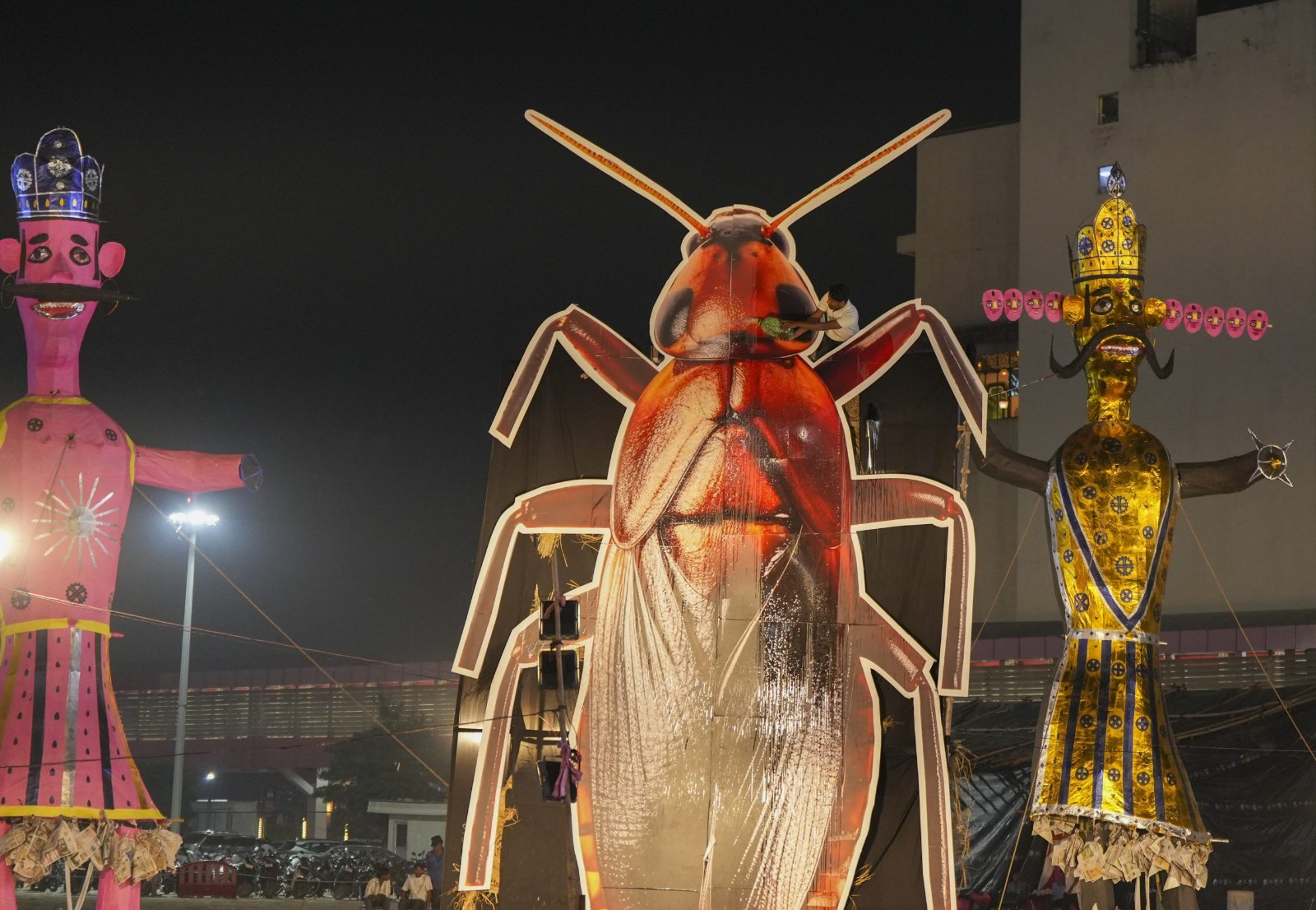
Every autumn, as the festival of Dussehra reaches its climax, vast crowds gather at Delhi’s historic Ramlila Maidan to watch the towering effigies of Ravana, Kumbhakarna, and Meghnad go up in flames. This year, however, the traditional spectacle featured a jarring addition: a thirty-foot effigy of a cockroach, positioned directly beside the mythological demon king.
The inclusion of the insect was neither an accidental prop nor a whimsical artistic choice. Organised by a committee headed by a local Bharatiya Janata Party (BJP) legislator and heavily branded with the political imagery of the ruling party, the event offered a stark window into how cultural spaces are increasingly weaponised for partisan ends. When asked about the rationale behind the grotesque addition, the organisers offered a chilling explanation. The cockroach, they declared, represented social and political filth.
In a country where public discourse is often saturated with pious appeals to civic cleanliness, such as the national Swachh Bharat campaign, the vocabulary of hygiene carries heavy historical baggage. When political actors begin categorizing elements of the populace as literal dirt to be incinerated, the metaphor ceases to be about sweeping streets and becomes a dangerous exercise in dehumanization.
The concept of social filth in India cannot be detached from the ancient, hierarchical structure of the caste system. For millennia, the rigid division of labor has assigned notions of purity and pollution to human beings based on their birth. Those who perform essential sanitary labor, manage animal hides, or handle waste have historically been branded as untouchables, relegated to the margins of society despite sustaining the basic functions of urban and rural life.
When modern political operators adopt the language of eradicating filth, they revive these deeply entrenched prejudices. The traditional social order has long treated marginalized communities as sources of contamination while simultaneously depending entirely on their labor. By translating this worldview into effigy burnings, the ritualistic destruction of evil is subtly redirected away from abstract vices and toward living human beings who dissent, protest, or simply fail to conform to the dominant political ideology.
The choice of what to burn, and what to spare, is itself revealing. Modern India contends with monumental crises that afflict millions of lives daily. Rampant corruption drains public coffers, predatory lending and financial fraud ruin working-class families, and the deadly scourge of substance abuse and alcohol addiction destroys countless youth. Yet none of these systemic failures merited a towering effigy at the Ramlila Maidan. Corruption is rarely framed as a moral pollutant worthy of public incineration, perhaps because acknowledging it too closely touches the corridors of institutional power.
Instead, the target is reserved for political opposition, social critics, and those who question state authority. Observers noted the bitter irony when citizens exercising their democratic right to dissent are routinely met with venomous rhetoric that reduces them to pests. When political tolerance is abandoned, civic disagreement is no longer treated as a healthy component of a republic, but as an infestation that requires extermination.
This worldview extends beyond the political sphere into the realm of daily consumption and cultural policing. Dietary habits, long weaponized as markers of social standing, are subjected to the same rigid binary of pure and impure. Vegetarianism is frequently elevated not merely as a personal dietary choice, but as a moral benchmark of high status, while the dietary patterns of the vast majority of Indians who consume non-vegetarian food are stigmatized as unclean. Such an attitude seeks to impose a narrow, regional, and socially privileged lifestyle as the sole definition of national acceptability, alienating the majority of the population whose culinary traditions and regional diversities do not fit the prescribed mold.
Such an exclusionary vision stands in stark contrast to the philosophical foundations it claims to uphold. Classical Indian texts offer a remarkably inclusive view of existence. The Upanishads explicitly state that no living creature holds an inherent right to dominate another across the vast tapestry of the universe. Even within the epics that inspire the Dussehra festival, the narrative celebrates unexpected acts of grace. Lord Rama performs funeral rites for Jatayu, a bird, demonstrating profound reverence for life across species boundaries. He willingly accepts half-eaten fruit from Sabari, a marginalized tribal woman, establishing an ethical framework rooted in radical empathy and human dignity rather than ritual exclusion.
To invoke the name of Rama while celebrating the destruction of fellow human beings as filth is a profound betrayal of those very traditions. A society that learns to view its own citizens as cockroaches has traveled a perilous distance from the ideals of fraternity enshrined in its constitutional foundations. True civic health does not require the eradication of dissenting voices or the ritual humiliation of the marginalized. It demands an honest reckoning with the real plagues of poverty, inequality, and institutional corruption, rather than the cowardly substitution of human beings for effigies.