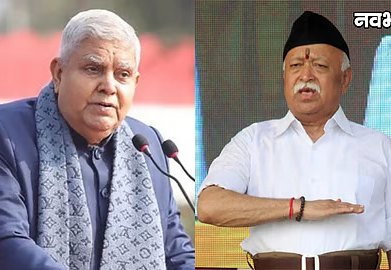
The RSS and the Jagdeep Dhankhar Conundrum: Reading the Signals in Nagpur
The appearance of former Vice-President Jagdeep Dhankhar at the Rashtriya Swayamsevak Sangh centenary Vijayadashami celebrations in Nagpur alongside RSS chief Mohan Bhagwat has stirred considerable political speculation. His resignation in July 2025 followed well-known friction with Prime Minister Narendra Modi and the ruling Bharatiya Janata Party leadership. Observers have long noted that his exit stemmed from personal and protocol disputes rather than ideological divergence. Within the architecture of parliamentary democracy, executive power is anchored in the office of the Prime Minister. Dhankhar was elevated by the party rather than the reverse, yet reports suggested tension over protocol hierarchies.
Despite his unceremonious departure from office and the subsequent chill in relations with the government, Dhankhar has remained a staunch defender of Sangh ideology. During his tenure, particularly as Governor of West Bengal, he transformed the Raj Bhavan into an ideological outpost, vigorously championing parliamentary sovereignty over judicial independence. His alignment with the Sangh Parivar runs deep, making him an enthusiastic supporter rather than an estranged critic. Consequently, the RSS faced no ideological barrier in extending an invitation to him, continuing its recent tradition of outreach to figures outside its traditional fold.
The timing and symbolism of the invitation have prompted several interpretations in political circles. One hypothesis suggests the move was intended to signal friction between Mohan Bhagwat and Narendra Modi, particularly given the RSS leadership’s occasional veiled remarks on leadership limits and electoral hubris. However, this theory is undermined by Bhagwat’s subsequent address at the very same event, where he strongly endorsed the Modi administration’s policies and praised India's global standing under Modi's leadership. The warm reception of that speech dispelled notions of an overt schism meant to reprimand the Prime Minister through Dhankhar's presence.
A second explanation views the event through the lens of institutional role-playing, where the Sangh functions as an internal corrective or counterweight to the political arm while maintaining overarching ideological unity. Yet orchestrating such a high-profile platform solely for political signaling appears unnecessarily elaborate.
The most credible motivation points toward upcoming electoral arithmetic, particularly concerning Uttar Pradesh and key agrarian communities. The Jat demographic across northern states like Rajasthan, Haryana, Punjab, and western Uttar Pradesh holds substantial political weight. Dhankhar, himself a prominent Jat leader, was originally elevated to the vice-presidency partly to address alienation among agrarian groups following contentious farm legislation. With electoral battles looming in Uttar Pradesh and lingering rural discontent over agricultural prices and economic pressures, the Sangh Parivar appears keen to project positive symbolism toward the Jat community. The BJP suffered notable setbacks in Uttar Pradesh during the 2024 general elections, losing ground in key regions and facing discontent among youth and specific castes. By honoring Dhankhar at a central ideological stage, the RSS may be executing a calculated maneuver to mend fences with a vital constituency, ensuring that symbolic outreach precedes the electoral test ahead.