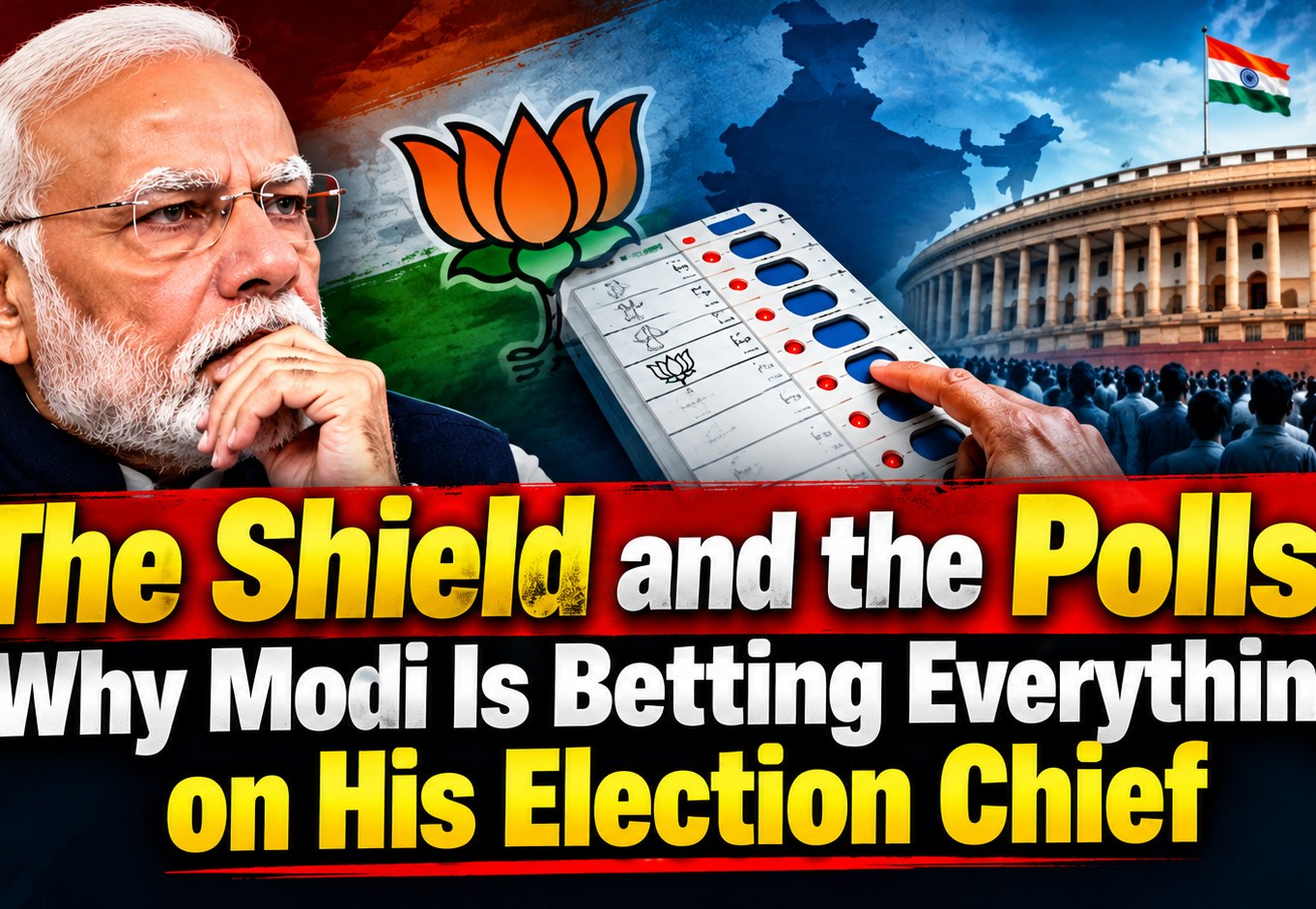
Across the political landscape of contemporary India, a familiar tension is returning to the capital. Delhi is simmering with unrest, and the focal point of the friction is no longer just a policy dispute or an ideological clash. It has crystallized into a direct confrontation over the actions of Chief Election Commissioner Gyanesh Kumar, a struggle that is steadily morphing into a referendum on Prime Minister Narendra Modi himself. With crucial assembly elections looming in Uttar Pradesh, the question preoccupying political observers is not merely why the opposition is up in arms, but why Modi refuses to drop a bureaucrat who has become a lightning rod for national discontent.
To the casual observer, the question might seem naive. The Chief Election Commissioner occupies a constitutional post, and a prime minister cannot simply dismiss the head of the election watchdog on a whim. Yet, in the practical mechanics of Indian governance, technicalities rarely dictate outcomes. If Modi truly wanted Kumar gone, mechanisms exist, ranging from parliamentary procedures to an honorable exit. Historical precedent offers clear parallels. When the nationwide farmers agitation reached a boiling point ahead of the previous Uttar Pradesh assembly elections in late 2021, and when scandals touched key ministers like Dharmendra Pradhan over examination paper leaks, the prime minister eventually recognized the political peril. Faced with the looming wrath of Jat farmers and mounting electoral damage, Modi stepped back, repealed the contentious agricultural laws, and recalibrated his administration.
Yet, in the present crisis surrounding the Special Intensive Revision of electoral rolls, the posture from the top is markedly different. The opposition has transformed what began as murmurs of electoral manipulation into a mass mobilization. When the Election Commission undertakes a revision process that reportedly impacts millions of voters, forcing citizens from all walks of life, from domestic workers to corporate drivers, to scramble for documentation just to retain their franchise, the friction ceases to be an abstract political debate. It becomes a personal grievance experienced directly by the electorate. The widespread nature of these administrative hurdles has lent credence to the narrative that something systematic is amiss within the poll panel.
The ruling Bharatiya Janata Party has gone to extraordinary lengths to insulate Kumar from accountability. The heavy-handed response to peaceful protests, deploying tens of thousands of security personnel, shutting down internet access, detaining critics, and clashing with members of parliament, has only deepened public suspicion. Compounding these anxieties is the unprecedented legal immunity granted to the election chief against civil and criminal prosecution even after retirement, a protection that even members of the judiciary do not enjoy, pushed through by a panel heavily weighted toward the executive. When the state deploys overwhelming force to shield a supposedly independent official, the public naturally infers that there is something substantial to hide.
This raises a central strategic dilemma for the prime minister. Modi has built his political brand on an image of unyielding strength, yet he has demonstrated flexibility in the past when electoral survival demanded it. The stakes in Uttar Pradesh could hardly be higher. The state remains the crown jewel of national politics; its arithmetic defines the stability of the central government. In the 2019 general election, the ruling party swept the state, but the 2024 results saw its tally plummet significantly, even witnessing a symbolic defeat in Ayodhya. Current projections suggest the upcoming assembly contest will be razor-thin. A defeat in Uttar Pradesh would not only threaten the party's future dominance at the national level but could also embolden restive coalition partners within the broader alliance.
Given the immense political fallout, why does the leadership continue to absorb the negative publicity rather than defuse the crisis by removing the official at its center? Two competing calculations appear to guide the government's hand.
The first option would be to sideline Kumar, thereby lowering the political temperature and removing a rallying cry for the opposition before the voters head to the polls. Such a move would neutralize a major vulnerability. However, the alternative calculation points in the opposite direction. There are persistent analyses suggesting a correlation between aggressive electoral roll revisions in certain regions and subsequent victories for the ruling party. If the BJP believes that retaining the current leadership at the election commission is indispensable for securing a favorable outcome in Uttar Pradesh, the short-term reputational cost of protests may be viewed as an acceptable price to pay. In high-stakes politics, victories are measured by their results, and critics have long argued that the means are easily overshadowed by the spoils of power.
Ultimately, Modi's refusal to distance himself from the Chief Election Commissioner exposes a calculated gamble. The prime minister must weigh the immediate cost of simmering national outrage and a galvanized opposition, embodied by leaders staging relentless street protests, against the perceived necessity of administrative alignment in the country's most vital electoral battleground. How this gamble plays out in Uttar Pradesh will not only determine the political fate of the state, but will also set the trajectory for Indian democracy in the years ahead.