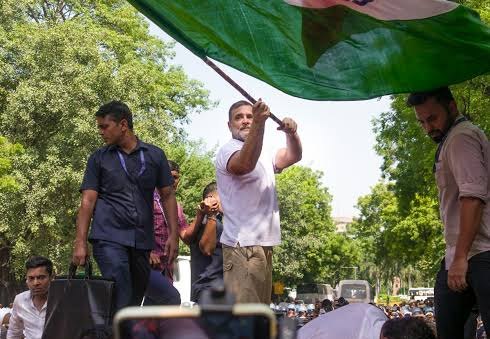
For a political leader who spent a decade serving as the prime punchline of his opponents, the recent metamorphosis of Rahul Gandhi is nothing short of startling. Long dismissed by the ruling Bharatiya Janata Party as an absentee dynast, a part-time politician prone to extended holidays, and a lightweight incapable of sustained grit, the leader of India’s opposition has undergone a deliberate tactical reinvention. He is no longer confined to the sterile, air-conditioned boardrooms where the Congress party historically drafted resolutions long past midnight, shielded from the morning papers and evening bulletins. Instead, Gandhi has taken to the asphalt, transforming himself into a perpetual street fighter whose protests dominate evening television screens and digital feeds across the nation.
This shift is far from accidental. It reflects a sophisticated, highly synchronized operation engineered to conquer the modern news cycle. Under the old regime of the United Progressive Alliance, the Congress Working Committee would convene late in the evening at the residence of party matriarch Sonia Gandhi. Those meetings routinely stretched past midnight, producing worthy communiqués that missed every print deadline and television bulletin. By morning, the deliberations were old news, easily buried beneath competing headlines. The party’s communication strategy was, by any objective standard, a masterclass in obscurity.
Gandhi and his dedicated campaign apparatus have completely dismantled that archaic machinery. Operating independently of the traditional party hierarchy, his team tailors every demonstration with a clinical understanding of how modern media is consumed. The protests rarely begin in the morning. Instead, they kick off shortly after lunch, typically around two or three in the afternoon.
This timing is anchored in the daily rhythm of Indian journalism. Around five or six in the evening, major newspaper editors, bureau chiefs, and desk heads gather for their primary editorial conferences. At these meetings, decisions are made regarding front-page layouts, lead editorials, and the defining narratives of the following day. By timing the crescendo of a street protest to coincide precisely with these editorial huddles, the opposition makes itself impossible to ignore. A demonstration featuring barricades breached, protesters bundled into police vans, and senior leaders clashing with law enforcement cannot be wished away by editors sympathetic to the government. It demands coverage, if only because the visual impact dominates the room.
The calculation extends seamlessly into the high-stakes world of prime-time television. Between six and eleven in the evening, prominent news anchors moderate high-decibel debates that command the attention of urban professionals, the salaried middle class, and younger demographic cohorts. These viewers return home from offices or universities around dusk, settling in with a cup of tea just as television screens light up with footage of Gandhi scaling police barricades, locking arms with allies outside high-security zones, or staging sit-ins at the doorsteps of the powerful. Even channels fundamentally aligned with the ruling establishment find themselves forced to engage with these images, dedicating precious broadcast hours to dissecting the opposition's latest escalation.
Digital consumption habits receive equal consideration. For Gen Z and younger metropolitan voters who bypass traditional print and linear television entirely, the afternoon protests translate into a torrent of viral reels and vertical video clips circulating on social media platforms by evening. Whether it is a quiet moment of sharing an energy drink with a fellow demonstrator, an unscripted stop at a roadside eatery, or a casual lunch meeting with opposition leaders at a popular capital restaurant, these humanizing fragments project a continuous aura of accessibility and momentum. The optics are carefully curated to convey a simple message: the opposition is united, active, and perpetually on the move.
The substance of the strategy matches its staging. These are not token demonstrations designed for fleeting visibility. Gandhi and his coalition partners are committing hours to physical confrontation, absorbing police batons, and pushing deep into restricted zones with calculated persistence. From sustained campaigns surrounding examination paper leaks to direct marches toward the election commission and the highest offices of the state, the agitation is relentless. By drawing regional allies and opposition leaders into the fold, the movement transcends a single party platform, casting Gandhi not merely as a factional leader but as the central anchor of a broader national resistance.
Political observers in New Delhi recognize this as a fundamental break from the past. For years, the ruling party defined the terms of political engagement, setting the agenda while the opposition floundered in disarray. By mastering the mechanics of the daily news cycle and wedding physical endurance to modern digital choreography, the opposition has reclaimed the narrative space. Whether this aggressive street-level defiance can successfully translate into durable electoral gains remains the ultimate question for Indian democracy. Yet for now, the enduring image of the country's principal opposition leader is no longer that of a distant heir in a conference hall, but of a determined combatant refusing to yield the pavement.