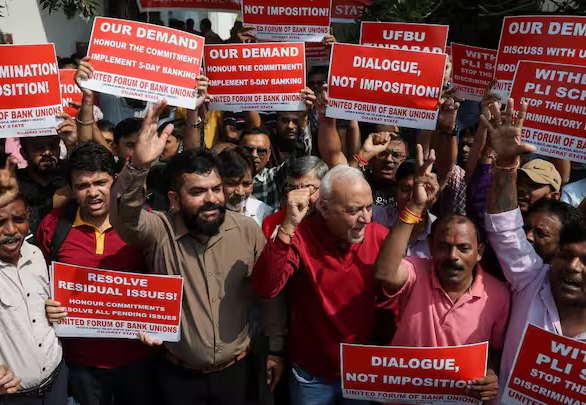
When the United Forum of Banking Unions (UFBU) announced the deferral of its nationwide three-day strike late on the evening of September 27th, financial circles in Mumbai and New Delhi offered a quiet sigh of relief. A complete shutdown of India’s state-owned banking network, which handles the bulk of the country’s fiscal transactions, would have caused significant disruption. Yet, the choice of wording in the press release issued by the union umbrella organization was precise and deliberate. The strike was deferred, not canceled or called off.
This subtle distinction carries considerable weight. The pause in industrial action reflects a temporary tactical holding pattern rather than a permanent resolution. The decision came after last-minute discussions convened by the Indian Banks’ Association (IBA) under directives from the Ministry of Finance. For now, high-level committees have been designated to examine core union grievances. However, the fundamental tensions dividing the central government and public sector bank personnel remain unresolved.
The Anatomy of Pressure
The deferral capped off weeks of escalating friction between public bank employees and government administration. In the run-up to the planned strike, authorities deployed an unusual array of measures designed to curb participation. Local administrations enforced restrictions prohibiting demonstrations within 50 meters of bank premises. In major hubs like Hyderabad, major rallies were displaced from traditional financial district venues to suburban exhibition grounds.
Internal management directives further heightened the stakes. Probationary staff received explicit warnings that joining industrial actions would negatively impact their performance appraisals and employment status. Management implemented facial recognition technology and monitoring protocols at key urban centers to track union mobilization. Additionally, officers in Grade IV and above were reassigned or placed under mandates to ensure branches remained open. In a further move to disrupt prep work ahead of the planned Monday walkout, branches were instructed to remain open on the preceding Sunday under the rationale of clearing customer backlogs.
Despite these measures, staff turned out wearing black badges in symbolic protest while performing scheduled duties. When unions signaled plans to escalate toward an indefinite strike in late October, official policy shifted from confrontation to direct negotiation, leading to the late-night accord on September 27th.
Wages, Schedules, and Structural Rifts
At the center of the dispute are two specific policy disagreements: implementation of a five-day workweek and restructuring of Performance-Linked Incentives (PLI).
The five-day week proposal is not a new demand. The principle of alternate Saturday holidays was recognized as early as the 10th Bipartite Settlement in 2015. By March 2024, the IBA and union representatives had finalized a formal written agreement to adopt a full five-day schedule, with employees committing to extend daily operational hours by 40 minutes to offset lost Saturday hours. Because around 80% of routine banking transactions occur through digital channels, and institutions like the Reserve Bank of India already observe a five-day schedule, the operational impact appeared manageable. However, implementation stalled within the Department of Financial Services, creating administrative friction. While unions agreed to offset the shift with daily extended hours, government clearance remained pending over lingering operational concerns, leading to the current agreement to refer the matter to a high-level stakeholder implementation committee.
The second major point of friction involves the distribution of Performance-Linked Incentives. While unions accepted the principle of linking variable pay to institutional profitability during bipartite negotiations, recent execution created sharp internal disparities. Under existing guidelines, incentive pools were capped at a maximum equivalent of 15 days' salary across staff levels. However, recent disbursements granted allocations equal to 365 days of base pay to senior executives in Grade IV to VII categories. This produced extreme compensation spreads, where junior staff received nominal payouts while senior executives collected sums ranging from 20 lakh to 30 lakh rupees.
Unions argued that this approach undermined operational cohesion within branches, where overall performance relies on collective effort across all cadres. They demanded an equitable distribution based on uniform salary multiples rather than unilateral executive payouts. Following the latest negotiations, this policy has been referred to a joint committee tasked with reviewing the scheme's overall structure.
The Broader Economic Debate
Beyond working conditions and pay equity, the disagreement touches on broader questions regarding the strategic role of public sector banks, particularly concerning corporate bad debt and financial inclusion mandates. Over the past twelve years, state banks have written off approximately 18.79 lakh crore rupees in non-performing assets. Under the Insolvency and Bankruptcy Code (IBC) framework, formal debt resolutions have frequently involved substantial reductions in principal recovery, commonly known as haircuts, for corporate borrowers.
Union leaders have raised concerns regarding these write-offs, advocating for greater public transparency regarding persistent corporate default cases, strict recovery measures, and statutory restrictions to prevent major defaulters from accessing political office. Management and government representatives, meanwhile, maintain that debt resolutions remain strictly governed by statutory secrecy laws and formal IBC proceedings.
Furthermore, staff organizations have voiced opposition to the expanded implementation of retail service charges on routine activities, such as automated teller machine withdrawals, physical check processing, and digital payments like UPI, alongside non-viable social mandates. While management views these fees as necessary under cost-recovery models and commercial bank autonomy, union leadership views them as detrimental to public financial access.
From the perspective of bank personnel, state-owned institutions serve a dual purpose: maintaining commercial viability while providing broad public financial access. They point to the low yields offered on basic savings deposits relative to prevailing inflation as a factor driving retail savings toward higher-risk speculative assets. Additionally, unions argue that wholesale lending to non-banking financial companies (NBFCs) at lower institutional interest rates allows intermediaries to re-lend to retail borrowers at significantly higher margins, rather than direct state-bank lending serving those segments directly.
An Uncertain Outlook
The deferral of the September strike provides a temporary window for negotiation. The joint committees established during the September 27th meeting are tasked with developing workable frameworks for the five-day workweek and reviewing incentive scheme structures.
In industrial relations, deferrals function as an intentional pause to allow administrative processes to work. Should the committee process yield concrete operational guidelines, the immediate risk of banking disruptions will subside. However, if negotiations stall without clear progress, the United Forum of Banking Unions retains the option to resume strike actions. For India's financial sector, the coming months will test whether institutional dialogue can resolve these deep-seated structural disputes.