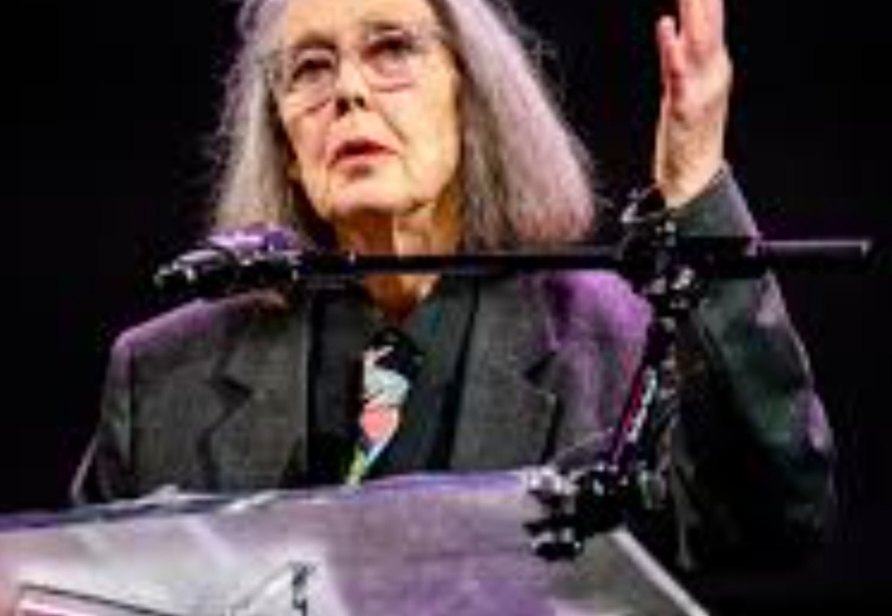
On 8 October 2026, in Stockholm, the Swedish Academy announced Canada's Anne Carson as this year's Nobel laureate in literature. Ingrid Carlberg, the Academy's permanent secretary, made the announcement. Carson, who receives the honour at the age of seventy-six, is a poet, writer, essayist and classicist. The prize money is 12 million Swedish kronor, and the formal ceremony will take place in Stockholm in December. Last year's prize went to the Hungarian novelist László Krasznahorkai, and now the honour passes to a poet. The Academy's citation describes her work as bold and inventive. In its view, she has entered into a playful dialogue with the classical tradition and created new forms for contemporary literature. That single sentence holds three features of Carson's writing: her closeness to the ancient world, the playfulness within that closeness, and her constant experiments with literary form. She has crossed the boundaries between poetry, prose, translation and drama so effortlessly that, picking up any of her books, the question of what genre it belongs to often hardly matters.
Anne Patricia Carson was born on 21 June 1950 in Toronto, Canada, and was educated at the University of Toronto, where she earned a BA in 1974, an MA in 1975 and a PhD in 1981. Ancient Greek language and literature have remained the centre of her scholarship. She went on to teach at institutions such as Emory, Princeton, McGill and the California College of the Arts, and she currently teaches classics and comparative literature at the University of Michigan.
One distinctive thread in her writing is a fascination with the origins of words. She has said that etymology is the starting point of all her work. Her poems take shape as she traces where a word came from, which meanings it has acquired over time and which it has lost. As a result, her lines travel from ancient Greek to today's spoken idiom in a single breath. Her outlook suggests that language is not merely a vehicle for thought but a living archaeological layer. Her work as a translator has become so fused with her own poetry that it is hard to separate the two.
An important milestone in her career was Eros the Bittersweet, published in 1986. It grew out of a dissertation she had written in 1985 on Sappho, the ancient Greek poet. Asking why love is at once sweet and bitter, Carson unfolds a philosophy of desire, lack and distance. The book's central idea is that what we long for in love is exactly what we do not have, and that this absence is what gives birth to love. It did not remain a work of literary criticism alone; readers received it as a reflective essay on the nature of love.
In 1998 she published Autobiography of Red, a novel in verse and one of her best-known works. Loosely based on a Greek myth, it brings the story of the monster Geryon and his friend Herakles into the modern age, where a shy boy with a camera searches for his own identity. The daring of joining an ancient myth to the turmoil of a modern teenager overwhelmed readers.
The Beauty of the Husband, which appeared in 2001, brought her the widest recognition. Its subject is the slow collapse of a marriage, told as a long narrative in poetry. The book won the T. S. Eliot Prize, making her the first woman to receive it. Each chapter opens with a line drawn from Keats. Seldom has the tangle of love, betrayal and beauty been presented so directly and so painfully. The portrait of how a husband's beauty becomes a curse for his wife unsettles the reader and also compels thought.
Her list of honours is long. She received a MacArthur Fellowship in 2000, and later won the Governor General's Award and the Lannan Literary Award. She became the first woman to win the Griffin Poetry Prize, for Men in the Off Hours, and the first to win it a second time, for Red Doc. In 2020 her Norma Jeane Baker of Troy received the Governor General's Award, and in the same year she was given Spain's prestigious Princess of Asturias Award. In 2021 she received the PEN/Nabokov Award for Achievement in International Literature.
The title Norma Jeane Baker of Troy often provokes curiosity. The work merges Helen of Troy with Marilyn Monroe, creating a picture of two women the world knows for their beauty but whose inner selves no one knows. Though born thousands of years apart, the two figures are placed at opposite ends of one experience. The sweep of references in her poetry is astonishing. Helen of Troy, Hector and the Gorgons appear alongside Virginia Woolf, Gertrude Stein and Emily Brontë. In her writing, the wall between the ancient and the modern barely exists.
The quest of the spirit and the soul is another stream in her work. Decreation, inspired by the ideas of Simone Weil, deals with the dissolution of the self. In dialogue with French mystical thought, the book gently unfolds the notions of diminishing oneself, dissolving the ego and drawing closer to the divine. Indian readers will find the theme familiar: it is a Western counterpart of what saints and seekers have taught about renouncing the ego and becoming one with the ultimate reality. Hence her poetry offers a singular way of looking at love, death and God.
Collaboration is another distinctive feature of her literature. She has worked with the Merce Cunningham Dance Company, Laurie Anderson, Lou Reed and the visual artist Kim Anno. Her ties with dance, music and painting have been continuous, and her writing has never been confined to the printed page. Some of her books are designed to unfold from a box or like a single scroll, insisting that the reader handle an object rather than turn pages. She has shown that literature can be a physical, tactile experience.
The choice was not sudden. For many years her name had been counted among the likely contenders. In 2018, when the prize was suspended owing to the Academy's internal controversy, Carson was among the writers on the longlist for the "New Academy Prize", the one-off alternative award. This year too, before the announcement, forecasts around the world placed China's Can Xue and Carson at the front, with Japan's Haruki Murakami and America's Thomas Pynchon also discussed. In the end the Academy ruled in Carson's favour.
There is one more reason to welcome the decision. In recent years the Nobel has often favoured novelists, so a turn towards poetry is a pleasant change for readers. Carson's poetry is not easily understood. It has unexpected turns; sometimes lines end abruptly, and sometimes a single sentence runs the length of a page. Yet she has embraced this difficulty deliberately. Before meaning comes within reach, the reader must wrestle with the words, and that struggle becomes the real pleasure of reading. Her work is therefore not for hurried reading; it matures slowly.
Her reaction right after the announcement revealed her character. She said she had already begun planning how to give the prize money away. She also had a small piece of advice for readers curious about her work: find the middle and start from there. The advice suits her style. She does not accept the conventional rule of reading from the beginning; she believes one may enter at any point and let the web of meaning unfold from there.
Carson's message may be especially meaningful for Indian readers. The conflict between tradition and modernity is a recurring debate here too. Carson shows that ancient literature is not a museum piece. It can speak to the lives of people today, question them and give words to their feelings. It can also inspire a fresh look at devotional poetry, folk songs and mythology. The lesson of her work is that respect for tradition and playful boldness towards it can be held together.
Finally, although this honour celebrates one individual, it also celebrates a particular literary temperament. The Academy has recognised curiosity, devotion to words, an exploration of the complexity of human relationships and the courage to cross the boundaries between art forms. When she receives the award in Stockholm in December, her poems will reach new readers. For those who have not yet read her, the best way in, as she herself advised, is to begin from any midpoint.