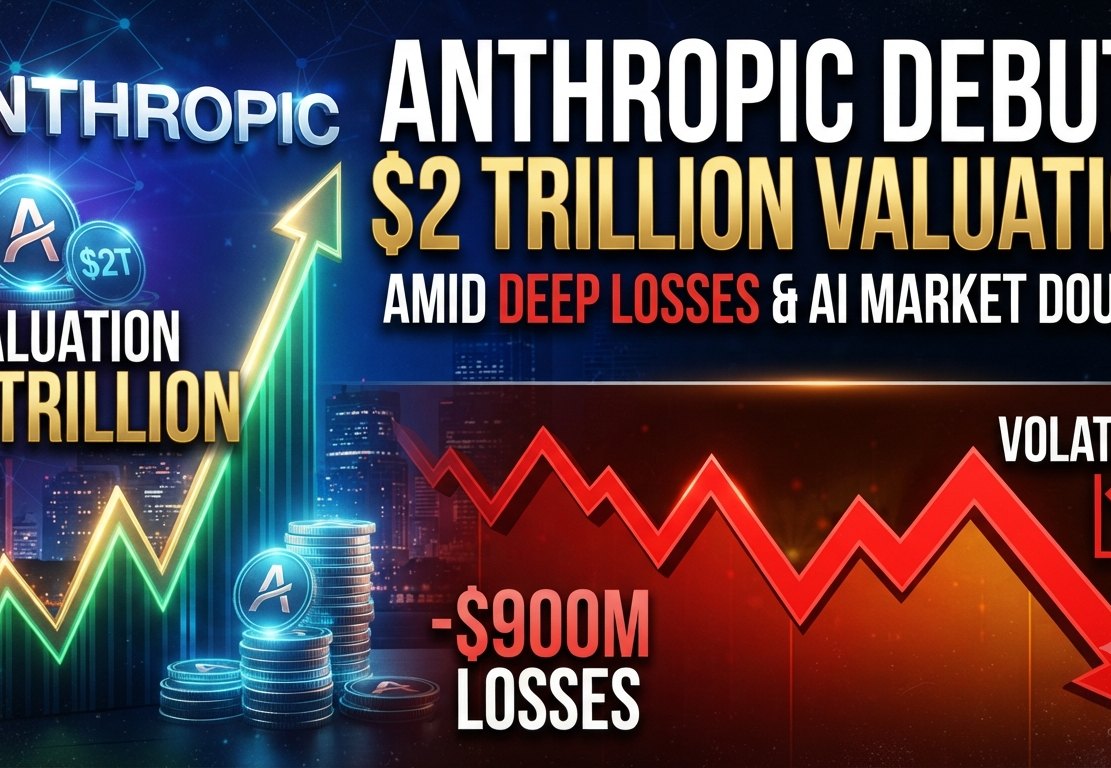
Anthropic, a company founded in 2021 by seven former OpenAI employees who split over disagreements on how artificial intelligence should be developed, has made a dramatic entry into the public market through its initial public offering. Prior to this move, ownership had remained restricted to founders, investors, and staff holding stock options. Opening at 83 dollars per share, the stock surged to 115.1 dollars during its debut and closed its first day 34 percent higher than the opening price. By the end of the trading week, the share price stood at 88.91 dollars, after falling 8.26 dollars or 8.5 percent on Friday alone. Even with that pullback, the weekly closing price remained above the initial offering level, pushing the company's valuation to 2 trillion dollars after initial estimates had placed it around 1.5 trillion dollars. That surge transformed what began as a prospective third-largest IPO into the largest IPO by valuation, surpassing the gross domestic product of Saudi Arabia and exceeding the combined value of the top ten listed companies in India.
The rapid rise in valuation has created substantial paper wealth across the organization. Out of 5,300 employees, 5,100 now hold shares worth more than 1 million dollars. About 2,800 employees hold stakes exceeding 10 million dollars, and 600 employees hold stakes reaching 100 million dollars. Each of the seven founders holds a stake valued at roughly 23 billion dollars. Much like Nvidia over the past five years, Anthropic has drawn massive investor interest because its business sits at the center of artificial intelligence. Tools such as Claude, particularly for coding alongside offerings like legal assistance, have gained strong traction. In information technology workplaces, developers frequently generate code with Claude, review and revise it, and streamline their work, a shift linked to fewer entry-level jobs in several companies.
Beneath the headline numbers, however, the public listing raises sharp questions about profitability, governance, and market expectations. During the first nine months of 2026, Anthropic recorded 33 billion dollars in revenue against 104 billion dollars in losses. Market capitalization reflects share price multiplied by total shares rather than current earnings, and investors are backing expectations of future returns from artificial intelligence rather than present profits. Still, the gap between heavy losses and a multi-trillion-dollar valuation highlights a central tension: when profitability remains uncertain, how long can investor optimism sustain such high valuations, and when will the company turn profitable?
A second tension centers on public interest versus shareholder returns. When Anthropic was formed after the departure from OpenAI, its founders framed it as a public interest company focused on public good above shareholder and investor gains. Once a company lists on the stock market, delivering returns to shareholders becomes a primary pressure. This raises a practical test for leadership: if a product or technology generates strong profits but carries risks to the public, will the company voluntarily step back or curb it in the interest of public good?
A third set of questions surrounds artificial intelligence safety and heavy commercial investment. The founders left OpenAI emphasizing responsible development and preventing artificial intelligence from becoming dangerous, and Anthropic's leadership has publicly warned about severe risks, including threats to human survival. At the same time, the company is investing heavily in artificial intelligence systems and expanding practical tools like Claude. Observers are left asking how the company reconciles warnings about existential risk with aggressive expansion, and whether it is positioning itself as uniquely safe to guard artificial intelligence safety while others are not.
The timing of the offering adds to the uncertainty around artificial intelligence markets. Questions over whether artificial intelligence will generate reliable profits have grown louder, and many observers expect a bubble, not technological but financial, to burst eventually. On the day Anthropic launched its IPO, the Nasdaq moved into negative territory, and shares of major technology and artificial intelligence companies declined, including Alphabet, Meta, Amazon, and Nvidia. Broader markets across regions tied to artificial intelligence investment, including the United States, Japan, South Korea, Taiwan, and Hong Kong, also saw losses. Even as Anthropic drew strong initial demand and reached a 2 trillion dollar valuation before sliding from its peak toward 88.91 dollars by week's end, broader selling suggested that investors remain anxious about future profits. Whether Anthropic's high valuation holds up in upcoming trading weeks, and how these contradictions between steep losses, safety warnings, public-interest claims, and market volatility resolve, remains an open question.