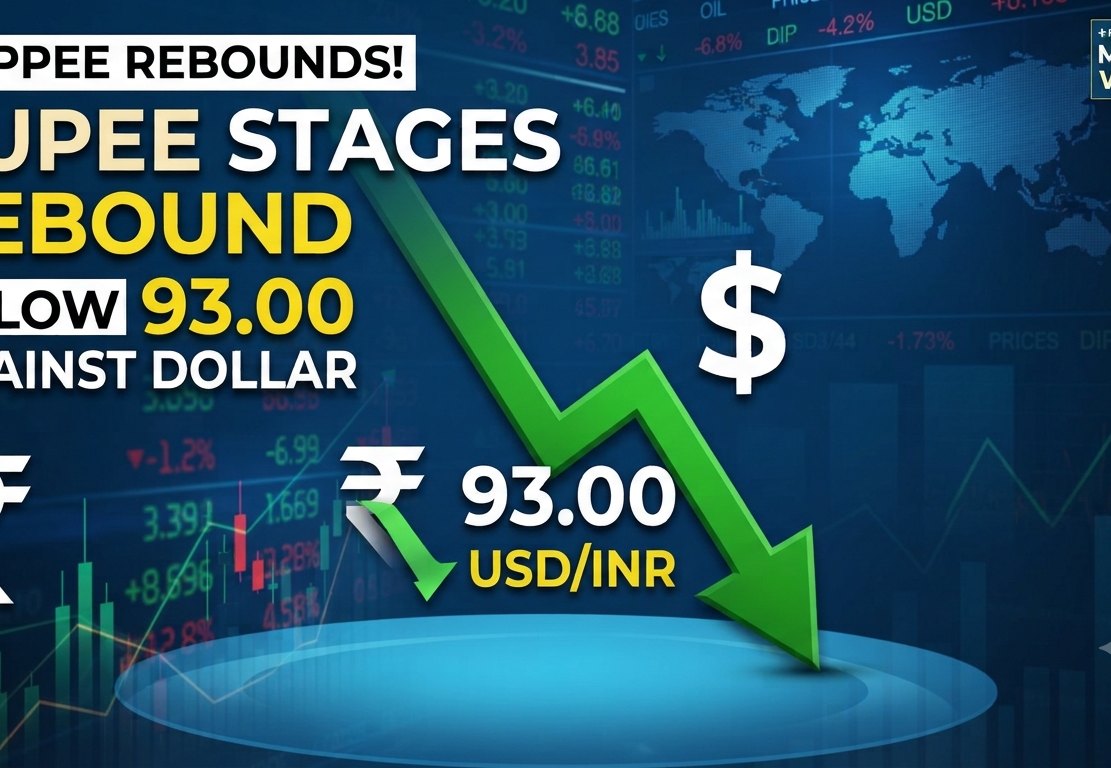
The Indian rupee has moved back below 93 per dollar, trading around 92.715 and easing fears of a slide toward 100 after touching roughly 97 per dollar during a period of heavy downward pressure. Projections now suggest the currency could even see further appreciation into 2027 and 2028 if current global and domestic shifts hold.
Exchange rates reflect a constant two-way movement between the rupee and the dollar. When demand for dollars rises, the dollar strengthens, or dollar inflows slow down, pressure builds against the rupee. Conversely, when dollar supply improves or the dollar weakens against other currencies, room opens up for the rupee to gain ground. Domestic economic conditions alone do not set that path. Global currency flows, geopolitical tensions, geo-economic developments, and economic shifts in the United States all play a role.
A primary factor behind the recent rebound is a pullback in crude oil prices. India imports about 89 percent of its oil needs and spends roughly one-third of its total import bill on oil, making the economy heavily energy-dependent and sensitive to price swings. Oil prices had climbed to around 117 dollars per barrel before easing back to roughly 92 dollars, including in oil futures trading. That retreat has been linked to expectations that war momentum under Donald Trump could cool following United States midterm results, especially as Democrats gained ground in Congress and are seen as likely to check escalations toward war, even amid intermittent mutual strikes. Lower oil prices mean lower dollar outgo on energy imports, easing strain on the rupee.
Cooling precious metals prices represent a second major driver. India relies on imports for gold rather than domestic production, alongside limited recycled gold coming from households selling or reshaping jewelry, while the central bank has been buying rather than selling gold. Because oil and gold are traded in dollars, high bullion prices increase dollar demand and weigh on the rupee. Gold prices had surged to 1,80,000 rupees on January 30, 2026, before dropping to around 1,30,000 rupees, a decline of nearly 50,000 rupees or close to 30 percent. Silver has fallen by nearly 65 percent, with expectations of further declines. Lower prices reduce the dollar burden tied to importing these metals.
A third shift involves foreign investment returning to Indian equities in November after heavy outflows. Earlier in the year, more than 30 billion dollars in foreign investment exited the Indian stock market. That outflow coincided with strong investor interest in artificial intelligence markets in places such as the United States, Japan, South Korea, China, and Hong Kong, where Indian companies have limited AI presence, leaving Indian equities lagging while those markets rose or held up better. More recently, nervousness around AI profitability and safety, along with questions over Nvidia following a Jensen Huang controversy, has slowed the pace of AI investment growth, even as Anthropic saw a strong public offering. As enthusiasm around AI investments cools slightly, foreign capital has started flowing back into Indian stocks.
A softening dollar index adds a fourth layer of support. The dollar index measures the dollar against a basket of currencies and stood near 103.76 in recent trading, staying under 104. In 2025, the dollar index dropped by roughly 10 percent and fell below 100, at times under 99, before climbing again in 2026 as conflict boosted dollar-denominated trade in oil and weapons. With the dollar index easing back from those highs, pressure on the rupee has lightened further.
Underlying macroeconomic indicators remain part of the broader backdrop rather than new catalysts on their own. India continues to hold comfortable foreign exchange reserves and posts growth rates around 7.8 percent to 8 percent. Yet the recent recovery below 93 per dollar rests on these shifting external and market pressures, with cheaper oil and gold, renewed equity inflows, and a softer dollar index taking weight off the currency.