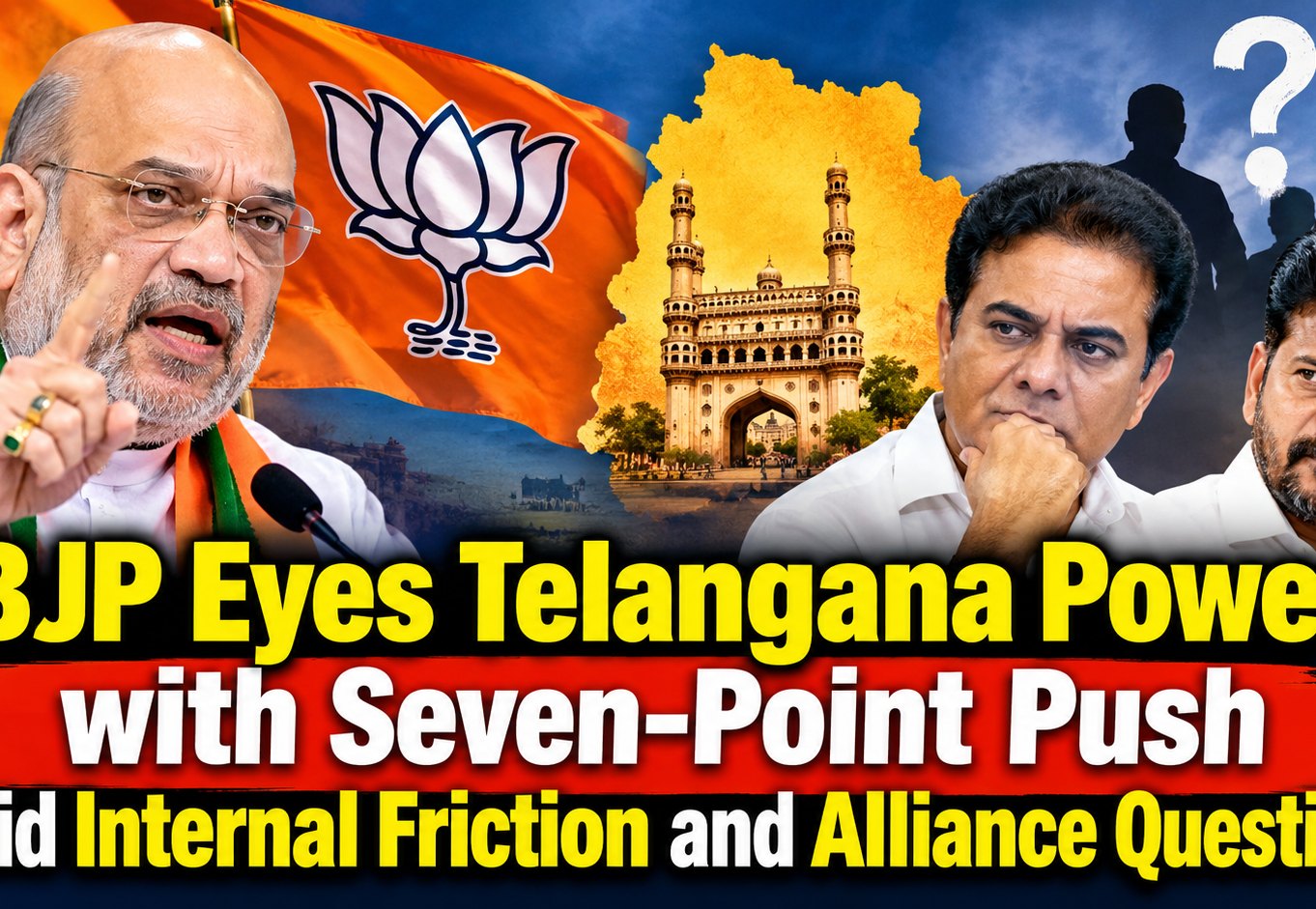
Recent meetings in Hyderabad involving Union Home Minister Amit Shah and prominent figures from cinema, politics, and business have reignited debate over whether the Bharatiya Janata Party can capture power in Telangana. Confident claims that the party will win 100 percent of the state have fueled brisk discussion across political circles and media reports. Whether such confidence translates into electoral victory remains uncertain, yet the broad contours of a seven-part strategic blueprint are taking shape as the BJP attempts to chart a path forward in the state.
The first pillar of this approach centers on direct command from the central leadership. Rather than leaving campaign management and strategic decisions solely to the state unit, top national leaders are drawing control closer to New Delhi. Feedback is being gathered from within the state, from outside the state, from within party ranks, and through external non-party channels so that strategy can be drafted and executed continuously from the center. This shift reflects a lack of confidence, both inside the BJP and among outside observers, that the state leadership alone can carry the party into government. When a figure like Amit Shah speaks of winning, observers pay attention because of his track record in states such as Uttar Pradesh and West Bengal. At the same time, past experiences show that national strategies crafted with northern India in mind often falter in southern states where direct familiarity with local dynamics is limited. Reading the ground pulse in southern India has repeatedly proven difficult for central planners, leading to missteps at the state level.
Bringing unity to the state leadership forms the second part of the plan, though its prospects are widely questioned. Factionalism has long plagued the BJP in Telangana, with observers noting that even a handful of leaders can fracture into multiple rival groups. Visits by national leaders, including Amit Shah, Nitin Nabin, and B.L. Santhosh, have frequently been accompanied by internal meetings marked by warnings and reprimands. Reports have even suggested that Prime Minister Narendra Modi has rebuked Telangana Members of Parliament over their conduct. Despite repeated interventions from above, cohesion within the state unit remains elusive, leaving open how durable unity will be achieved.
A third element involves contesting elections independently. Reports indicate that the BJP favors going it alone in Telangana, largely because aligning with the Telugu Desam Party and Jana Sena is viewed as a liability given prevailing local sentiments in the state. In neighboring Andhra Pradesh, the TDP and Jana Sena operate in an alliance, and Jana Sena leaders have signaled electoral ambitions in Telangana as well. A Jana Sena candidate is in the fray for the Khammam, Nalgonda, and Warangal graduates legislative council constituency, while the BJP has neither announced its own candidate nor declared support for Jana Sena. Pawan Kalyan has spoken assertively about looking after interests in Telangana, and Nara Lokesh has voiced confidence from Andhra Pradesh about a return to power in Telangana for the TDP. These overlapping ambitions raise sharp questions over whether the BJP will compete against them, partner with them, or hold them back from contesting in Telangana. In past elections, the TDP stayed out of the race and Jana Sena extended support without contesting, prompting debate over whether Telangana politics will be subordinated to Andhra Pradesh political calculations or vice versa. For now, contesting independently is seen as the preferred route to avoid baggage tied to regional sentiment.
Social engineering represents the fourth plank of the strategy, pairing Hindutva appeals with targeted caste and community arithmetic. Across India, the BJP blends cultural mobilization with coalition building across social groups. Examples elsewhere illustrate how these alignments are constructed: in Karnataka, Lingayats have formed a loyal base for the BJP alongside Vokkaliga support for the Janata Dal (Secular) and Siddaramaiah's Ahinda outreach uniting backward classes, scheduled castes, scheduled tribes, and minorities. In Uttar Pradesh, upper castes have been paired with non-Yadav Other Backward Classes such as Rajbhar and Suheldev groups, alongside Rashtriya Lok Dal ties reaching Jat voters and outreach to non-Jatav Dalits outside Bahujan Samaj Party ranks. In Bihar, elevating Samrat Choudhary from a Most Backward Class background highlighted that caste calculus. In Telangana, observers point toward a possible M3 or three-M formula centered on Munnuru Kapu, M Mudiraj, and Madiga communities. Ahead of the previous assembly elections, the party pledged to name a Backward Class chief minister and projected two prominent leaders from distinct backgrounds rather than a single face: Bandi Sanjay Kumar from the Munnuru Kapu community and Eatala Rajender from the Mudiraj community. Outreach to the Madiga community through scheduled caste categorization and gestures of respect toward Krishna Madiga forms another piece of this social mosaic.
Recruiting leaders from rival parties is the fifth pillar, aimed at addressing a glaring organizational gap. A major hurdle for the BJP in Telangana is the shortage of local leaders capable of polling around 10,000 votes on their own across all 119 assembly constituencies. Having strong contenders in only a small handful of seats makes winning a majority difficult. Bringing established figures in from outside is viewed as a practical shortcut when homegrown candidates are lacking, much like drawing a strong player from elsewhere when a team lacks depth in a position. A similar playbook was used earlier by K. Chandrashekar Rao after the Telangana Rashtra Samithi came to power, drawing influential leaders from a weakening Telugu Desam Party across districts, aided by personal ties from his own past in that party. Notable figures brought into that fold included Tummala Nageswara Rao in Khammam, Kadiyam Srihari in Warangal, Talasani Srinivas Yadav in Hyderabad, Errabelli Dayakar Rao in Warangal, Patnam Mahender Reddy in Ranga Reddy, and Mandava Venkateshwar rao in Nizamabad. Now, the BJP is looking to draw leaders from other parties, particularly the opposition Bharat Rashtra Samithi, to build viable faces across assembly segments, while anticipating potential seat expansion from delimitation that could help accommodate both existing and incoming leaders.
The sixth element relies on familiar Hindutva politics. Campaigning along these lines often sharpens Hindu-Muslim polarization, targets Asaduddin Owaisi, raises debates over Hyderabad versus Bhagyangar, and brings up issues such as Rohingya migrants, keeping a combative ideological pitch active.
Finally, a seventh component operates as a psychological and narrative push. High-profile assertions from a leader of Amit Shah's stature are designed to signal momentum, spark widespread public discussion, and build an impression that victory is within reach. Shaping that perception is itself part of political messaging, leaving the central question of how much of this seven-point strategy will succeed in Telangana still to be tested.