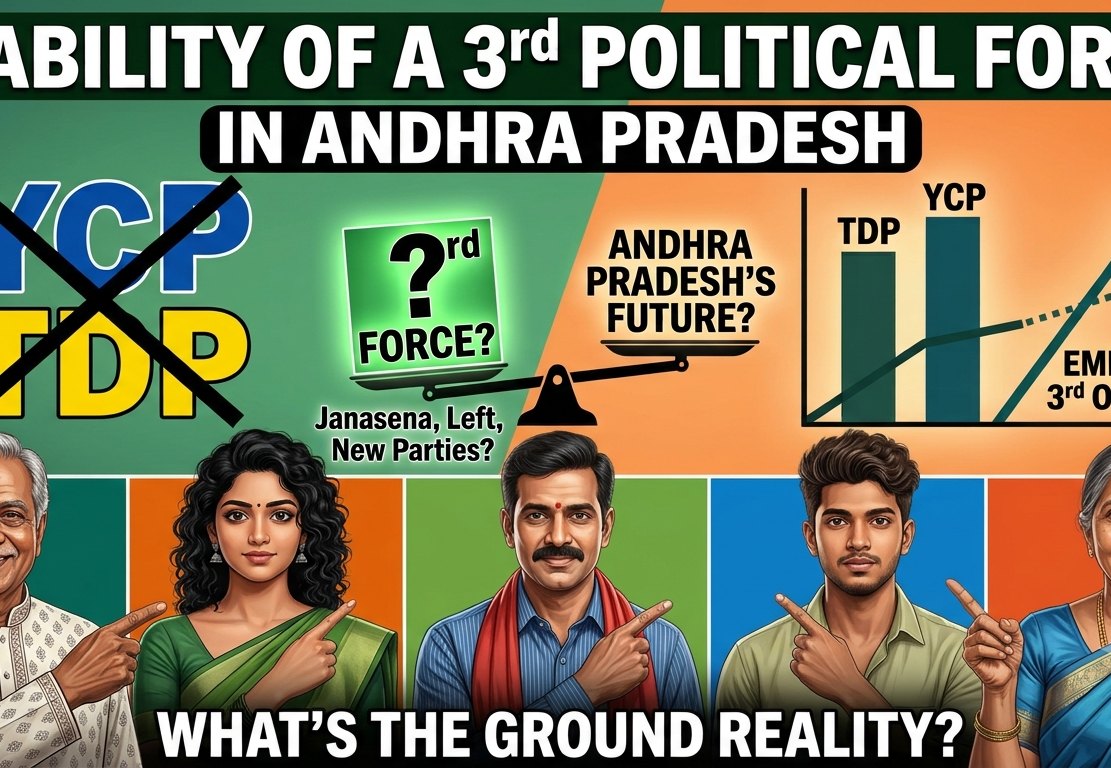
The Emergence of Parivartana Rajaneethi Party
The political landscape of Andhra Pradesh has seen an e addition with the launch of a new political formation named the Parivartana Rajaneethi Party(PRP), founded by former Member of Parliament V. Vijayasai Reddy. This development brings the viability of a third political force back into public discourse. Historically, the state has witnessed various parties attempt to carve out a distinct third political space outside the traditional duopoly of the Indian National Congress (INC) and the Telugu Desam Party (TDP), and later the Yuvajana Sramika Rythu Congress Party (YSRCP). Past attempts include the Praja Rajyam Party (PRP) founded by actor-turned-politician Chiranjeevi, the Lok Satta Party founded by Jayaprakash Narayan, the Jai Bharat National Party founded by former Joint Director of CBI V.V. Lakshminarayana, and electoral maneuvers by Janasena Party led by Pawan Kalyan before entering into an alliance framework, alongside independent efforts by former Director General of Police A.B. Venkateswara Rao.
The core question facing political analysts is whether a third alternative can genuinely sustain itself and capture power in Andhra Pradesh, or if it will remain a peripheral player. Examining electoral history provides empirical context regarding how political space functions at both national and regional levels.
The Dynamics of the Third Political Space
In national elections across India, the two major national parties—the Bharatiya Janata Party (BJP) and the Indian National Congress—frequently secure a combined vote share that hovers between 50 and 60 percent. This leaves roughly 40 to 50 percent of the electorate engaging with other political entities or regional alternatives. At the state level, a distinct third political space typically accounts for around 20 percent of the vote share, though this figure fluctuates.
For instance, following the Kargil conflict, the BJP recorded a notable vote share of approximately 18 percent during its formative growth phase. Similarly, when Chiranjeevi launched the Praja Rajyam Party in 2009, it secured around 71 million votes, translating to an 18 percent vote share and 18 assembly seats. In Tamil Nadu, initial projections for actor Vijay's political entry also centered around a 15 to 20 percent baseline political space.
This 20 percent baseline is not static. It can shrink to 5 or 10 percent, or expand to 30 to 35 percent depending on prevailing political conditions. In Andhra Pradesh, intense polarization between the major established leaders and parties—specifically the traditional bipolar rivalry between the Telugu Desam Party and the YSRCP, reinforced by strong caste consolidation on both sides—tends to squeeze the available political space for a third force. During the recent local body and assembly elections, the combined vote shares of the dominant coalition and the primary opposition left a narrow margin of roughly 10 percent for alternative political maneuverability. Consequently, while a baseline third political space inherently exists, translating that space into an outright electoral victory requires specific catalytic conditions.
Historical Lessons from Past Political Experiments
Evaluating past political movements in the region highlights why certain third-force attempts succeeded while others faltered.
1. Timing and Context
The timing of a party’s launch dictates its reception. When Chiranjeevi established the Praja Rajyam Party in 2009, he faced two formidable political figures in Y.S. Rajasekhara Reddy and N. Chandrababu Naidu, heading deeply entrenched parties. Convincing voters to abandon established alignments proved difficult.
A different timeline might have yielded alternative outcomes. Had the party been launched prior to 2004, before Y.S. Rajasekhara Reddy undertook his famous padayatra and consolidated anti-incumbency sentiment against the incumbent Telugu Desam Party government or had it allied effectively with Left parties that instead chose an alignment with the TDP, the political trajectory of undivided Andhra Pradesh could have been fundamentally altered. Electoral calculations indicate that an alliance between the Praja Rajyam Party and Left parties in 2009 could have secured 60 to 70 assembly seats, creating a powerful tripartite contest. Strategic missteps in coalition-building often dissipate a newly emerging third political space.
2. Consistency and Continuity
Sustained political presence is critical. Chiranjeevi’s initial electoral entry in 2009 secured 18 assembly seats, drawing intense public and media focus, with the party leader securing a prominent seat in the legislative council proceedings. However, the lack of long-term organizational consistency and continuity eroded momentum.
A contrasting example of sustained persistence can be seen outside the state with Mamata Banerjee in West Bengal. Breaking away from the Indian National Congress to form the Trinamool Congress (TMC) when the Left Front held entrenched power, she maintained persistent grassroots pressure until her party dismantled the incumbent structure and assumed power in 2011. Similarly, Arvind Kejriwal in Delhi and the Aam Aadmi Party in Punjab demonstrated how prolonged anti-corruption and civic movements can eventually displace established parties.
In Andhra Pradesh, Pawan Kalyan’s Janasena Party also undertook independent electoral experiments in 2019, contesting alongside alternative fronts before eventually entering into a coalition framework to prevent anti-incumbency votes from splitting. While ideological purity is often demanded of third forces, practical electoral pressures frequently compel alignment to secure legislative representation.
3. Charisma and Organizational Strategy
Charisma alone does not guarantee electoral success. Tamil Nadu provides clear comparative examples: M.G. Ramachandran and Jayalalithaa succeeded within established political frameworks, and actor Vijay secured a distinct entry, whereas actors like Rajinikanth, Kamal Haasan, and Vijaykanth experienced different electoral outcomes despite possessing immense mass popularity.
In undivided Andhra Pradesh, N.T. Rama Rao achieved a historic electoral landslide by founding the Telugu Desam Party, whereas megastar Chiranjeevi and prominent actor Pawan Kalyan faced different electoral hurdles. Charisma provides an initial spark, but long-term success requires organizational depth, disciplined propaganda, effective campaign strategies, and public trust.
4. Socio-Political Movements
Third alternatives frequently emerge from deep-seated socio-political movements rather than top-down political announcements. The rise of the Telangana Rashtra Samithi (TRS)—now Bharat Rashtra Samithi (BRS)—was fueled by grassroots momentum stemming from the Telangana statehood movement. Conversely, leaders who attempted to launch parties based on top-down sentiments, such as Kiran Kumar Reddy's Samaikyandhra Party following state bifurcation, failed to gain traction because the movement lacked organic grassroots anchoring compared to regional identity struggles.
5. The Caste-Plus Formula
Caste remains an influential factor in Indian electoral politics. Successful third-force formations in northern and western states relied on a "Caste-Plus" formula rather than relying on a single community.
In Andhra Pradesh, dominant communities such as the Kammas and Reddys formed the backbone of the TDP and YSRCP respectively. Other significant communities, including the Kapu demographic, possessing substantial numerical strength and political aspirations, historically experienced fluctuating voting patterns due to the absence of a consolidated, broad-based anchor. Observers note that any third force aiming to break the bipolar dominance must successfully unite a core demographic anchor with broader, marginalized communities that lack adequate political participation.
Conclusion through Scientific Analogy
Political transformations often mirror physical principles. Applying the First Law of Motion—the law of inertia, which states that a body remains at rest or in uniform motion unless acted upon by an external force—helps explain political stagnation. The established duopoly maintains a state of political inertia.
To break this inertia and successfully elevate a third political space from a marginal 10 percent baseline into a governing force exceeding 30 percent, seven critical catalysts must align: favorable timing, unwavering consistency, charismatic leadership backed by robust organization, deep-seated socio-political movements, effective broad-based coalition formulas (Caste-Plus), strategic resource mobilization, and the intervention of external political dynamics. Without these combined forces, alternative political experiments risk fading into the background of an entrenched two-party system.