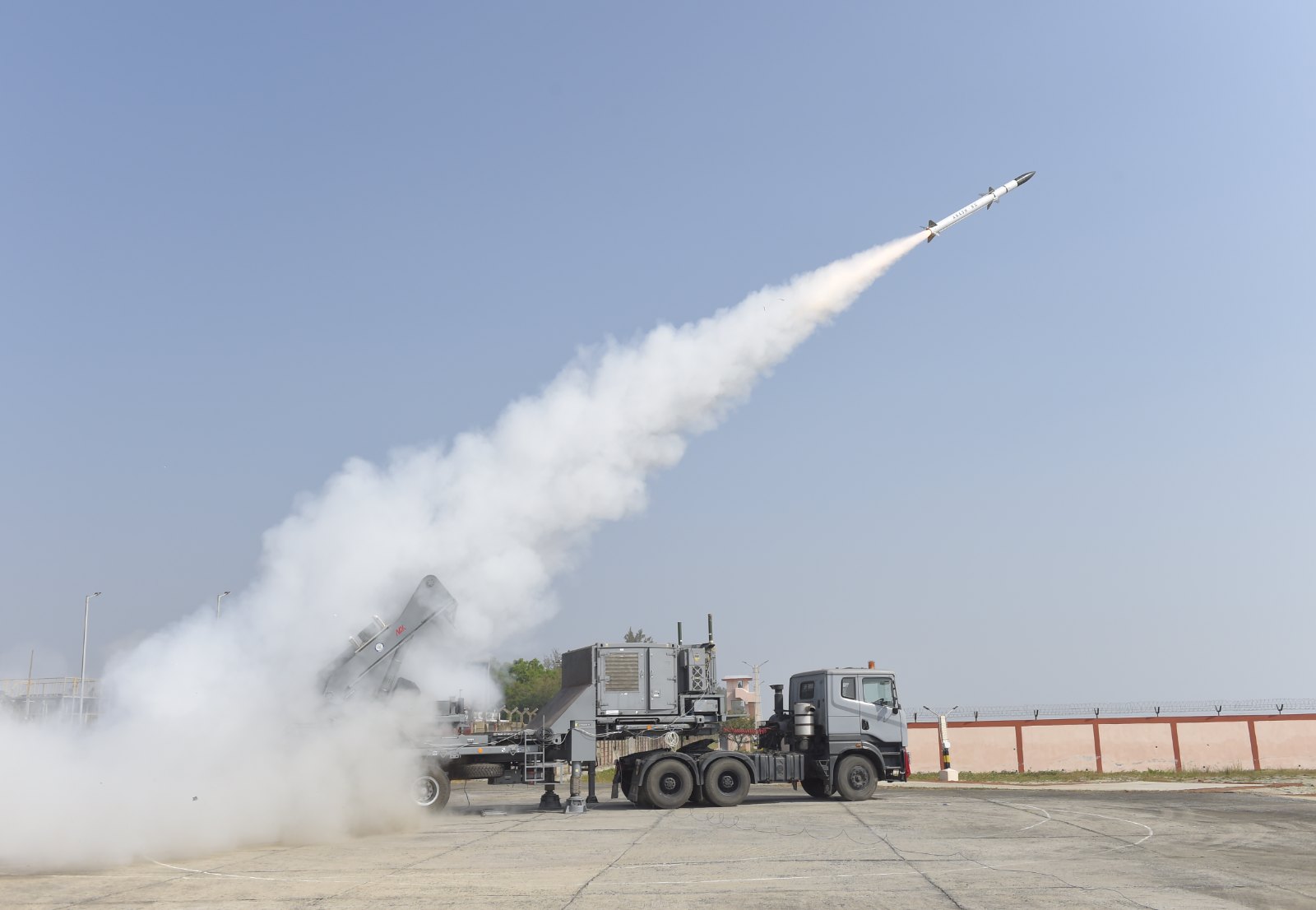
When Defence Secretary Rajesh Kumar Singh confirmed that New Delhi had secured export deals for its indigenous Akash surface-to-air missile system with Tajikistan and Turkmenistan, the official tone was characteristically restrained. Coming on the heels of earlier deliveries to Armenia, the announcement was presented primarily as a technical victory for domestic industrial policy. Yet the geographic destination of these batteries tells a far more consequential story. By placing air defence hardware into the ex-Soviet republics of Central Asia, India has quietly established a military-industrial presence in a zone long viewed by Moscow as its immediate sphere of influence and by Beijing as its exclusive economic backyard.
For decades, foreign military procurement across Central Asia was a predictable affair. Soviet legacy equipment formed the baseline, while Russia retained a near-monopoly on hardware upgrades, security guarantees, and training frameworks. In recent years, China moved aggressively to fill gaps in the region's air defense, supplying medium and long-range systems like the HQ-9 and HQ-17 to regional capitals seeking to diversify away from absolute dependence on Moscow. India was simply not on the strategic radar as a provider of advanced kinetic hardware.
That balance is shifting. The appeal of the Akash platform to middle powers like Tajikistan and Turkmenistan lies in a pragmatic mix of performance, cost, and geopolitical neutrality. Developed by the Defence Research and Development Organisation and manufactured by state-run enterprises Bharat Dynamics and Bharat Electronics, Akash is a mobile, short-to-medium-range system designed to intercept aircraft, cruise missiles, and drones up to 30 kilometres away. Crucially, its integrated Rajendra phased-array radar allows a single battery to track and engage multiple low-altitude threats simultaneously. In operational terms, it offers a robust capability at a fraction of the cost of Western, Russian, or Chinese equivalents.
Financial considerations tell only part of the story. Russia’s prolonged military engagements in Eastern Europe have severely disrupted its defense export supply chains, leaving traditional buyers across Central Asia facing systemic delays for components, maintenance, and interceptor replenishments. At the same time, governments in Dushanbe and Ashgabat remain cautious about becoming overly reliant on Chinese security architecture. Importing Indian hardware provides a neat diplomatic compromise: it upgrades defense capabilities without incurring political leverage from either major regional hegemon.
The tactical arrival of Indian air defense units alongside Chinese and Soviet platforms creates a fascinating operational paradox. Turkmenistan, for instance, now fields a layered air defense inventory that includes Chinese missile-gun systems alongside newly arrived Indian batteries. While headline observers often imagine a unified, interconnected regional air defense network, the reality on the ground is far more segmented. Indian and Chinese command-and-control systems rely on distinct software architectures, data standards, and proprietary radars. Without shared interface specifications, these platforms will operate as independent defensive layers, coordinated by human operators rather than direct machine-to-machine links.
For India, the strategic dividends extend beyond export revenue. Winning international reference customers in Central Asia establishes an enduring operational footprint. Missile systems are not point-in-time retail purchases; they anchor decades-long relationships defined by technical support, spare parts supply chains, software updates, and joint training exercises. By embedding its defense logistics inside Central Asian security structures, New Delhi secures a tangible diplomatic anchor in a key geopolitical crossroads.
This expansion mirrors a broader evolution in Indian foreign policy. Under the banner of strategic autonomy, New Delhi has moved from being the world’s largest arms importer to an increasingly assertive vendor of defense technology. Systems like the Akash SAM and the BrahMos supersonic cruise missile represent a deliberate effort to build military-industrial depth while offering global South nations an alternative to traditional bloc alignments.
Navigating this new terrain will require delicate diplomacy. Neither Beijing nor Moscow is likely to welcome a new arms supplier operating in their geographic neighborhood. Yet for Central Asian capitals seeking balance in an unstable multi-polar world, India’s emergence as a reliable defense partner presents an attractive third option. The delivery of Akash batteries may begin as a commercial transaction, but its strategic echo will resound across Eurasian geopolitics for years to come.