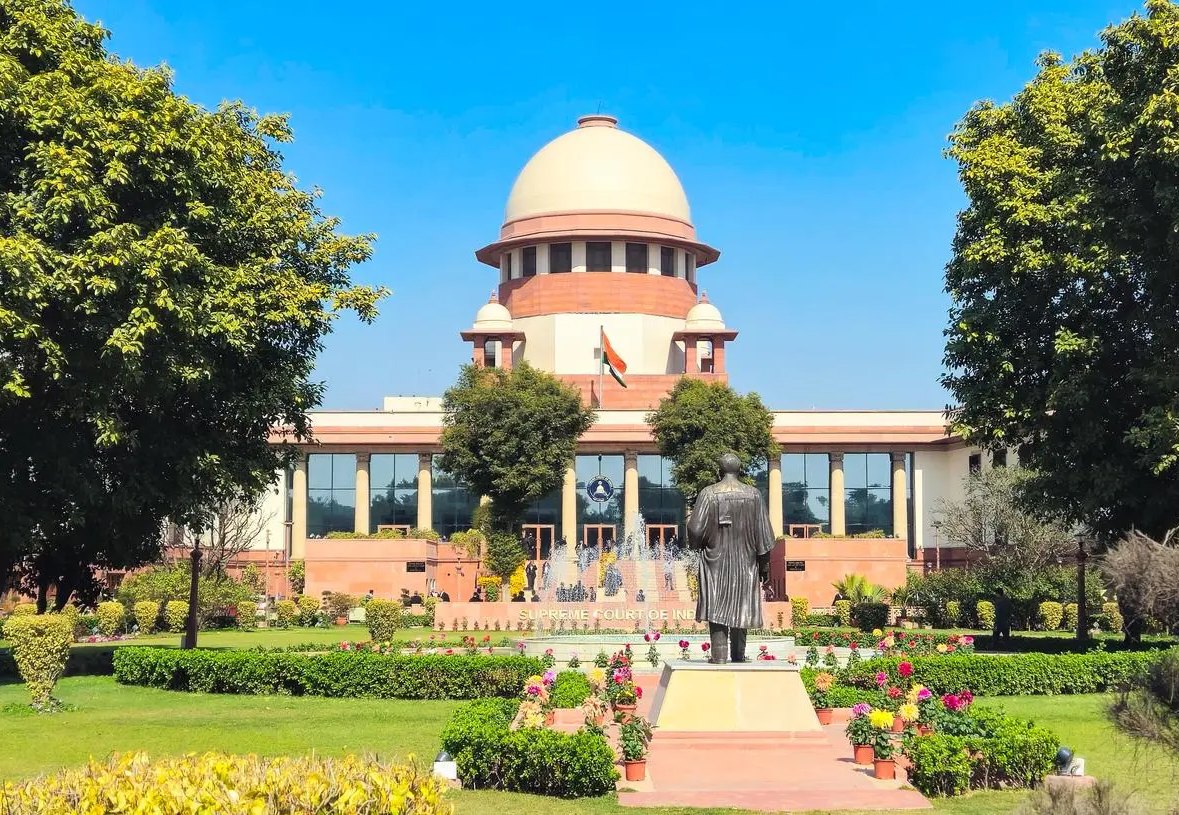
The Supreme Court of India has issued a directive regarding police arrests, addressing the gap between initial detention and formal legal procedures. Justice Ujjal Bhuyan formulated the standard specifying that the twenty-four-hour period mandated to present an arrested individual before a judicial magistrate begins the exact moment law enforcement curtails a person's freedom. This ruling targets a persistent practice within criminal jurisprudence where police detachments detain individuals informally, subject them to custodial interrogation or third-degree methods, and only record the formal arrest later.
Under Article 22 of the Constitution, anyone taken into custody must be produced promptly before a judicial magistrate. The core architecture of the criminal justice system separates the power to investigate from the power to adjudicate. Police officers possess the authority to investigate crimes and bring charges, but they lack the legal power to determine guilt or impose punishments. Adjudication remains the sole domain of the judiciary, where defense counsels and prosecutors present arguments before an impartial magistrate.
Despite these statutory safeguards, ground-level enforcement often blurs the line between detention and formal arrest. Law enforcement agencies sometimes exploit ambiguities in penal codes, keeping suspects in unofficial custody to extract confessions before logging the official arrest. Only in High-profile instances, Custody timelines and whereabouts faced public scrutiny.
The ruling establishes that the moment an officer initiates physical control or declares a detention, the twenty-four-hour clock starts ticking. While transit time required to transport a suspect from an out-of-town location to a local jurisdiction is legally excluded from this calculation, the broader intent is to eliminate undocumented holding periods.
Implementing these protections for ordinary citizens without institutional backing presents significant challenges. High-profile figures often benefit from immediate media visibility, public tracking, and social networks that deter clandestine detentions. Ordinary individuals lacking such protective backing face severe disadvantages. When a citizen without social capital is detained without proper documentation, tracing their whereabouts becomes exceedingly difficult.
The misuse of legal provisions extends beyond custody timelines to the filing of criminal charges over speech and expression. Courts have repeatedly struck down specific overreaching provisions, such as certain sections of the Information Technology Act, yet authorities continue to register cases based on political speech or commentary. Criminal charges regarding verbal statements should require a direct causal relationship or a clear spark-and-powder connection to actual violence. Charging individuals with years of prison terms simply for expressing viewpoints, absent any physical incitement, violates constitutional protections. Even after judicial reprimands, such cases continue to be filed, reflecting systemic friction between administrative overreach and constitutional liberties.
Modern technology provides a partial check against arbitrary police actions. Ubiquitous closed-circuit television cameras, mobile phone recordings by neighbors, and digital documentation make it harder for enforcement teams to operate entirely out of sight compared to past decades. These digital footprints offer a layer of defense against high-handed enforcement, ensuring that detentions leave traces.
Law enforcement agencies often defend informal interrogation methods by pointing to the practical difficulties of prosecuting hardened criminals. Investigators argue that professional offenders leave minimal physical evidence, making it nearly impossible to secure convictions without extracting admissions during early custodial interrogation. While this operational frustration contains elements of truth, the foundational principle of Indian jurisprudence maintains that it is better for numerous guilty individuals to escape than for a single innocent person to suffer wrongful punishment. Coercive interrogation risks breaking innocent individuals who might confess under extreme duress simply to escape physical torment.
India operates under a system defined by the rule of law rather than the rule of majority. Democratic governance requires that prime ministers, chief ministers, police officers, and judges alike remain strictly bound by statutory limitations. Allowing authorities to bypass legal protocols based on discretionary power subverts the constitutional framework. The Supreme Court directive reinforces that administrative convenience cannot override fundamental human rights, safeguarding the distinction between investigating an alleged offense and preserving human dignity.