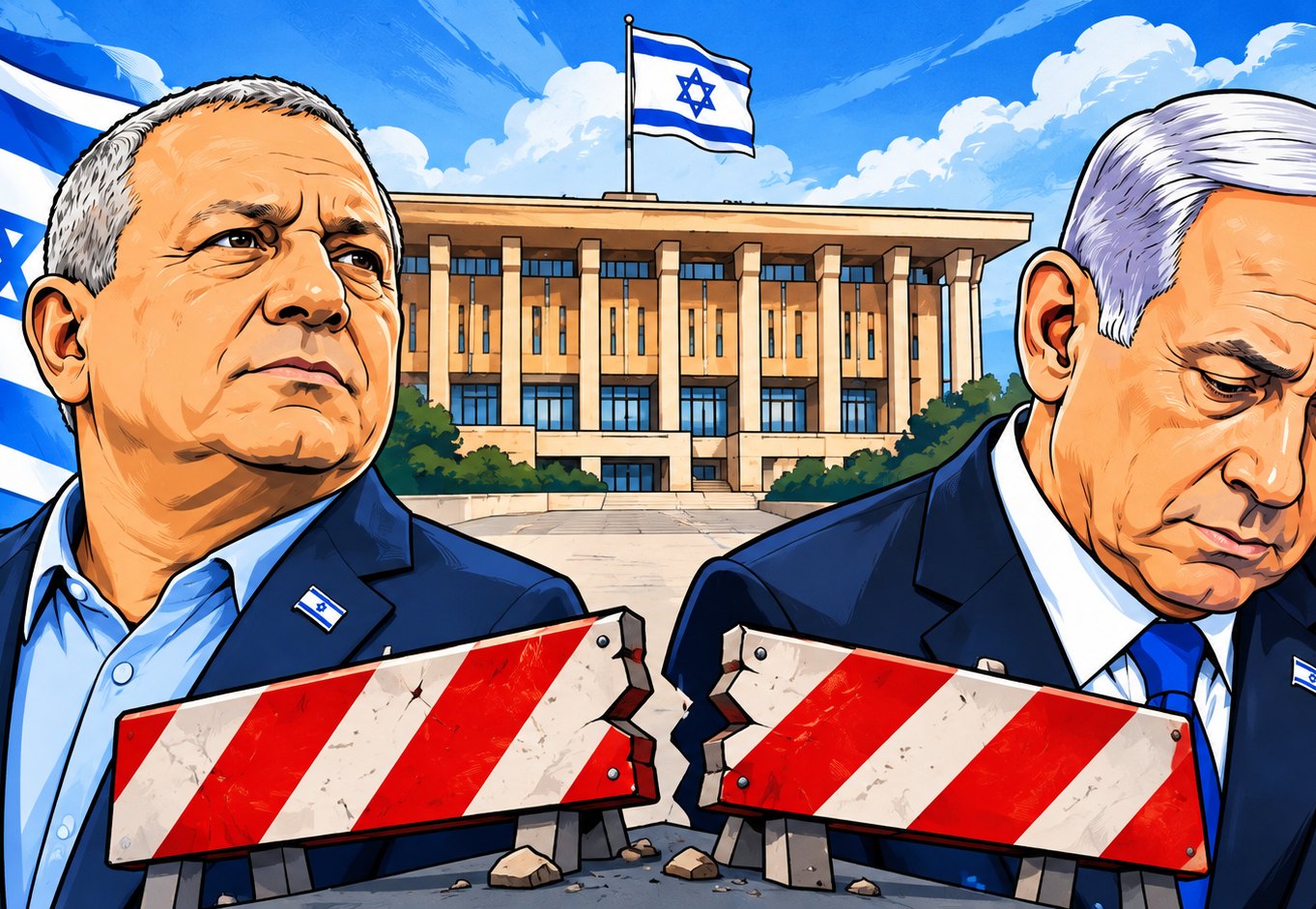
The effort by Benjamin Netanyahu to secure his position as prime minister has hit a major obstacle. The Israeli president has officially invited Gadi Eisenkot, a prominent opposition figure and rival to Netanyahu, to take the lead and attempt to form a new government. While this invitation marks a significant political shift, it does not mean Netanyahu has instantly lost power or that Eisenkot has formally taken office. Netanyahu currently remains in charge as the caretaker prime minister while coalition negotiations unfold.
Under the Israeli political framework, the president holds a crucial role following parliamentary elections. Although the presidential office is largely ceremonial, the president meets with political parties, representatives, and members of parliament to gauge which leader holds the strongest path toward forming a majority government. Once these consultations are complete, the president formally invites a designated leader to begin building a governing coalition.
The Parliamentary Arithmetic
The recent parliamentary elections resulted in a hung parliament. The right-wing coalition led by Netanyahu secured fifty-three seats, with Netanyahu's own Likud party emerging as the single largest party with twenty-seven seats. Despite being the leader of the largest single party and the largest electoral block, Netanyahu fell short of the sixty-one seats required for a majority in the one-hundred-and-twenty-member parliament.
The second-largest alliance, led by Gadi Eisenkot, secured forty-eight seats, with Eisenkot's own party accounting for twenty-one of them. Additionally, a third block consisting of two Arab parties holds nineteen seats. During consultations with the president, lawmakers representing forty-eight seats from Eisenkot's alliance, alongside nineteen Arab party law-makers, explicitly named Eisenkot as their preferred choice for prime minister. This brought a total of sixty-seven projected supportive voices, prompting the president to extend the initial opportunity of government formation to Eisenkot.
Coalition Challenges and the Arab Party Dilemma
The primary hurdle for Eisenkot lies in successfully assembling a working governing majority. While Arab party lawmakers stated their willingness to support an Eisenkot-led government, bridging that political divide presents an immense challenge.
Netanyahu has launched sharp public campaigns accusing his rivals of attempting to form a government alongside individuals he labels as terrorists. By leveraging nationalist sentiments, Netanyahu seeks to construct a political narrative framing any cooperation with Arab parties as dangerous to the state. This rhetoric creates deep structural difficulties for Eisenkot, as Israeli mainstream politics heavily orbit around Jewish majority sentiment. Even though Arab parties have moderated their stances by acknowledging Israel as a Jewish state rather than strictly a secular one, the societal atmosphere cultivated by Netanyahu makes open political partnerships extremely difficult.
Alternative Pathways and Future Scenarios
Eisenkot faces a narrow path forward, with a few distinct possibilities. One option involves relying on the support of Arab parties, either directly within a coalition framework or through outside legislative backing. However, the intense political fallout and nationalist backlash from Netanyahu's camp make this route turbulent.
A second possibility involves attempting to peel away factions from Netanyahu's existing right-wing coalition, which includes various far-right parties. Yet, ideological friction remains a barrier. While far-right politicians and Eisenkot may share similar stances regarding military actions against Hamas, they diverge sharply on broader regional questions, particularly concerning the conduct of Israeli settlers in Palestinian territories. Eisenkot, a former military chief whose family suffered personal losses during wartime, aligns with liberal and democratic principles that clash with far-right agendas.
A third scenario centers on calls for a national unity government. Netanyahu has publicly advocated for a broad Jewish unity administration to safeguard the country. Under this framework, Netanyahu would likely insist on remaining prime minister given that his faction represents the largest single bloc. However, Eisenkot has previously expressed strong resistance to serving under Netanyahu.
If these coalition efforts fail within the allotted window of several weeks, and extensions also yield no result, Israel could face fresh elections. With high voter turnout among Arab citizens driven by a desire for political change, the ongoing clash of political narratives points toward a deeply polarized future.