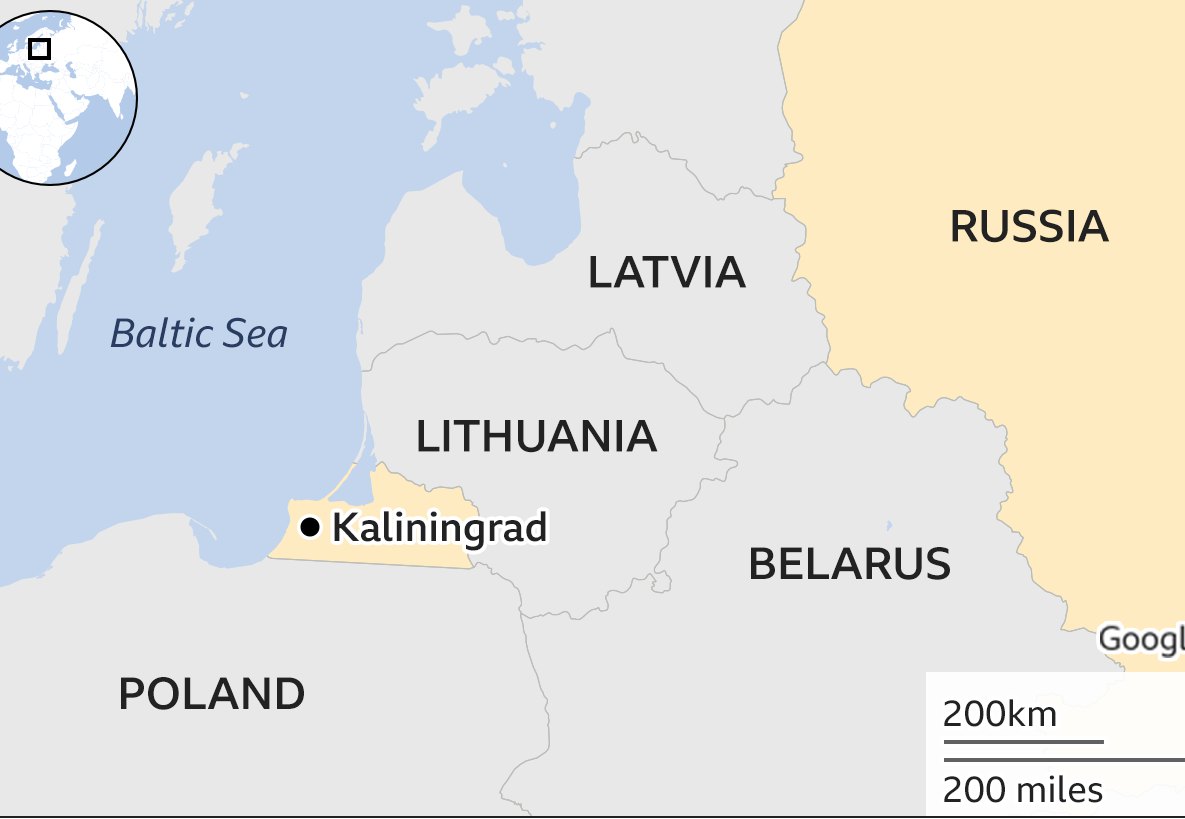
The war in Ukraine, now grinding through its fifth year, has accustomed the international community to a steady rhythm of attrition and escalation. Yet while global attention remains largely fixed on the Donbas and the Black Sea, a far more dangerous flashpoint is smouldering further north along the Baltic coast. The Russian exclave of Kaliningrad, a heavily fortified pocket of territory wedged between Poland and Lithuania, has emerged as the potential trigger for a direct confrontation between Moscow and NATO.
Long regarded by strategic analysts as a potential starting point for a broader European conflict, Kaliningrad’s unique geographic isolation and heavy militarisation present a classic security dilemma. Recent warnings from Moscow, communicated in formal written documentation to NATO rather than mere political rhetoric, signal that Russia considers any threat to the exclave an existential issue. The Kremlin has explicitly stated that any attempt to alter Kaliningrad’s status or restrict access to it could prompt a nuclear response.
To understand why a territory of roughly one million residents carries such strategic weight requires looking at the geopolitical shifts of the past eight decades. Known as Königsberg prior to 1945, the historic East Prussian city was transferred to the Soviet Union under the Potsdam Agreement following the defeat of Nazi Germany. Following the collapse of the Soviet Union in 1991, the region remained part of the Russian Federation, isolated from the mainland by hundreds of miles of foreign territory.
During the Cold War, the Baltic Sea was a shared arena where Soviet power balanced against a limited NATO footprint. In 1990, only two of the nine nations bordering the Baltic Sea belonged to the Atlantic Alliance. Today, following the accession of Finland in 2023 and Sweden in 2024, eight of those nine littoral states are NATO members. Russia stands alone.
This dramatic shift in the regional power balance has intensified insecurities on both sides. From Moscow’s perspective, Kaliningrad is an outpost surrounded by potential adversaries. Located between two staunch NATO members, Lithuania and Poland, the exclave relies heavily on land corridors running through foreign territory and sea lanes across the Baltic for its resupply and communication with mainland Russia. Kremlin strategists fear that in a period of crisis, NATO could easily establish an air and naval blockade, effectively severing the exclave from mainland Russia.
For NATO, the threat looks entirely different. Kaliningrad serves as an advanced military fortress equipped with sophisticated air defence networks, coastal missile batteries, and long-range firepower. Western military planners fear that Russia could use the enclave to project power deep into northern Europe or to close the Suwalki Gap, the narrow land corridor connecting Poland to the Baltic states. Should conflict break out, Kaliningrad places key European infrastructure, energy grids, and maritime routes within range of Russian precision strikes.
The immediate source of friction stems from recent rhetoric and military maneuvers around the Baltic. Statements by Lithuanian officials emphasizing NATO's capability to breach Kaliningrad's defences, combined with Allied air exercises held near the enclave's airspace, have heightened Russian suspicions. Plans for further NATO maneuvers in the region have only reinforced the Kremlin's view that the Alliance is testing its operational readiness around the exclave.
Concurrently, NATO members report frequent Russian probing actions, including incursions into Allied airspace and maritime zones across the Baltic Sea. These mutual intelligence-gathering missions and readiness tests create an environment where miscalculation becomes dangerously easy.
The conflict in Ukraine looms large over these developments. Had the war remained localized, regional management of Baltic security might have followed established diplomatic channels. However, the conflict altered European alignment, compelling historically neutral nations like Finland and Sweden to join NATO. Instead of checking NATO's eastward expansion, Russia’s operations in Ukraine expanded the Alliance's presence along its northern borders.
This dynamic leaves little room for error. Because Kaliningrad sits at the intersection of economic infrastructure, underwater communication cables, critical energy routes, and dense military deployments, even a minor incident could escalate rapidly. An unidentified drone, a misdirected missile, or an accidental interception in restricted airspace could provoke immediate responses before diplomatic channels can intervene.
Unlike the war in Ukraine, where Western nations have provided financial and material assistance while avoiding direct military participation, a crisis in Kaliningrad directly involves sovereign NATO territory. Under Article 5 of the North Atlantic Treaty, an attack on one member state requires a collective response from all members. Direct military engagement between Russian forces and NATO units in the Baltic would eliminate the buffer that has kept the conflict contained since 2022.
Furthermore, Kaliningrad plays a vital role in Russia's national economy. As a key warm-water port on the Baltic, it supports commercial shipping, energy exports, and supply lines that sustain domestic markets. Losing access to this coastline would force Russian cargo to detour around Northern Europe, imposing economic burdens the state can ill afford. Consequently, Russian leaders view the territory not merely as a military base, but as a critical economic lifeline.
President Vladimir Putin currently operates from a position of relative confidence on the international stage. With Russian forces holding significant territory in eastern Ukraine, Western sanction packages showing diminishing marginal returns, and Russia strengthening its trade and diplomatic ties through multilateral blocs like BRICS and the Shanghai Cooperation Organisation, Moscow feels little pressure to make concessions. In addition, shifting domestic priorities within key Western capitals have raised questions about the long-term durability of Allied strategy.
In this context, Moscow’s formal nuclear warnings over Kaliningrad reflect a firm boundary. Just as Russia declared NATO membership for Ukraine an unacceptable security risk prior to its military action, it has now marked Kaliningrad as a clear red line.
Preventing a catastrophic conflict in the Baltic will require both sides to acknowledge the fragile geography of the enclave. While NATO seeks to reassure its easternmost allies against potential aggression, actions that appear to threaten Kaliningrad’s basic connectivity run the risk of triggering the very escalation Western leaders hope to avoid. Conversely, continued Russian military signaling around the Baltic states forces NATO to strengthen its forward defence posture.
As long as the broader geopolitical standoff continues, Kaliningrad will remain one of the most volatile territories in Europe. Navigating this narrow corridor between deterrence and provocation will require strategic restraint, clear communications, and a realistic assessment of the risks involved.