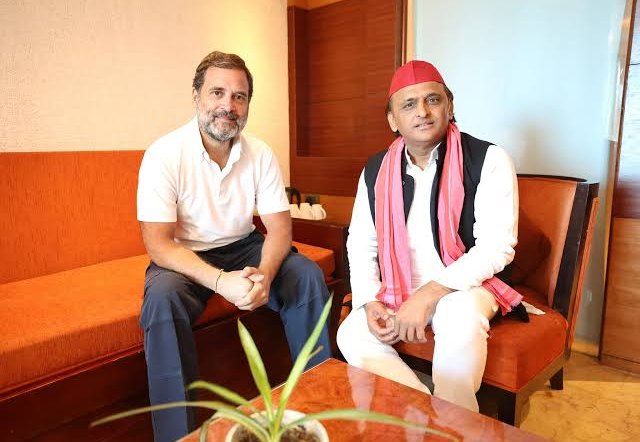
Political hubris is a resilient malady, particularly within the grand old party of Indian politics. Flush with a modest national revival in the 2024 general election and convinced that Rahul Gandhi has finally established himself as the undisputed focal point of anti-incumbency, the Indian National Congress is displaying symptoms of a familiar delusion. Fresh off calculated posturing in neighbouring Bihar, where regional strategists argue that long-term survival requires shedding constraining local alliances, elements within the Congress now look upon Uttar Pradesh with renewed, if unwarranted, entitlement. They demand a larger share of the legislative pie for the upcoming 2027 state assembly elections, pointing to national momentum, anti-vote-rigging campaigns, and visible public crowds.
Yet, confusing moral sympathy with electoral machinery is a fatal error in the cut-throat politics of India’s most populous state. For Congress to mistake its improved national optics for deep-rooted regional viability in Uttar Pradesh is not merely reckless; it risks handing the Bharatiya Janata Party (BJP) a lifeline at the precise moment the ruling party appears structurally vulnerable.
On paper, the opportunity for the opposition is genuine. The 2024 general elections severely bruised the ruling party in Uttar Pradesh. The BJP saw its Lok Sabha tally in the state plummet from 62 seats in 2019 to just 29 out of 80, allowing the Samajwadi Party (SP) and Congress alliance to secure a combined majority of seats. Losing ground in the heartland of the Ram Janmabhoomi movement stripped the BJP of its absolute parliamentary majority, forcing it into a dependent coalition at the Centre. Recent nationwide surveys consistently show that Chief Minister Yogi Adityanath’s administration faces persistent headwinds, exacerbated by youth protests, economic anxiety, and creeping disillusionment among upper-caste constituencies, particularly Brahmins, long considered part of the ruling party’s core base.
To assume that these vulnerabilities will automatically translate into an opposition victory, however, is to misread the historical mechanics of political revival. The BJP possesses an organizational machinery, a financial reservoir, and a media ecosystem capable of swift course correction. The recent state assembly elections in Maharashtra and Haryana served as a stark lesson. In both states, the Congress-led opposition celebrated victories during the parliamentary rounds, only to be crushed months later in the state-level contests once the BJP mobilized its formidable ground network. Celebrating victory while merely clearing the floor is a dangerous habit.
Preventing a similar reversal in Uttar Pradesh requires a fundamental prerequisite: a tightly sealed electoral understanding between the Samajwadi Party and Congress. But the success of such a coalition hinges entirely on which party submits to the operational realities of the state.
The stark truth is that Congress possesses neither the cadre nor the localized architecture required to convert passive sentiment into actual votes. Beyond occasional high-profile marches by Rahul Gandhi or Priyanka Gandhi Vadra, the party’s grassroots presence across Uttar Pradesh's districts and villages remains largely phantom-like. Sympathy does not staff polling booths; trained cadres do.
By contrast, Akhilesh Yadav’s Samajwadi Party retains a living, resilient organizational core that endures whether in or out of power. Like the Telugu Desam Party in Andhra Pradesh, which survived an existential decade in opposition between 2004 and 2014 before mounting a dramatic comeback, the SP possesses an emotionally loyal base that stays intact during political droughts. Parties built around institutional power collapse when out of office, a fate currently threatening regional entities that lacked cadre-based resilience. The SP, rooted in localized cadre strength, does not suffer from this fragility.
Furthermore, the SP has successfully engineered a modern social coalition that Congress cannot replicate. Historically reliant on the formidable Muslim-Yadav formula pioneered by Mulayam Singh Yadav, the younger Yadav has executed a crucial tactical expansion termed PDA, an acronym for Pichhde (backward classes), Dalit, and Alpsankhyak (minorities). By actively courting non-Yadav Backward Classes and non-Jatav Dalits, the SP broke out of its traditional caste ghetto. The most striking proof came in Faizabad, the parliamentary constituency housing Ayodhya, where the SP fielded Awadhesh Prasad, a Dalit leader, in an unreserved seat and won. This counter-engineering directly disrupted the BJP’s strategy of consolidating non-dominant backward and Dalit groups through smaller caste-based regional outfits. Congress brings no such cohesive social block to the table; its hope that Muslim voters will automatically gravitate toward a national alternative crumbles during state elections, where minority communities vote strategically for whichever party can actually defeat the BJP.
This brings the discussion to the stark reality of political polarization. In states where contestation is strictly binary, minor actors without concentrated bases are ruthlessly squeezed out. Voters evaluate state elections through a presidential lens, weighing specific regional narratives and credible leadership figures. In Uttar Pradesh, the contest for Chief Minister is unambiguously framed between Yogi Adityanath and Akhilesh Yadav. Congress offers neither a state-level narrative nor a credible chief ministerial candidate. Without a leader in the ring, expecting unattached voters to back a national banner is wishful thinking.
Does this imply that Congress is irrelevant in Uttar Pradesh? Not entirely. While the Samajwadi Party can command a vast majority of the anti-BJP vote on its own, it still requires what political analysts call the winning edge. In tightly contested elections, a margin of three to five percent can convert a narrow defeat into a decisive landslide. Congress retains residual appeal among specific pockets, including sections of upper-caste voters seeking an alternative to the BJP, as well as segments of Dalits and Muslims. In this arrangement, Congress functions much like Pawan Kalyan’s Jana Sena Party did in Andhra Pradesh: providing the critical extra margin that gave the opposition coalition complete strike-rate efficiency.
For Congress, pragmatism must outweigh pride. Taking a cue from smaller alliance partners who prioritized victory margins over total seat count, the party must willingly accept the role of a junior partner. Contesting 20 seats with an 80% win rate does far more to rebuild a party's institutional credibility than demanding 80 seats and losing 70. Rebuilding a national footprint for the 2029 Lok Sabha elections requires securing actual state legislators today.
If Congress insists on overreaching, driven by inflated estimates of its own revival, it risks fracturing the anti-incumbent vote and handing Uttar Pradesh back to the BJP on a silver platter. In the high-stakes arithmetic of the Hindi heartland, the path forward is plain: Congress must let the Samajwadi Party anchor the state, or prepare to remain an idle spectator to its own marginalization.