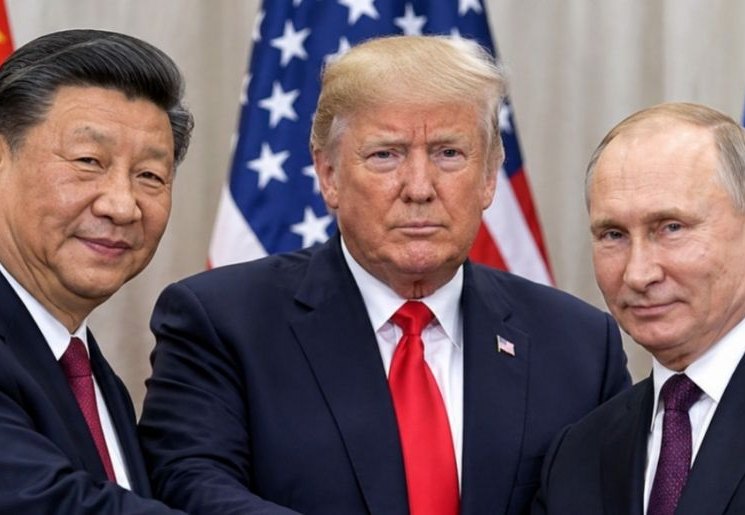
For the first time in history, the top leaders of three major global powers are set to meet. United States President Donald Trump, Russian President Vladimir Putin, and Chinese President Xi Jinping are scheduled to gather on November 19 during the Asia Pacific Economic Cooperation summit.
This upcoming gathering has drawn widespread attention, particularly regarding its historical weight and how it compares to past summits of global superpowers.
Historical Comparisons and Shifts in Global Power
The last time a similar meeting of three major power leaders occurred was in 1945, when US President Franklin D. Roosevelt, Soviet leader Joseph Stalin, and UK Prime Minister Winston Churchill convened. Comparing that historical moment to the present reveals major geopolitical shifts over the past eighty years.
Two of the original countries from 1945 remain major players today, demonstrating that core global power structures have largely endured. However, the United Kingdom has stepped back, and China has emerged as a new global power. This transition illustrates the relative decline of Europe and the rise of Asia. Furthermore, while the Soviet Union dissolved, Russia remains a key actor in international affairs despite looking different from its predecessor.
There is a fundamental difference in the backdrop between the 1945 summit and the upcoming 2026 meeting. The 1945 conference followed World War II, where the Allied victors gathered to divide and reshape the global map, leading to major territorial divisions such as the separation of Germany into the German Democratic Republic and the Federal Republic of Germany.
In contrast, the 2026 summit follows no major global war involving these three powers fighting together as allies. As a result, the current meeting carries strong symbolism rather than the substantive, map-drawing power of 1945. Furthermore, the modern world is distinctly multipolar, with influential nations like India, South Africa, and Brazil holding weight, meaning these three leaders cannot completely dictate global affairs alone.
Conflicting Agendas and Competing Interests
A defining characteristic of this upcoming meeting is the absence of a formal, circulated common agenda. Because the leaders happen to be attending the twenty-one-member Asia Pacific Economic Cooperation forum, they are holding an informal meeting. While they share broad interests, their specific national objectives often conflict or overlap in complicated ways.
The Ukraine Conflict
For Vladimir Putin, the primary focus is Ukraine. Putin's objective is to secure a deal on Ukraine that excludes Ukraine itself and bypasses European involvement, ensuring terms that favor Russian dominance.
When the Ukraine war began in 2022, Western nations and the United States anticipated that Putin would weaken, face domestic backlash, and become globally isolated. Four years later, the fact that Putin is sitting down with Trump and Xi highlights the failure of those Western calculations.
However, China is not entirely on board with Putin's approach. While Russia and China maintain close ties, their strategic interests diverge. China maintains strong relations with Europe and seeks to exploit the transatlantic divide between the United States and Europe. Beijing is unlikely to sideline Europe entirely to appease a Russian-centric deal on Ukraine. Consequently, Ukraine may not even feature prominently as a core agenda item during the talks.
The Iran Conflict
For Donald Trump, the conflict involving Iran ranks high on the agenda. Trump faces a significant political challenge regarding the Iran war, having failed to secure a clear military victory while facing domestic political pressure. Finding a respectable and honorable exit from the conflict has proven difficult.
Trump hopes to leverage the influence of Russia and China, both of which maintain good relations with Iran, to persuade Tehran to agree to a ceasefire. China also has an economic interest in ending the Iran conflict, as oil flows from the Middle East to China through the Strait of Hormuz.
Conversely, Russia benefits indirectly from the Iran conflict because it drives up global oil prices, which aids the Russian energy-export economy. This dynamic was reflected when Trump initially eased sanctions on Russia after the Iran war began, only to threaten harsh tariffs later through legislative measures like the Lindsey Graham bill. Thus, ending the Iran war is a strategic necessity for the United States and an economic necessity for China, but it remains a low priority for Russia.
Nuclear Arms Reductions
Nuclear arms control is another area where motivations differ sharply. The United States and Russia have a long history of bilateral arms agreements dating back to the Cold War era, such as the Strategic Arms Limitation Talks and the Strategic Arms Reduction Treaty. With recent treaties expiring, the United States is eager to negotiate a new nuclear agreement.
This push does not stem from pure pacifism, but rather from maintaining structural advantage. The United States possesses the largest nuclear arsenal in the world, and freezing further development helps preserve that permanent dominance. Russia, holding the second-largest arsenal, might find some common ground, but China views the matter differently.
China possesses a significantly smaller nuclear arsenal compared to the other two nations. If Beijing agreed to cap or reduce its nuclear capabilities now, it would remain permanently disadvantaged in nuclear capacity. Furthermore, China is currently modernizing its nuclear forces, giving Beijing little incentive to accept limits that freeze its growth while US dominance remains intact.
Conclusion
With such starkly contrasting priorities, including Russia's focus on Ukraine, America's push regarding Iran, and the divisions over nuclear arms control, the upcoming summit functions primarily as a high-profile diplomatic opportunity. While it serves as a powerful symbol of modern diplomacy, the fundamental differences in national agendas suggest the meeting will yield more symbolism than binding structural agreements.