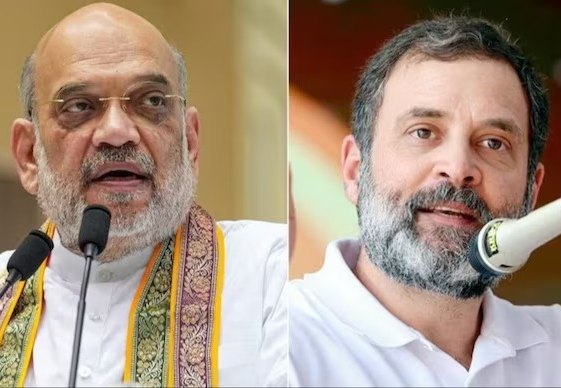
Amit Shah, recently asserted that the Congress party will remain out of power for the next thirty years. This bold declaration comes alongside specific advice directed toward Rahul Gandhi and the broader leadership of the opposition, suggesting a pivot in strategy away from international platforms toward grassroots engagement in Indian villages.
The remarks highlight a profound evolution in how major political entities frame their long term electoral objectives and opponents within the democratic ecosystem, though observers note that Rahul Gandhi has already undertaken extensive nationwide foot marches through villages during the Bharat Jodo Yatra. Furthermore, both Prime Minister Narendra Modi and the Leader of the Opposition travel abroad in their respective official capacities, making the critique of foreign visits a point of debate.
Shifting Messaging: From Erasure to Timeline Predictions
For years, the political lexicon surrounding the opposition was dominated by the Bharatiya Janata Party slogan advocating for a Congress Mukt Bharat, or a Congress free India. Terms implying total elimination suggested that the opposition force would cease to exist entirely within the country, much like historical parties that faded away over time such as the original Janata Party, Bangla Congress, Reddy Congress, Congress Urs, Bharatiya Kranti Dal, Bharatiya Socialist Party, Congress Syndicate, Swatantra party, and the Bharatiya Jana Sangh.
However, introducing a thirty year timeline introduces a stark contradiction to that earlier narrative. Suggesting that a party might return to prominence after three decades implicitly acknowledges its continued long term survival and eventual cyclical revival. Political analysts point out that wishing for the absolute extinction of any major opposition party runs contrary to the foundational principles of a healthy democracy. A robust multi party framework relies on viable counterweights to governance, and framing politics around total elimination edges uncomfortably close to authoritarian tendencies. By shifting the rhetoric from total eradication to a delayed return, the ruling establishment has tacitly adjusted its tactical assessment of the opposition's endurance.
The Enduring National Footprint of the Congress Party
Examining the broader trajectory of Indian electoral politics reveals how the Congress party has transitioned from an era of undisputed single party dominance to navigating a complex landscape of non Congress alternatives and coalition alliances. Even when its parliamentary dominance fractured following the nineteen seventy seven Janata Party victory, and later shifted into coalition wars against BJP led alliances, the Congress never became politically irrelevant.
Today, the Congress remains the primary challenger to the BJP in roughly two hundred parliamentary constituencies, with Rahul Gandhi standing as the main opposition figure. A critical examination of India's political geography shows that sustaining a presence beyond a single home state remains an immense hurdle for most regional parties.
In contrast, despite suffering severe electoral reversals in regions like undivided Andhra Pradesh where its vote share dropped near one percent, the Congress party retains active governmental control in states like Kerala, Telangana, Karnataka, and Himachal Pradesh, alongside participating in ruling coalitions in Tamil Nadu and Jharkhand. This structural reality makes complete political marginalization statistically improbable.
The Fluidity of Electoral Fortunes
Political fortunes in a vibrant democracy are inherently fluid rather than static. History shows that a political movement centered around Lord Ram grew from winning just two parliamentary seats decades ago to crossing three hundred seats, only to face fresh electoral challenges in its own heartland. Similarly, long standing administrations like the thirty four year Left Front rule in West Bengal under Jyoti Basu and Buddhadeb Bhattacharjee eventually gave way to the Trinamool Congress, while leaders like Chandrababu Naidu also spoke of multi decade tenures that proved subject to electoral shifts.
Voter sentiment can swing dramatically within the span of a few months between legislative assembly elections and national parliamentary contests. For instance, the Bharat Rashtra Samithi secured thirty seven percent of the vote in the twenty twenty three Telangana assembly elections, only to see that share drop to seventeen percent in the twenty twenty four Lok Sabha polls. In the same vein, the Telugu Desam Party won fifteen seats in the twenty fourteen Telangana assembly elections before eventually losing its organizational presence in the state.
Ultimately, claiming that any major political force is destined for a specific thirty year exile overlooks the unpredictable nature of democratic competition. As historical precedents and traditional Telugu proverbs remind observers, political tides shift continuously, and rigid timelines often underestimate the capacity of organizations to adapt, reorganize, and reconnect with the electorate.