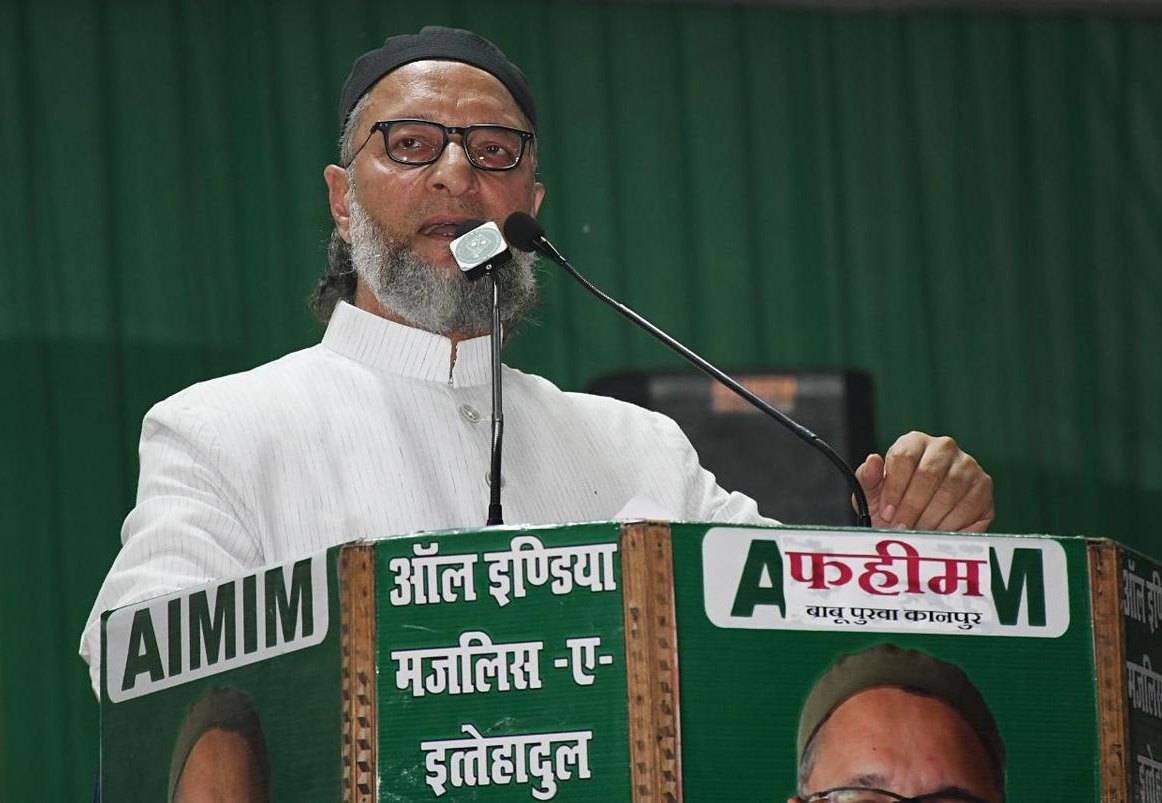
Secular and non-BJP political parties face mounting anxiety over the expanding electoral footprint and alliance strategy of the All India Majlis-e-Ittehadul Muslimeen (MIM) led by Asaduddin Owaisi. While the party's vote shares in states outside its core base often appear modest at roughly one percent or less, its gradual expansion and coalition arithmetic threaten tight contests where narrow margins decide outcomes.
A decade-long look at MIM's electoral record since the Bharatiya Janata Party (BJP) came to power at the center in 2014 shows steady, incremental movement rather than sudden leaps. In the 2014 Maharashtra assembly elections, MIM contested 24 seats, won two, finished second in three, and recorded a 0.93 percent vote share. In 2019, contesting 44 seats pushed its vote share to 1.34 percent while it again won two seats and finished second in four. In the 2024 Maharashtra assembly elections, MIM contested 17 seats, won one, polled 0.85 percent, and came second in five constituencies. Across those cycles, exact vote percentages shifted with the number of seats contested, yet the party stayed near or slightly below one percent while consistently increasing the number of runner-up finishes from three to four to five, with notable vote tallies in seats such as Malegaon Central, Aurangabad Central, and Nanded.
Bihar has shown a similar pattern of steady grounding despite defections among elected representatives. In the 2020 Bihar assembly elections, MIM contested 20 seats, won five on a 1.24 percent vote share, and later saw four of those MLAs switch to the Rashtriya Janata Dal (RJD). Even after those defections, MIM retained five seats in the 2025 assembly elections while contesting 28 seats and lifting its vote share to 1.85 percent. Beyond the five wins, the party placed second in two seats and third in 13 seats in 2025, showing that its voter base remained intact even when leaders crossed over.
Secular parties worry less about whether MIM wins large numbers of seats on its own and more about how its presence affects close races. Muslim voters tend to lean heavily toward non-BJP parties, and Dalit voters also form a significant share of non-BJP support in many seats. When MIM contests more seats and draws even a modest slice of votes, or pairs with Dalit partners, it can tip closely fought contests against secular candidates.
Alliance politics amplifies that concern. In Uttar Pradesh, MIM has pursued a Muslim-Dalit combination and aligned with Azad Samaj Party leader Chandrashekhar Azad, where Muslims and Dalits together account for roughly 40 percent of the electorate. The tactic builds on earlier moves rather than starting from scratch in Uttar Pradesh. In the 2015 Aurangabad municipal corporation elections, MIM fielded 13 Dalit candidates and helped win five reserved seats, and in Hyderabad the city's first Dalit mayor was an MIM candidate.
At the heart of the political clash is a sharp debate over representation, welfare, and fairness. Owaisi and MIM argue that self-described secular parties have treated Muslims as a vote bank while delivering limited economic empowerment or political share. They point to persistent poverty among Muslims, lower-income jobs, under-developed Muslim localities, and shrinking Muslim representation since the rise of Narendra Modi and the BJP, including among secular parties such as the Congress. In Telangana, where Muslims make up about 14 percent of the population, there were no Muslim MLAs from Congress and no Muslim minister until Mohammed Azharuddin was brought into the council of ministers during Jubilee Hills bypoll. In Bihar, where Muslims make up roughly 19 to 20 percent of the population, Tejashwi Yadav did not promise a deputy chief minister post from the community while a deputy chief minister role was announced for a group with around 3 percent voting strength. That argument resonates increasingly among educated, middle-class, and politically aware Muslim voters.
Secular parties are caught in a bind over how to respond. Increasing Muslim representation and prominence risks triggering Hindu consolidation by the BJP, yet keeping representation low hands Owaisi an effective grievance to campaign on. When secular parties blame MIM for splitting votes and causing defeats, Owaisi pushes back by asking why Muslims should be asked to sacrifice their own political interests for those parties.
At the same time, critics and secular parties point to a sharp contrast in MIM's approach in Telangana compared with other states. In the 2022 Uttar Pradesh assembly elections, MIM contested 95 seats without winning any, polling 0.49 percent overall while crossing 10,000 votes in at least six constituencies. By contrast, in Telangana, where MIM wins around seven MLAs, it contested 20 seats in 2014, eight in 2018, and nine in 2023. Critics contend that MIM contests sparingly in Telangana to suit ruling secular parties there while contesting widely elsewhere in ways that hurt secular rivals and benefit the BJP, turning Hyderabad into a secure base without facing strong pushback from either the central BJP government or state-level secular governments. While MIM replies that roughly 52 percent of Telangana's Muslims are concentrated in Hyderabad, critics note that half of the state's Muslims live outside Hyderabad and Rangareddy districts, and that Muslims and Dalits together make up over 30 percent of Telangana's population without a comparable statewide Dalit-Muslim push there, leading detractors to argue the strategy is driven by political calculations rather than Muslim welfare alone.